Gray Lachlan R, Turville Stuart G, Hitchen Tina L, Cheng Wan-Jung, Ellett Anne M, Salimi Hamid, Roche Michael J, Wesselingh Steve L, Gorry Paul R, Churchill Melissa J
Centre for Biomedical Research, Burnet Institute, Melbourne, Victoria, Australia ; Department of Biochemistry and Molecular Biology, Monash University, Victoria, Australia.
The Kirby Institute, Darlinghurst, New South Wales, Australia.
PLoS One. 2014 Feb 28;9(2):e90620. doi: 10.1371/journal.pone.0090620. eCollection 2014.
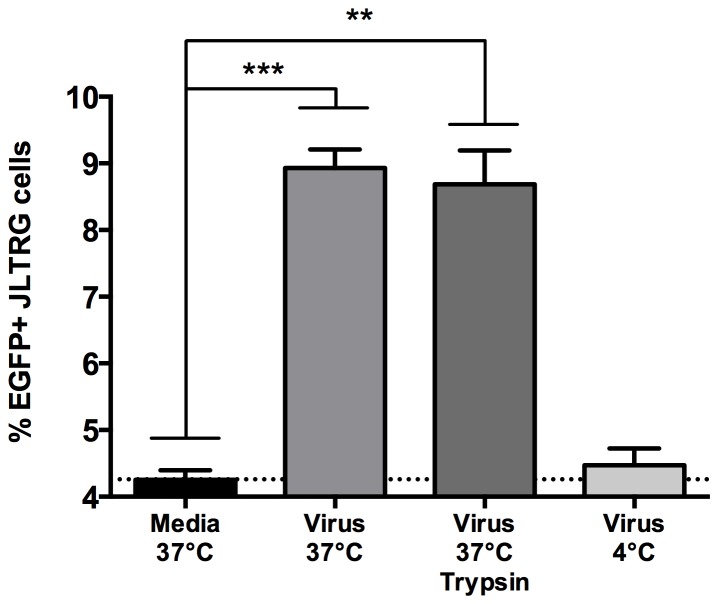
Astrocytes are extensively infected with HIV-1 in vivo and play a significant role in the development of HIV-1-associated neurocognitive disorders. Despite their extensive infection, little is known about how astrocytes become infected, since they lack cell surface CD4 expression. In the present study, we investigated the fate of HIV-1 upon infection of astrocytes. Astrocytes were found to bind and harbor virus followed by biphasic decay, with HIV-1 detectable out to 72 hours. HIV-1 was observed to associate with CD81-lined vesicle structures. shRNA silencing of CD81 resulted in less cell-associated virus but no loss of co-localization between HIV-1 and CD81. Astrocytes supported trans-infection of HIV-1 to T-cells without de novo virus production, and the virus-containing compartment required 37°C to form, and was trypsin-resistant. The CD81 compartment observed herein, has been shown in other cell types to be a relatively protective compartment. Within astrocytes, this compartment may be actively involved in virus entry and/or spread. The ability of astrocytes to transfer virus, without de novo viral synthesis suggests they are capable of sequestering and protecting virus and thus, they could potentially facilitate viral dissemination in the CNS.
在体内,星形胶质细胞会被HIV-1广泛感染,并在HIV-1相关神经认知障碍的发展中发挥重要作用。尽管它们被广泛感染,但由于星形胶质细胞缺乏细胞表面CD4表达,关于它们如何被感染的了解甚少。在本研究中,我们调查了HIV-1感染星形胶质细胞后的命运。发现星形胶质细胞会结合并容纳病毒,随后呈双相衰减,在72小时内都可检测到HIV-1。观察到HIV-1与CD81内衬的囊泡结构相关联。对CD81进行shRNA沉默导致细胞相关病毒减少,但HIV-1与CD81之间的共定位没有丧失。星形胶质细胞支持HIV-1向T细胞的转染,而无需重新产生病毒,并且含病毒区室的形成需要37°C,且对胰蛋白酶具有抗性。本文观察到的CD81区室在其他细胞类型中已被证明是一个相对具有保护作用的区室。在星形胶质细胞内,该区室可能积极参与病毒的进入和/或传播。星形胶质细胞在没有重新进行病毒合成的情况下转移病毒的能力表明它们能够隔离和保护病毒,因此,它们可能会促进病毒在中枢神经系统中的传播。