Ash Michelle K, Al-Harthi Lena, Schneider Jeffrey R
Department of Microbial Pathogens and Immunity, Rush University Medical Center, Chicago, IL 60612, USA.
Vaccines (Basel). 2021 Aug 5;9(8):867. doi: 10.3390/vaccines9080867.
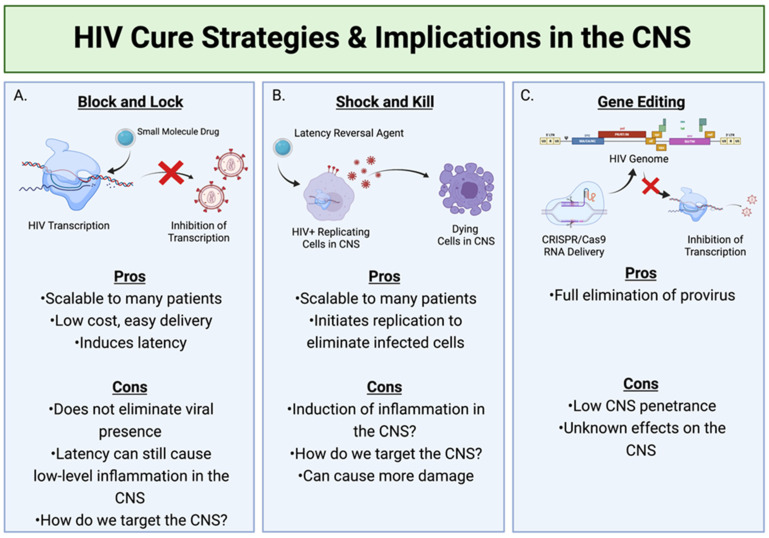
Advances in antiretroviral therapy have prolonged the life of people living with HIV and diminished the level of virus in these individuals. Yet, HIV quickly rebounds after disruption and/or cessation of treatment due to significant cellular and anatomical reservoirs for HIV, which underscores the challenge for HIV cure strategies. The central nervous system (CNS), in particular, is seeded with HIV within 1-2 weeks of infection and is a reservoir for HIV. In this review, we address the paradigm of HIV reservoirs in the CNS and the relevant cell types, including astrocytes and microglia, that have been shown to harbor viral infection even with antiretroviral treatment. In particular, we focus on developmental aspects of astrocytes and microglia that lead to their susceptibility to infection, and how HIV infection propagates among these cells. We also address challenges of measuring the HIV latent reservoir, advances in viral detection assays, and how curative strategies have evolved in regard to the CNS reservoir. Current curative strategies still require optimization to reduce or eliminate the HIV CNS reservoir, and may also contribute to levels of neuroinflammation that lead to cognitive decline. With this in mind, the latent HIV reservoir in the brain should remain a prominent focus when assessing treatment options and overall viral burden in the clinic, especially in the context of HIV-associated neurocognitive disorders (HAND).
抗逆转录病毒疗法的进展延长了艾滋病毒感染者的寿命,并降低了这些人体内的病毒水平。然而,由于艾滋病毒存在大量细胞和解剖学上的储存库,在治疗中断和/或停止后,艾滋病毒会迅速反弹,这凸显了艾滋病毒治愈策略面临的挑战。特别是中枢神经系统(CNS),在感染后的1-2周内就会被艾滋病毒感染,并且是艾滋病毒的一个储存库。在这篇综述中,我们探讨了中枢神经系统中艾滋病毒储存库的模式以及相关的细胞类型,包括星形胶质细胞和小胶质细胞,即使在接受抗逆转录病毒治疗的情况下,这些细胞也被证明携带着病毒感染。特别是,我们关注星形胶质细胞和小胶质细胞的发育方面,这些方面导致它们易受感染,以及艾滋病毒感染如何在这些细胞之间传播。我们还讨论了测量艾滋病毒潜伏储存库的挑战、病毒检测方法的进展,以及针对中枢神经系统储存库的治愈策略是如何演变的。目前的治愈策略仍需优化,以减少或消除艾滋病毒中枢神经系统储存库,并且还可能导致神经炎症水平升高,进而导致认知能力下降。考虑到这一点,在临床评估治疗方案和总体病毒负担时,尤其是在艾滋病毒相关神经认知障碍(HAND)的背景下,大脑中潜伏的艾滋病毒储存库应仍然是一个突出的重点。