Department of Pediatrics, Dong-A University, College of Medicine, Busan, Korea.
Department of Pediatrics, Pusan National University School of Medicine, Yangsan, Korea.
Allergy Asthma Immunol Res. 2014 Mar;6(2):126-30. doi: 10.4168/aair.2014.6.2.126. Epub 2013 Nov 15.
Transient tachypnea of the newborn (TTN) is a disorder caused by the delayed clearance of fetal alveolar fluid. β-adrenergic agonists such as albuterol (salbutamol) are known to catalyze lung fluid absorption. This study examined whether inhalational salbutamol therapy could improve clinical symptoms in TTN. Additional endpoints included the diagnostic and therapeutic efficacy of salbutamol as well as its overall safety.
From January 2010 through December 2010, we conducted a prospective study of 40 newborns hospitalized with TTN in the neonatal intensive care unit. Patients were given either inhalational salbutamol (28 patients) or placebo (12 patients), and clinical indices were compared.
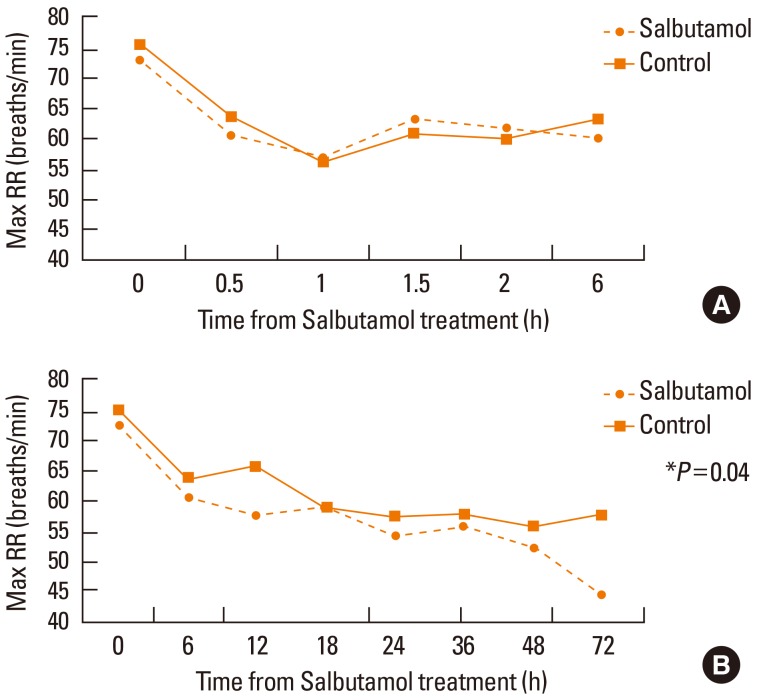
The duration of tachypnea was shorter in patients receiving inhalational salbutamol therapy, although this difference was not statistically significant. The duration of supplemental oxygen therapy and the duration of empiric antibiotic treatment were significantly shorter in the salbutamol-treated group. No adverse effects were observed in either treatment group.
Inhalational salbutamol therapy reduced the duration of supplemental oxygen therapy and the duration of empiric antibiotic treatment, with no adverse effects. However, the time between salbutamol therapy and clinical improvement was too long to allow definitive conclusions to be drawn. Further studies examining a larger number of patients with strict control over dosage and frequency of salbutamol inhalations are necessary to better direct the treatment of TTN.
新生儿暂时性呼吸急促(TTN)是一种由胎儿肺泡液清除延迟引起的疾病。β-肾上腺素能激动剂如沙丁胺醇(舒喘灵)已知可促进肺液吸收。本研究探讨了吸入沙丁胺醇治疗是否能改善 TTN 的临床症状。其他终点包括沙丁胺醇的诊断和治疗效果及其总体安全性。
从 2010 年 1 月至 2010 年 12 月,我们对新生儿重症监护病房收治的 40 例 TTN 新生儿进行了前瞻性研究。患者接受吸入沙丁胺醇(28 例)或安慰剂(12 例)治疗,并比较临床指标。
接受吸入沙丁胺醇治疗的患者呼吸急促持续时间较短,但差异无统计学意义。沙丁胺醇治疗组的吸氧时间和经验性抗生素治疗时间明显缩短。两组均未观察到不良反应。
吸入沙丁胺醇治疗可缩短吸氧时间和经验性抗生素治疗时间,无不良反应。然而,从沙丁胺醇治疗到临床改善的时间过长,无法得出明确的结论。进一步的研究需要检查更多的患者,严格控制沙丁胺醇的剂量和吸入频率,以更好地指导 TTN 的治疗。