Garcia Danilo, Nima Ali Al, Rappe Catrin, Rapp Ricciardi Max, Archer Trevor
Network for Empowerment and Well-Being, University of Gothenburg, Gothenburg, Sweden; Center for Ethics, Law and Mental Health (CELAM), University of Gothenburg, Gothenburg, Sweden.
Network for Empowerment and Well-Being, University of Gothenburg, Gothenburg, Sweden; Department of Psychology, University of Gothenburg, Gothenburg, Sweden.
PLoS One. 2014 Mar 4;9(3):e90309. doi: 10.1371/journal.pone.0090309. eCollection 2014.
Personality measures in recruitment situations need to (1) cover the Big-Five model of personality and (2) focus on interpersonal requirements of jobs. We investigated the relationship between the JobMatchTalent test and the NEO Personality Inventory-Revised (NEO PI-R). The JobMatchTalent consists of three areas (i.e., Stability Patterns, Action Patterns, and Relation Patterns) divided in 10 main scales providing a deeper picture of the employee (e.g., Work Structure, Tolerance).
The participants (N = 390) were recruited from the professional network LinkedIn and completed online versions of both instruments. We used correlation analysis to investigate the construct validity of the JobMatchTalent test by identifying significant correlation coefficients no lower than ±.30 (i.e., convergent validity) and those with nonsignificant correlations (i.e., discriminant validity). Regression analyses were used to investigate the variance of the NEO PI-R dimensions that was explained by the JobMatchTalent test.
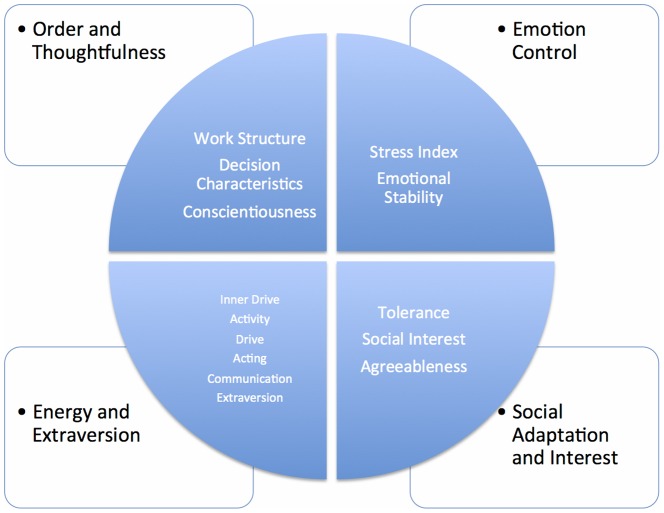
Four of the NEO PI-R dimensions showed considerable overlap with the following JobMatchTalent main scales: (1) Work structure and Decision Characteristics, which both are measures of thoughtfulness, planning, and order (i.e., Conscientiousness); (2) Inner drive, Activity, Drive, Acting, and Communication, which represent different aspects of being outgoing and extrovert (i.e., Extraversion); (3) Tolerance and Social interest, which measure a person's interest and ability to create social relations (i.e., Agreeableness); and (4) Stress Index, a measure of emotional stability (i.e., the opposite of Neuroticism). All 5 NEO PI-R dimensions overlapped with the JobMatchTalent sub-scales.
The study suggests that 4 of the NEO PI-R dimensions are logically categorized along the JobMatchTalent main scales: (1) Order and Thoughtfulness, (2) Energy and Extraversion, (3) Social Adaptation and Interest, and (4) Emotion Control. Hence, it suggests substantial overlap between the instruments, but also that the two instruments cannot be considered as equivalent to assess individual differences in recruitment situations.
招聘情境中的人格测评需要(1)涵盖人格的大五模型,(2)关注工作的人际要求。我们研究了JobMatchTalent测试与修订版大五人格量表(NEO PI-R)之间的关系。JobMatchTalent由三个领域(即稳定性模式、行动模式和关系模式)组成,分为10个主要量表,能更深入地描绘员工(如工作结构、耐受性)。
参与者(N = 390)从专业社交网络领英招募,完成了两种工具的在线版本。我们使用相关分析,通过识别不低于±0.30的显著相关系数(即收敛效度)和不显著相关的系数(即区分效度)来研究JobMatchTalent测试的结构效度。回归分析用于研究由JobMatchTalent测试解释的NEO PI-R维度的方差。
NEO PI-R的四个维度与以下JobMatchTalent主要量表有相当大的重叠:(1)工作结构和决策特征,两者都是对深思熟虑、计划和秩序的测量(即尽责性);(2)内在动力、活力、驱动力、行动和沟通,代表外向和外向的不同方面(即外向性);(3)耐受性和社会兴趣,测量一个人建立社会关系的兴趣和能力(即宜人性);(4)压力指数,一种情绪稳定性的测量(即神经质的反面)。所有5个NEO PI-R维度都与JobMatchTalent子量表重叠。
该研究表明,NEO PI-R的四个维度在逻辑上可按照JobMatchTalent主要量表进行分类:(1)秩序和深思熟虑,(2)活力和外向性,(3)社会适应和兴趣,(4)情绪控制。因此,这表明两种工具之间有大量重叠,但也表明在招聘情境中不能将这两种工具视为等效来评估个体差异。