Department of Biophysics, Graduate School of Science, Kyoto University Kitashirakawa-Oiwake-cho Kyoto, Japan.
Graduate School of Brain Science, Doshisha University Kyoto, Japan.
Front Cell Neurosci. 2014 Feb 18;8:42. doi: 10.3389/fncel.2014.00042. eCollection 2014.
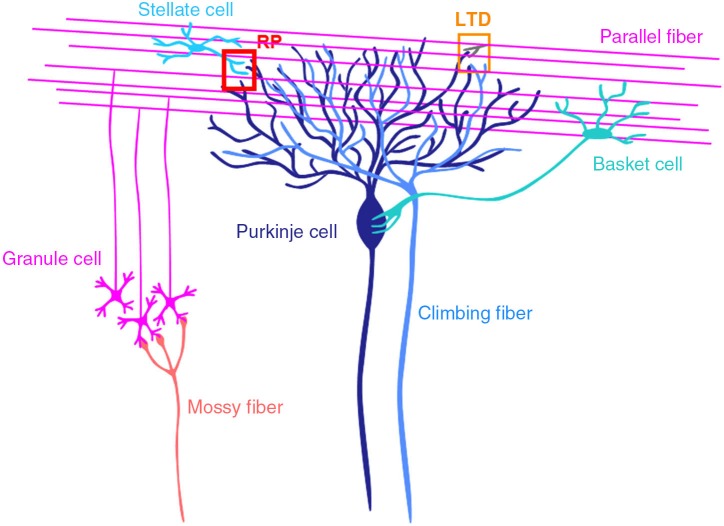
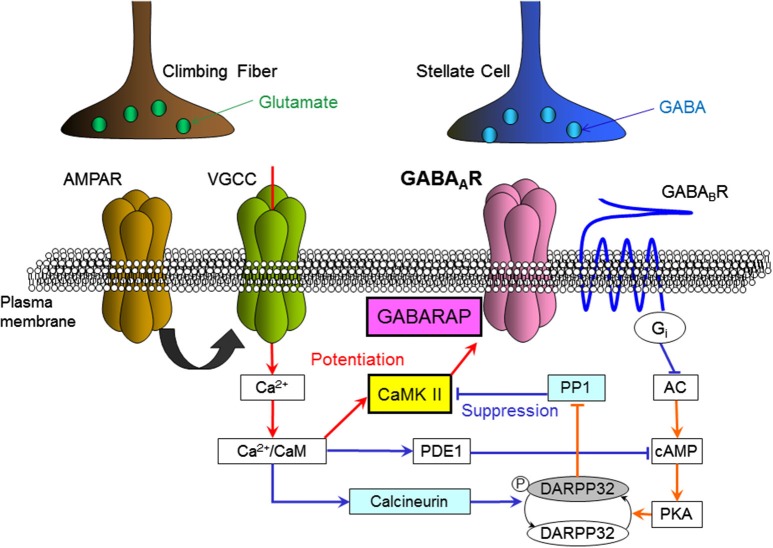
Purkinje cells receive both excitatory and inhibitory synaptic inputs and send sole output from the cerebellar cortex. Long-term depression (LTD), a type of synaptic plasticity, at excitatory parallel fiber-Purkinje cell synapses has been studied extensively as a primary cellular mechanism of motor learning. On the other hand, at inhibitory synapses on a Purkinje cell, postsynaptic depolarization induces long-lasting potentiation of GABAergic synaptic transmission. This synaptic plasticity is called rebound potentiation (RP), and its molecular regulatory mechanisms have been studied. The increase in intracellular Ca(2+) concentration caused by depolarization induces RP through enhancement of GABAA receptor (GABAAR) responsiveness. RP induction depends on binding of GABAAR with GABAAR associated protein (GABARAP) which is regulated by Ca(2+)/calmodulin-dependent kinase II (CaMKII). Whether RP is induced or not is determined by the balance between phosphorylation and de-phosphorylation activities regulated by intracellular Ca(2+) and by metabotropic GABA and glutamate receptors. Recent studies have revealed that the subunit composition of CaMKII has significant impact on RP induction. A Purkinje cell expresses both α- and β-CaMKII, and the latter has much higher affinity for Ca(2+)/calmodulin than the former. It was shown that when the relative amount of α- to β-CaMKII is large, RP induction is suppressed. The functional significance of RP has also been studied using transgenic mice in which a peptide inhibiting association of GABARAP and GABAAR is expressed selectively in Purkinje cells. The transgenic mice show abrogation of RP and subnormal adaptation of vestibulo-ocular reflex (VOR), a type of motor learning. Thus, RP is involved in a certain type of motor learning.
浦肯野细胞接收兴奋性和抑制性突触输入,并从小脑皮层发送唯一的输出。兴奋性平行纤维-浦肯野细胞突触的长时程抑制(LTD)作为运动学习的主要细胞机制已被广泛研究。另一方面,在浦肯野细胞上的抑制性突触上,突触后去极化诱导 GABA 能突触传递的长时程增强。这种突触可塑性称为反弹增强(RP),其分子调节机制已被研究。去极化引起的细胞内 Ca(2+)浓度增加通过增强 GABAA 受体(GABAAR)的反应性来诱导 RP。RP 诱导取决于 GABAAR 与 GABAAR 相关蛋白(GABARAP)的结合,GABARAP 的调节受 Ca(2+)/钙调蛋白依赖性激酶 II(CaMKII)调节。是否诱导 RP 取决于由细胞内 Ca(2+)和代谢型 GABA 和谷氨酸受体调节的磷酸化和去磷酸化活性之间的平衡。最近的研究表明,CaMKII 的亚基组成对 RP 诱导有重大影响。浦肯野细胞表达 α-和 β-CaMKII,后者对 Ca(2+)/钙调蛋白的亲和力比前者高得多。研究表明,当 α-CaMKII 与 β-CaMKII 的相对量较大时,RP 诱导被抑制。使用选择性在浦肯野细胞中表达抑制 GABARAP 和 GABAAR 结合的肽的转基因小鼠研究了 RP 的功能意义。转基因小鼠显示 RP 缺失和前庭眼反射(VOR)的适应不良,VOR 是一种运动学习。因此,RP 参与了某种类型的运动学习。