Shinomiya Ai, Shimmura Tsuyoshi, Nishiwaki-Ohkawa Taeko, Yoshimura Takashi
Division of Seasonal Biology, National Institute for Basic Biology , Okazaki , Japan.
Division of Seasonal Biology, National Institute for Basic Biology , Okazaki , Japan ; Laboratory of Animal Physiology, Graduate School of Bioagricultural Sciences, Nagoya University , Nagoya , Japan.
Front Endocrinol (Lausanne). 2014 Feb 21;5:12. doi: 10.3389/fendo.2014.00012. eCollection 2014.
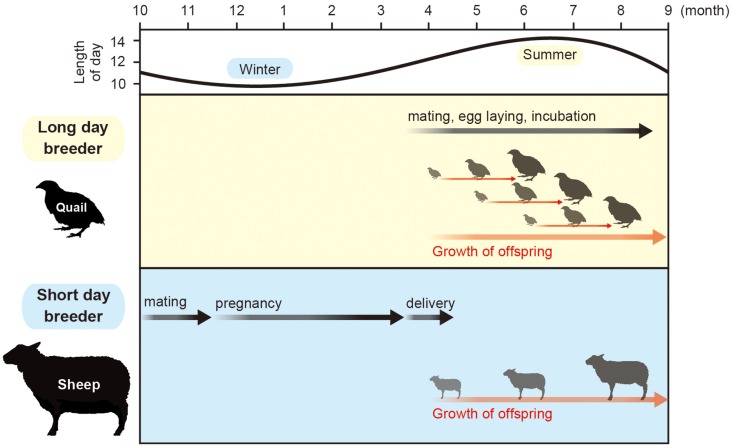
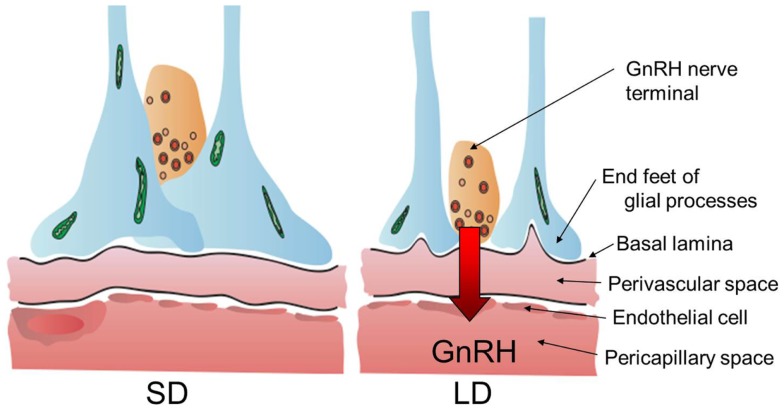
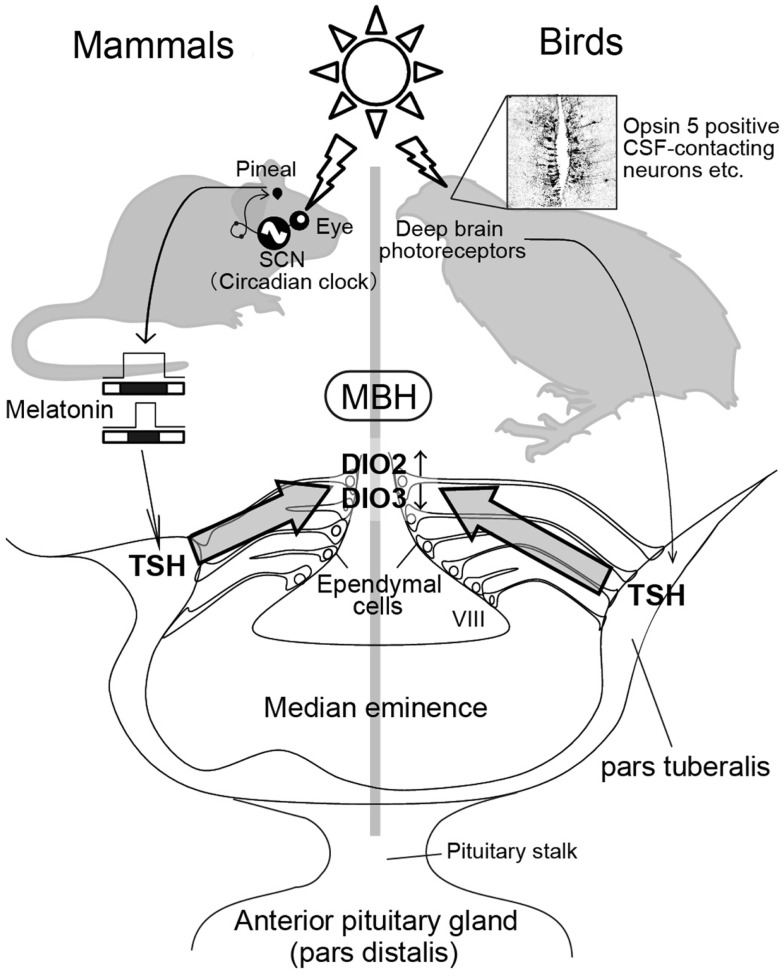
Organisms living outside the tropics measure the changes in the length of the day to adapt to seasonal changes in the environment. Animals that breed during spring and summer are called long-day breeders, while those that breed during fall are called short-day breeders. Although the influence of thyroid hormone in the regulation of seasonal reproduction has been known for several decades, its precise mechanism remained unknown. Recent studies revealed that the activation of thyroid hormone within the mediobasal hypothalamus plays a key role in this phenomenon. This localized activation of the thyroid hormone is controlled by thyrotropin (thyroid-stimulating hormone) secreted from the pars tuberalis of the pituitary gland. Although seasonal reproduction is a rate-limiting factor in animal production, genes involved in photoperiodic signal transduction pathway could emerge as potential targets to facilitate domestication.
生活在热带以外地区的生物通过测量白昼时长的变化来适应环境的季节性变化。在春季和夏季繁殖的动物被称为长日照繁殖者,而在秋季繁殖的动物则被称为短日照繁殖者。尽管甲状腺激素在季节性繁殖调节中的作用已为人所知数十年,但其确切机制仍不清楚。最近的研究表明,下丘脑中间基底部甲状腺激素的激活在这一现象中起关键作用。甲状腺激素的这种局部激活受垂体结节部分泌的促甲状腺激素控制。尽管季节性繁殖是动物生产中的一个限制因素,但参与光周期信号转导途径的基因可能成为促进驯化的潜在靶点。