Bentley Amy R, Chen Guanjie, Shriner Daniel, Doumatey Ayo P, Zhou Jie, Huang Hanxia, Mullikin James C, Blakesley Robert W, Hansen Nancy F, Bouffard Gerard G, Cherukuri Praveen F, Maskeri Baishali, Young Alice C, Adeyemo Adebowale, Rotimi Charles N
Center for Research in Genomics and Global Health, National Human Genome Research Institute, National Institutes of Health, Bethesda, Maryland, United States of America.
National Institutes of Health Intramural Sequencing Center, National Human Genome Research Institute, National Institutes of Health, Bethesda, Maryland, United States of America.
PLoS Genet. 2014 Mar 6;10(3):e1004190. doi: 10.1371/journal.pgen.1004190. eCollection 2014 Mar.
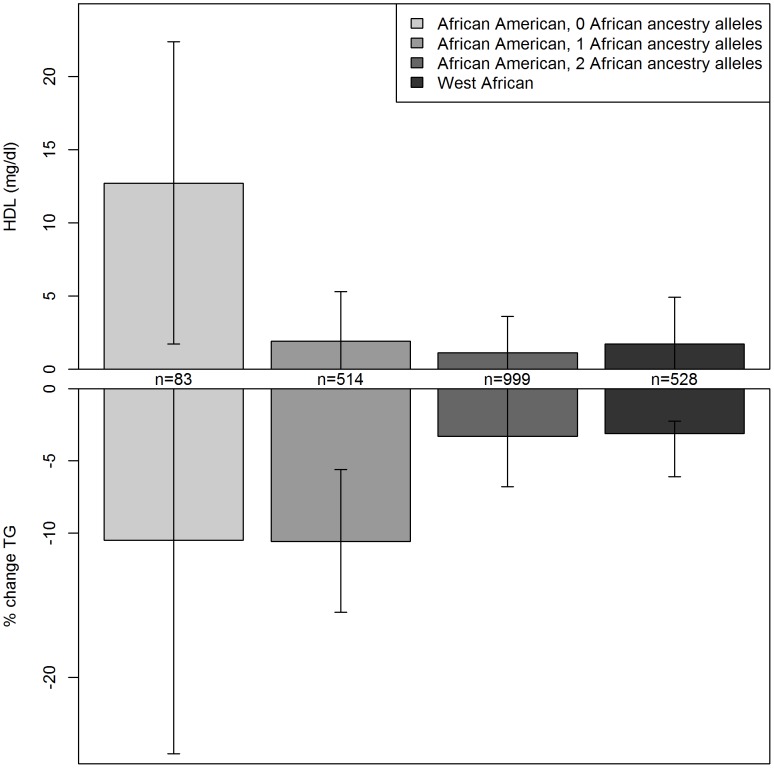
Although a considerable proportion of serum lipids loci identified in European ancestry individuals (EA) replicate in African Americans (AA), interethnic differences in the distribution of serum lipids suggest that some genetic determinants differ by ethnicity. We conducted a comprehensive evaluation of five lipid candidate genes to identify variants with ethnicity-specific effects. We sequenced ABCA1, LCAT, LPL, PON1, and SERPINE1 in 48 AA individuals with extreme serum lipid concentrations (high HDLC/low TG or low HDLC/high TG). Identified variants were genotyped in the full population-based sample of AA (n = 1694) and tested for an association with serum lipids. rs328 (LPL) and correlated variants were associated with higher HDLC and lower TG. Interestingly, a stronger effect was observed on a "European" vs. "African" genetic background at this locus. To investigate this effect, we evaluated the region among West Africans (WA). For TG, the effect size among WA was the same in AA with only African local ancestry (2-3% lower TG), while the larger association among AA with local European ancestry matched previous reports in EA (10%). For HDLC, there was no association with rs328 in AA with only African local ancestry or in WA, while the association among AA with European local ancestry was much greater than what has been observed for EA (15 vs. ∼ 5 mg/dl), suggesting an interaction with an environmental or genetic factor that differs by ethnicity. Beyond this ancestry effect, the importance of African ancestry-focused, sequence-based work was also highlighted by serum lipid associations of variants that were in higher frequency (or present only) among those of African ancestry. By beginning our study with the sequence variation present in AA individuals, investigating local ancestry effects, and seeking replication in WA, we were able to comprehensively evaluate the role of a set of candidate genes in serum lipids in AA.
尽管在欧洲裔个体(EA)中鉴定出的相当一部分血清脂质基因座在非裔美国人(AA)中也能重复出现,但血清脂质分布的种族差异表明,某些遗传决定因素因种族而异。我们对五个脂质候选基因进行了全面评估,以确定具有种族特异性效应的变体。我们对48名具有极端血清脂质浓度(高HDLC/低TG或低HDLC/高TG)的非裔美国人个体的ABCA1、LCAT、LPL、PON1和SERPINE1进行了测序。在基于人群的非裔美国人全样本(n = 1694)中对鉴定出的变体进行基因分型,并测试其与血清脂质的关联。rs328(LPL)及相关变体与较高的HDLC和较低的TG相关。有趣的是,在该基因座上,在“欧洲”与“非洲”遗传背景下观察到更强的效应。为了研究这种效应,我们评估了西非人群(WA)中的该区域。对于TG,仅具有非洲本地血统的非裔美国人中,西非人群的效应大小相同(TG降低2 - 3%),而具有欧洲本地血统的非裔美国人中更大的关联与先前在欧洲裔个体中的报道相符(10%)。对于HDLC,仅具有非洲本地血统的非裔美国人或西非人群中,rs328与之无关联,而具有欧洲本地血统的非裔美国人中的关联远大于在欧洲裔个体中观察到的情况(15 vs. ∼ 5 mg/dl),这表明存在与种族不同的环境或遗传因素的相互作用。除了这种血统效应外,在非洲血统人群中频率较高(或仅存在)的变体与血清脂质的关联也凸显了以非洲血统为重点的基于序列的研究工作的重要性。通过从非裔美国人个体中存在的序列变异开始我们的研究,调查本地血统效应,并在西非人群中寻求重复验证,我们能够全面评估一组候选基因在非裔美国人血清脂质中的作用。