Minutoli Letteria, Altavilla Domenica, Marini Herbert, Rinaldi Mariagrazia, Irrera Natasha, Pizzino Gabriele, Bitto Alessandra, Arena Salvatore, Cimino Sebastiano, Squadrito Francesco, Russo Giorgio Ivan, Morgia Giuseppe
Department of Urology, Polyclinic Hospital, University of Catania, Catania 95100, Italy.
J Biomed Sci. 2014 Mar 10;21(1):19. doi: 10.1186/1423-0127-21-19.
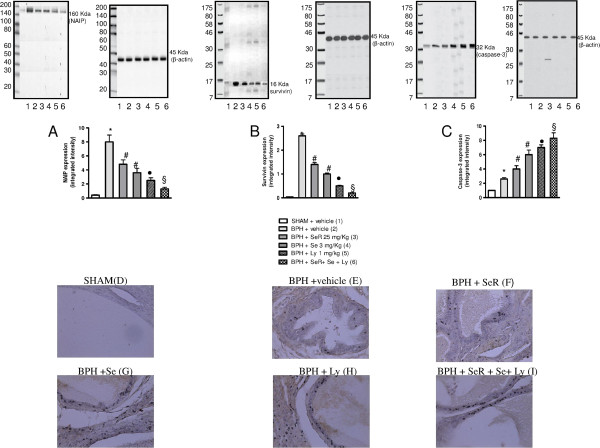
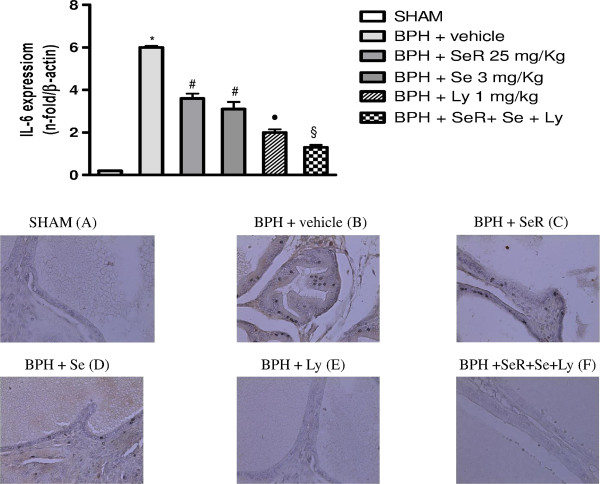
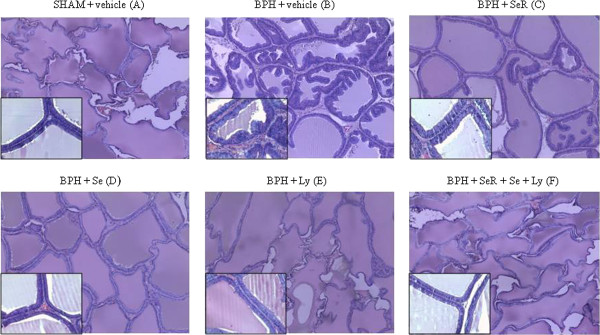
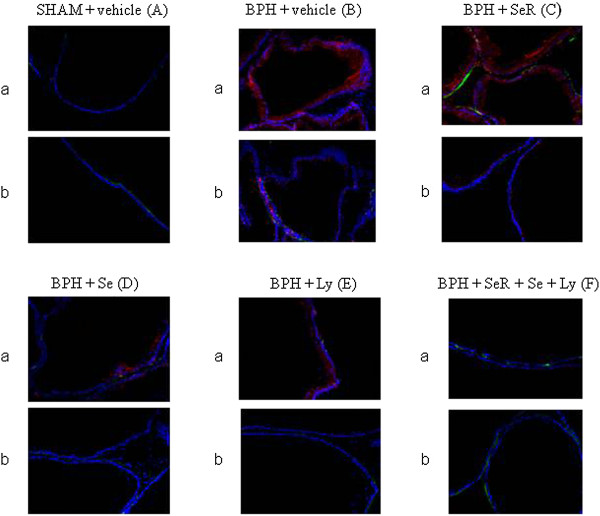
The apoptosis machinery is a promising target against benign prostatic hyperplasia (BPH). Inhibitors of apoptosis proteins (IAPs) modulate apoptosis by direct inhibition of caspases. Serenoa Repens (SeR) may be combined with other natural compounds such as Lycopene (Ly) and Selenium (Se) to maximize its therapeutic activity in BPH. We investigated the effects of SeR, Se and Ly, alone or in association, on the expression of four IAPs, cIAP-1, cIAP-2, NAIP and survivin in rats with experimental testosterone-dependent BPH. Moreover, caspase-3, interleukin-6 (IL-6) and prostate specific membrane antigen (PSMA) have been evaluated.Rats were administered, daily, with testosterone propionate (3 mg/kg/sc) or its vehicle for 14 days. Testosterone injected animals (BPH) were randomized to receive vehicle, SeR (25 mg/kg/sc), Se (3 mg/kg/sc), Ly (1 mg/kg/sc) or the SeR-Se-Ly association for 14 days. Animals were sacrificed and prostate removed for analysis.
BPH animals treated with vehicle showed unchanged expression of cIAP-1 and cIAP-2 and increased expression of NAIP, survivin, caspase-3, IL-6 and PSMA levels when compared with sham animals. Immunofluorescence studies confirmed the enhanced expression of NAIP and survivin with a characteristic pattern of cellular localization. SeR-Se-Ly association showed the highest efficacy in reawakening apoptosis; additionally, this therapeutic cocktail significantly reduced IL-6 and PSMA levels. The administration of SeR, Se and Ly significantly blunted prostate overweight and growth; moreover, the SeR-Se-Ly association was most effective in reducing prostate enlargement and growth by 43.3% in treated animals.
The results indicate that IAPs may represent interesting targets for drug therapy of BPH.
凋亡机制是治疗良性前列腺增生(BPH)的一个有前景的靶点。凋亡抑制蛋白(IAPs)通过直接抑制半胱天冬酶来调节细胞凋亡。锯叶棕(SeR)可与其他天然化合物如番茄红素(Ly)和硒(Se)联合使用,以最大化其在BPH中的治疗活性。我们研究了SeR、Se和Ly单独或联合使用对实验性睾酮依赖性BPH大鼠中四种IAPs(cIAP-1、cIAP-2、NAIP和存活素)表达的影响。此外,还评估了半胱天冬酶-3、白细胞介素-6(IL-6)和前列腺特异性膜抗原(PSMA)。大鼠每天接受丙酸睾酮(3mg/kg皮下注射)或其溶媒,持续14天。注射睾酮的动物(BPH)被随机分为接受溶媒、SeR(25mg/kg皮下注射)、Se(3mg/kg皮下注射)、Ly(1mg/kg皮下注射)或SeR-Se-Ly联合用药,持续14天。处死动物并取出前列腺进行分析。
与假手术动物相比,接受溶媒治疗的BPH动物cIAP-1和cIAP-2表达未改变,而NAIP、存活素、半胱天冬酶-3、IL-6和PSMA水平升高。免疫荧光研究证实了NAIP和存活素表达增强,并具有特征性的细胞定位模式。SeR-Se-Ly联合用药在重新激活细胞凋亡方面显示出最高疗效;此外,这种治疗组合显著降低了IL-6和PSMA水平。SeR、Se和Ly的给药显著减轻了前列腺超重和生长;此外,SeR-Se-Ly联合用药在减少治疗动物前列腺肿大和生长方面最有效,减少了43.3%。
结果表明,IAPs可能是BPH药物治疗的有趣靶点。