Levita Liat, Bois Catherine, Healey Andrew, Smyllie Emily, Papakonstantinou Evelina, Hartley Tom, Lever Colin
Present address: Department of Psychology, University of Sheffield, Western Bank, Sheffield S10 2TN, UK.
Biol Mood Anxiety Disord. 2014 Mar 7;4(1):4. doi: 10.1186/2045-5380-4-4.
Animal studies have suggested that the hippocampus may play an important role in anxiety as part of the Behavioural Inhibition System (BIS), which mediates reactivity to threat and punishment and can predict an individual's response to anxiety-relevant cues in a given environment. The aim of the present structural magnetic resonance imaging (MRI) study was to examine the relationship between individual differences in BIS and hippocampal structure, since this has not received sufficient attention in non-clinical populations. Thirty healthy right-handed participants with no history of alcohol or drug abuse, neurological or psychiatric disorders, or traumatic brain injury were recruited (16 male, 14 female, age 18 to 32 years). T1-weighted structural MRI scans were used to derive estimates of total intracranial volume, and hippocampal and amygdala gray matter volume using FreeSurfer. To relate brain structure to Gray's BIS, participants completed the Sensitivity to Punishment questionnaire. They also completed questionnaires assessing other measures potentially associated with hippocampal volume (Beck Depression Inventory, Negative Life Experience Survey), and two other measures of anxiety (Spielberger Trait Anxiety Inventory and the Beck Anxiety Inventory).
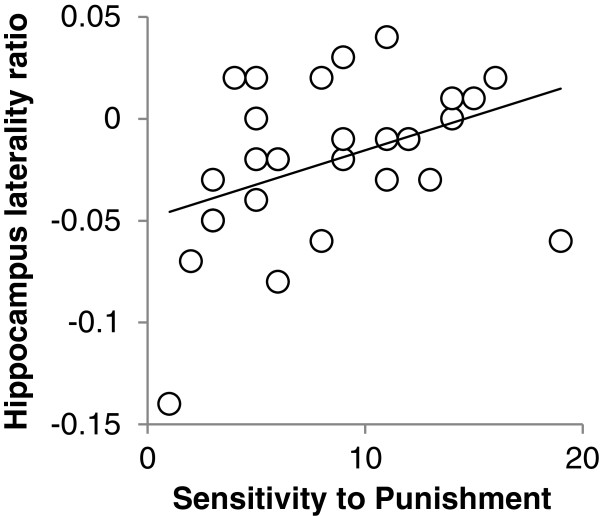
We found that high scores on the Sensitivity to Punishment scale were positively associated with hippocampal volume, and that this phenomenon was lateralized to the right side. In other words, greater levels of behavioural inhibition (BIS) were positively associated with right hippocampal volume.
Our data suggest that hippocampal volume is related to the cognitive and affective dimensions of anxiety indexed by the Sensitivity to Punishment, and support the idea that morphological differences in the hippocampal formation may be associated with behavioural inhibition contributions to anxiety.
动物研究表明,海马体可能作为行为抑制系统(BIS)的一部分在焦虑中发挥重要作用,该系统介导对威胁和惩罚的反应,并能预测个体在特定环境中对与焦虑相关线索的反应。本结构磁共振成像(MRI)研究的目的是检验BIS个体差异与海马体结构之间的关系,因为这在非临床人群中尚未得到充分关注。招募了30名无酒精或药物滥用史、无神经或精神疾病史、无创伤性脑损伤的健康右利手参与者(16名男性,14名女性,年龄18至32岁)。使用T1加权结构MRI扫描,通过FreeSurfer软件得出颅内总体积、海马体和杏仁核灰质体积的估计值。为了将脑结构与格雷的BIS联系起来,参与者完成了惩罚敏感性问卷。他们还完成了评估其他可能与海马体体积相关指标的问卷(贝克抑郁量表、负面生活经历调查),以及另外两项焦虑测量指标(斯皮尔伯格特质焦虑量表和贝克焦虑量表)。
我们发现惩罚敏感性量表得分高与海马体体积呈正相关,且这种现象偏向右侧。换句话说,更高水平的行为抑制(BIS)与右侧海马体体积呈正相关。
我们的数据表明,海马体体积与由惩罚敏感性所索引的焦虑的认知和情感维度相关,并支持海马结构形态差异可能与行为抑制对焦虑的影响有关这一观点。