Leal Stephanie L, Tighe Sarah K, Yassa Michael A
Department of Neurobiology and Behavior, University of California, Irvine, United States; Department of Psychological and Brain Sciences, Johns Hopkins University, United States.
Department of Psychiatry, University of Iowa Carver College of Medicine, United States.
Neurobiol Learn Mem. 2014 May;111:41-8. doi: 10.1016/j.nlm.2014.02.013. Epub 2014 Mar 4.
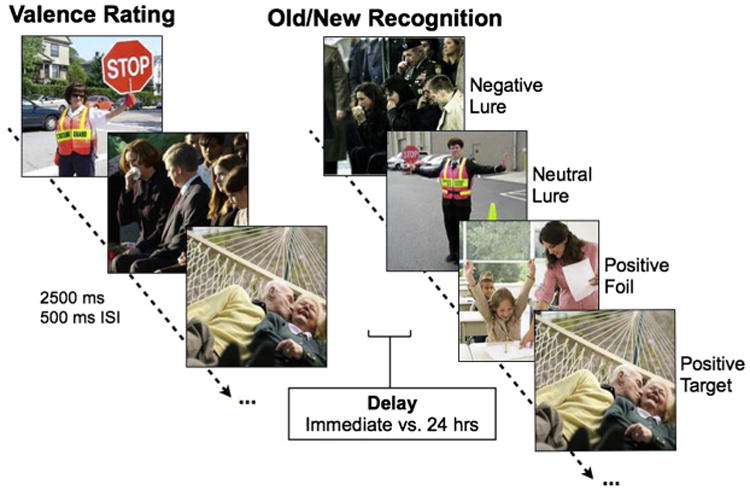
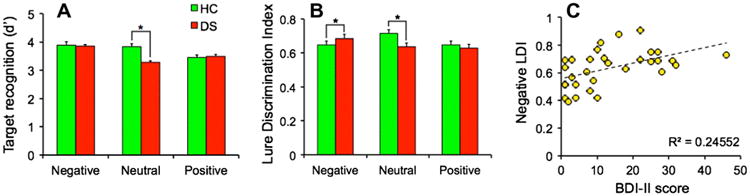
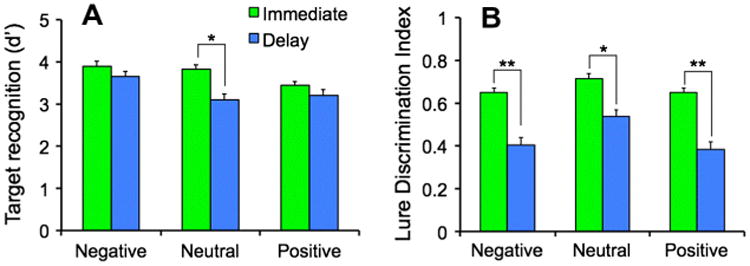
Emotional experiences can strengthen memories so that they can be used to guide future behavior. Emotional arousal, mediated by the amygdala, is thought to modulate storage by the hippocampus, which may encode unique episodic memories via pattern separation--the process by which similar memories are stored using non-overlapping representations. While prior work has examined mnemonic interference due to similarity and emotional modulation of memory independently, examining the mechanisms by which emotion influences mnemonic interference has not been previously accomplished in humans. To this end, we developed an emotional memory task where emotional content and stimulus similarity were varied to examine the effect of emotion on fine mnemonic discrimination (a putative behavioral correlate of hippocampal pattern separation). When tested immediately after encoding, discrimination was reduced for similar emotional items compared to similar neutral items, consistent with a reduced bias towards pattern separation. After 24h, recognition of emotional target items was preserved compared to neutral items, whereas similar emotional item discrimination was further diminished. This suggests a potential mechanism for the emotional modulation of memory with a selective remembering of gist, as well as a selective forgetting of detail, indicating an emotion-induced reduction in pattern separation. This can potentially increase the effective signal-to-noise ratio in any given situation to promote survival. Furthermore, we found that individuals with depressive symptoms hyper-discriminate negative items, which correlated with their symptom severity. This suggests that utilizing mnemonic discrimination paradigms allows us to tease apart the nuances of disorders with aberrant emotional mnemonic processing.
情感体验可以强化记忆,从而使其能够用于指导未来的行为。由杏仁核介导的情感唤醒被认为可调节海马体的存储,海马体可能通过模式分离来编码独特的情景记忆,模式分离是指利用非重叠表征来存储相似记忆的过程。虽然先前的研究分别考察了由于记忆的相似性和情感调节导致的记忆干扰,但此前尚未在人类中研究情感影响记忆干扰的机制。为此,我们开发了一项情感记忆任务,其中情感内容和刺激相似性有所变化,以考察情感对精细记忆辨别(海马体模式分离的一种假定行为关联)的影响。在编码后立即进行测试时,与相似的中性项目相比,相似的情感项目的辨别力降低,这与模式分离偏差的减少一致。24小时后,与中性项目相比,情感目标项目的识别得以保留,而相似情感项目的辨别力则进一步减弱。这表明了一种情感调节记忆的潜在机制,即选择性地记住要点,以及选择性地遗忘细节,这表明情感会导致模式分离减少。这可能会在任何给定情况下潜在地提高有效信噪比以促进生存。此外,我们发现有抑郁症状的个体对负面项目过度辨别,这与他们的症状严重程度相关。这表明利用记忆辨别范式使我们能够梳理出情感记忆加工异常的疾病的细微差别。