Department of Molecular Genetics and Microbiology, University of New Mexico Health Sciences Center, 915 Camino de Salud NE, Albuquerque, NM 87131, USA; INEM, INSERM U1151, CNRS UMR8253, Université Paris Descartes/Paris V, Sorbonne Paris Cité, 75014 Paris France.
Department of Molecular Genetics and Microbiology, University of New Mexico Health Sciences Center, 915 Camino de Salud NE, Albuquerque, NM 87131, USA.
Curr Biol. 2014 Mar 17;24(6):609-20. doi: 10.1016/j.cub.2014.02.008. Epub 2014 Mar 6.
Autophagy is a fundamental cell biological process whereby eukaryotic cells form membranes in the cytoplasm to sequester diverse intracellular targets. Although significant progress has been made in understanding the origins of autophagosomal organelles, the source of lipids that support autophagic membrane formation remain an important open question.
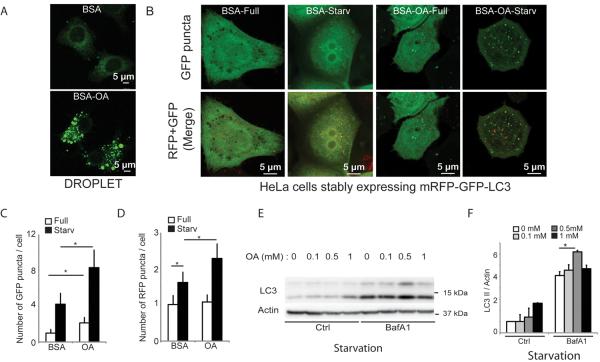
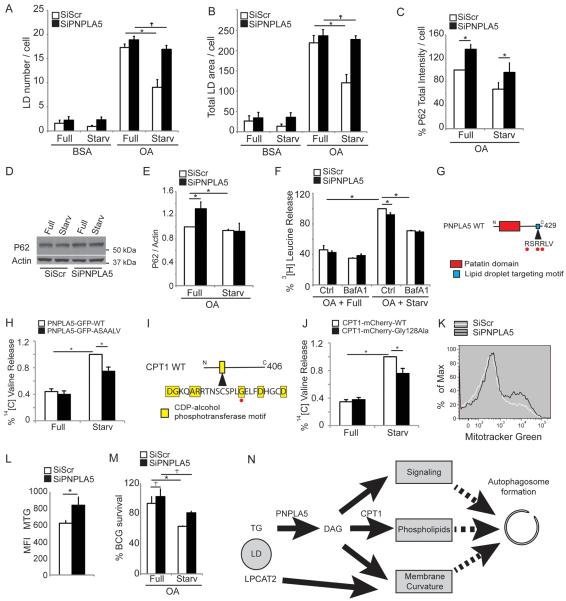
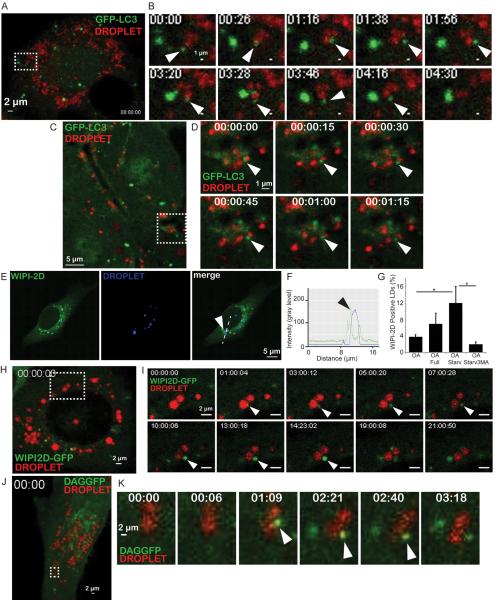
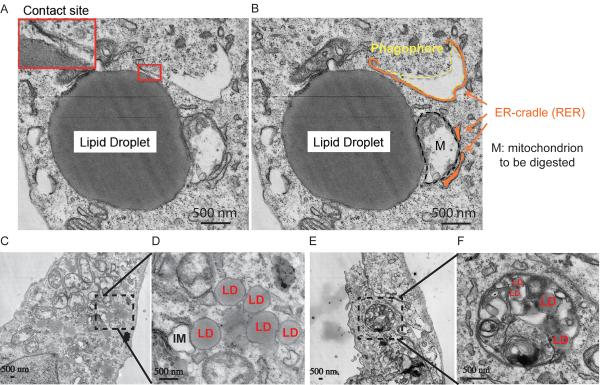
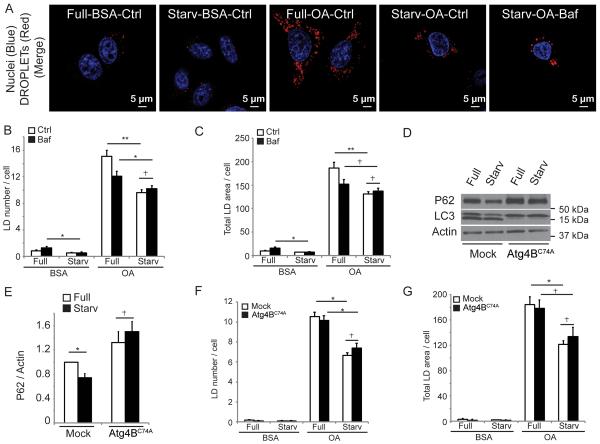
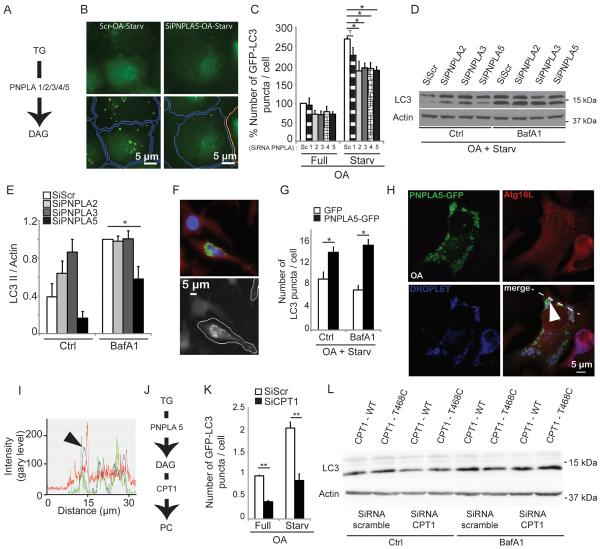
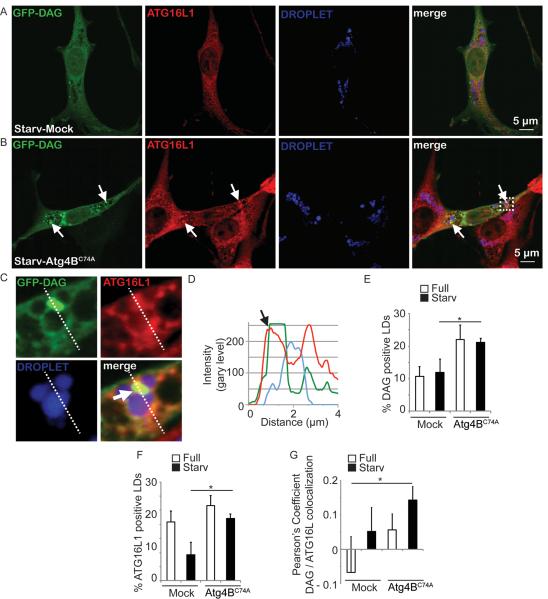
Here we show that lipid droplets as cellular stores of neutral lipids including triglycerides contribute to autophagic initiation. Lipid droplets, as previously shown, were consumed upon induction of autophagy by starvation. However, inhibition of autophagic maturation by blocking acidification or using dominant negative Atg4(C74A) that prohibits autophagosomal closure did not prevent disappearance of lipid droplets. Thus, lipid droplets continued to be utilized upon induction of autophagy, but not as autophagic substrates in a process referred to as lipophagy. We considered an alternative model whereby lipid droplets were consumed not as a part of lipophagy, but as a potential contributing source to the biogenesis of lipid precursors for nascent autophagosomes. We carried out a screen for a potential link between triglyceride mobilization and autophagy and identified a neutral lipase, PNPLA5, as being required for efficient autophagy. PNPLA5, which localized to lipid droplets, was needed for optimal initiation of autophagy. PNPLA5 was required for autophagy of diverse substrates, including degradation of autophagic adaptors, bulk proteolysis, mitochondrial quantity control, and microbial clearance.
Lipid droplets contribute to autophagic capacity by enhancing it in a process dependent on PNPLA5. Thus, neutral lipid stores are mobilized during autophagy to support autophagic membrane formation.
自噬是一种基本的细胞生物学过程,真核细胞通过细胞质中的膜来隔离各种细胞内靶标。尽管在理解自噬体细胞器的起源方面已经取得了重大进展,但支持自噬膜形成的脂质来源仍然是一个重要的开放性问题。
在这里,我们表明,作为中性脂质(包括甘油三酯)储存库的脂滴有助于自噬的起始。如先前所示,在饥饿诱导自噬时,脂滴会被消耗。然而,通过阻断酸化或使用禁止自噬体闭合的显性负性 Atg4(C74A)来抑制自噬成熟并不能阻止脂滴的消失。因此,在诱导自噬时,脂滴仍会被利用,但不是作为 lipophagy 过程中的自噬底物。我们考虑了另一种模型,其中脂滴不是作为 lipophagy 的一部分被消耗,而是作为新生自噬体的脂质前体生物发生的潜在来源。我们进行了一项关于甘油三酯动员与自噬之间潜在联系的筛选,并确定了一种中性脂肪酶 PNPLA5 是有效自噬所必需的。定位于脂滴的 PNPLA5 对于自噬的最佳起始是必需的。PNPLA5 对于多种底物的自噬都是必需的,包括自噬衔接蛋白的降解、大量蛋白质的降解、线粒体数量的控制和微生物的清除。
脂滴通过增强依赖于 PNPLA5 的过程来促进自噬能力。因此,中性脂质储存物在自噬过程中被动员以支持自噬膜的形成。