Kraaijenbrink Thirsa, van der Gaag Kristiaan J, Zuniga Sofia B, Xue Yali, Carvalho-Silva Denise R, Tyler-Smith Chris, Jobling Mark A, Parkin Emma J, Su Bing, Shi Hong, Xiao Chun-Jie, Tang Wen-Ru, Kashyap V K, Trivedi R, Sitalaximi T, Banerjee Jheelam, Tuladhar Nirmal M, Opgenort Jean-Robert M L, van Driem George L, Barbujani Guido, de Knijff Peter
MGC Department of Human and Clinical Genetics, Leiden University Medical Centre, Leiden, the Netherlands.
The Wellcome Trust Sanger Institute, Wellcome Trust Genome Campus, Hinxton, United Kingdom.
PLoS One. 2014 Mar 10;9(3):e91534. doi: 10.1371/journal.pone.0091534. eCollection 2014.
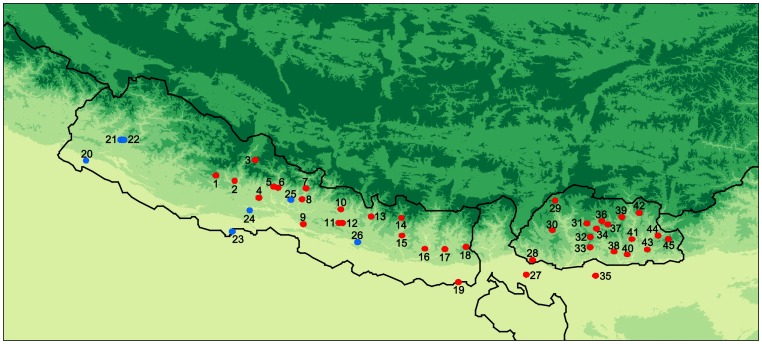
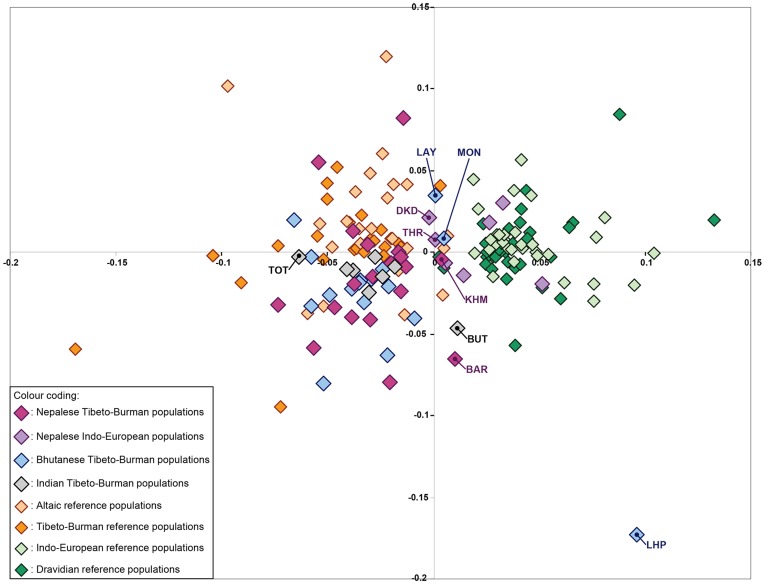
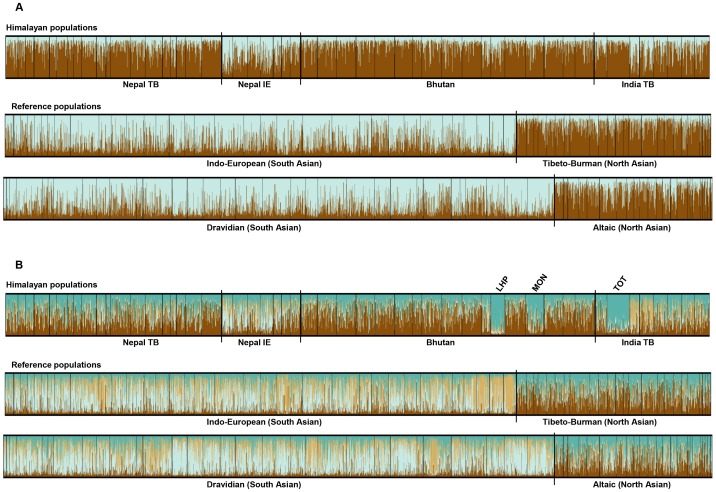
The greater Himalayan region demarcates two of the most prominent linguistic phyla in Asia: Tibeto-Burman and Indo-European. Previous genetic surveys, mainly using Y-chromosome polymorphisms and/or mitochondrial DNA polymorphisms suggested a substantially reduced geneflow between populations belonging to these two phyla. These studies, however, have mainly focussed on populations residing far to the north and/or south of this mountain range, and have not been able to study geneflow patterns within the greater Himalayan region itself. We now report a detailed, linguistically informed, genetic survey of Tibeto-Burman and Indo-European speakers from the Himalayan countries Nepal and Bhutan based on autosomal microsatellite markers and compare these populations with surrounding regions. The genetic differentiation between populations within the Himalayas seems to be much higher than between populations in the neighbouring countries. We also observe a remarkable genetic differentiation between the Tibeto-Burman speaking populations on the one hand and Indo-European speaking populations on the other, suggesting that language and geography have played an equally large role in defining the genetic composition of present-day populations within the Himalayas.
藏缅语系和印欧语系。以往的基因调查主要利用Y染色体多态性和/或线粒体DNA多态性,结果表明这两个语系人群之间的基因流动大幅减少。然而,这些研究主要集中在该山脉以北和/或以南居住的人群,未能研究大喜马拉雅地区内部的基因流动模式。我们现在报告一项基于常染色体微卫星标记,对喜马拉雅国家尼泊尔和不丹说藏缅语和印欧语的人群进行的详细的、有语言信息依据的基因调查,并将这些人群与周边地区进行比较。喜马拉雅地区内部人群之间的遗传分化似乎远高于邻国人群之间的遗传分化。我们还观察到,一方面说藏缅语的人群与另一方面说印欧语的人群之间存在显著的遗传分化,这表明语言和地理在界定当今喜马拉雅地区人群的基因构成方面发挥了同样重要的作用。