Department of Anthropology, University College London, London, WC1H 0BW, UK.
Key Laboratory of Animal Ecology and Conservation Biology, Centre for Computational and Evolutionary Biology, Institute of Zoology, Chinese Academy of Sciences, Beijing, 100101, China.
Sci Rep. 2020 Nov 27;10(1):20792. doi: 10.1038/s41598-020-77404-4.
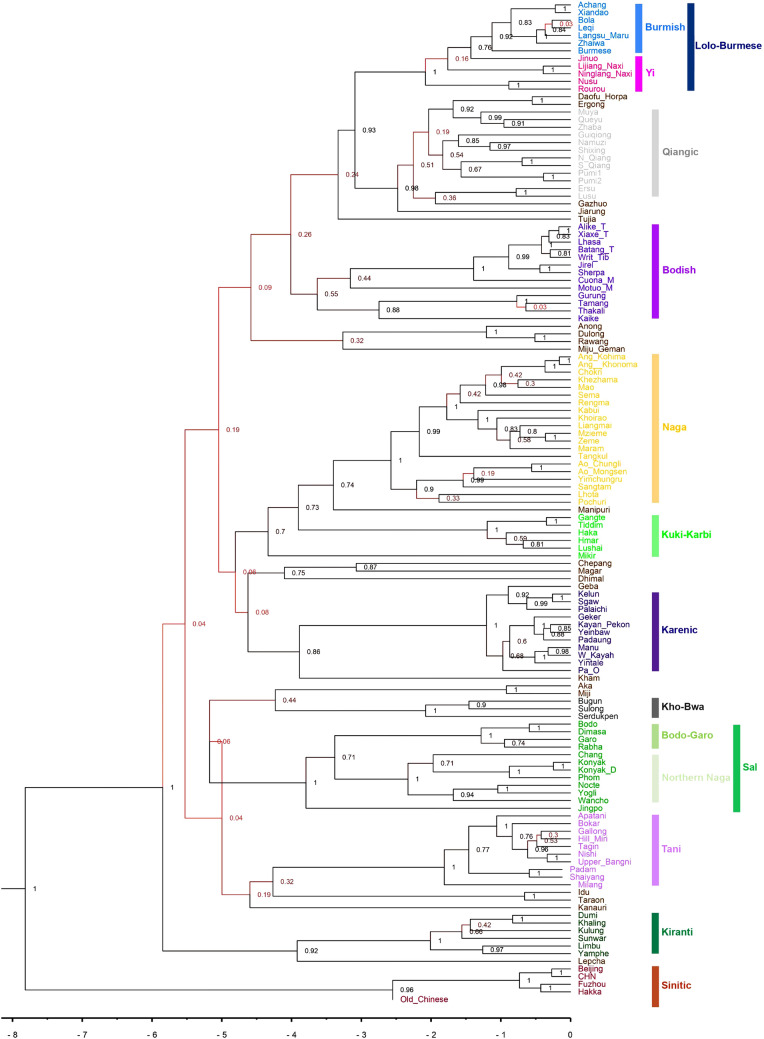
An accurate reconstruction of Sino-Tibetan language evolution would greatly advance our understanding of East Asian population history. Two recent phylogenetic studies attempted to do so but several of their conclusions are different from each other. Here we reconstruct the phylogeny of the Sino-Tibetan language family, using Bayesian computational methods applied to a larger and linguistically more diverse sample. Our results confirm previous work in finding that the ancestral Sino-Tibetans first split into Sinitic and Tibeto-Burman clades, and support the existence of key internal relationships. But we find that the initial divergence of this group occurred earlier than previously suggested, at approximately 8000 years before the present, coinciding with the onset of millet-based agriculture and significant environmental changes in the Yellow River region. Our findings illustrate that key aspects of phylogenetic history can be replicated in this complex language family, and calls for a more nuanced understanding of the first Sino-Tibetan speakers in relation to the "early farming dispersal" theory of language evolution.
对汉藏语系语言演化进行准确重构,将极大地促进我们对东亚人口历史的理解。最近的两项系统发生学研究试图实现这一目标,但它们的一些结论彼此不同。在这里,我们使用贝叶斯计算方法,对更大、更具语言多样性的样本进行分析,重建了汉藏语系的系统发生关系。我们的研究结果证实了先前的工作,即汉藏语系的祖先首先分裂为汉和藏缅两个分支,并支持关键内部关系的存在。但我们发现,这一组的最初分化发生在更早的时期,大约在 8000 年前,与黄河流域小米农业的出现和重大环境变化同时发生。我们的研究结果表明,在这个复杂的语系中,系统发生历史的关键方面可以得到复制,并呼吁对最初的汉藏语使用者与语言演化的“早期农业扩散”理论之间的关系有更细致的理解。