Rydzik Anna M, Brem Jürgen, van Berkel Sander S, Pfeffer Inga, Makena Anne, Claridge Timothy D W, Schofield Christopher J
Department of Chemistry, University of Oxford, Chemistry Research Laboratory, 12 Mansfield Road, Oxford OX1 3TA (UK).
Angew Chem Int Ed Engl. 2014 Mar 17;53(12):3129-33. doi: 10.1002/anie.201310866. Epub 2014 Feb 24.
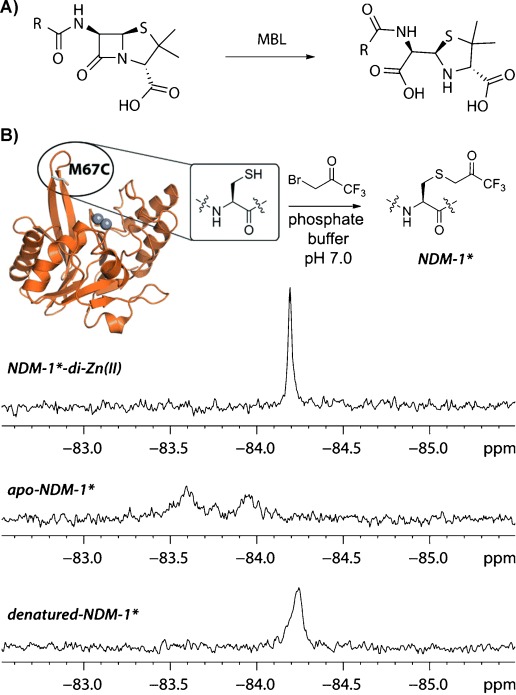
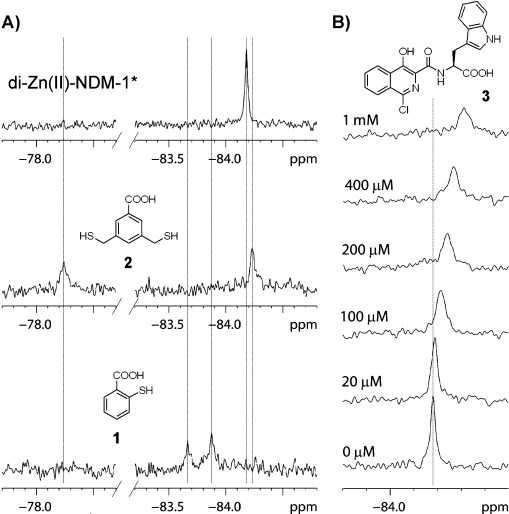
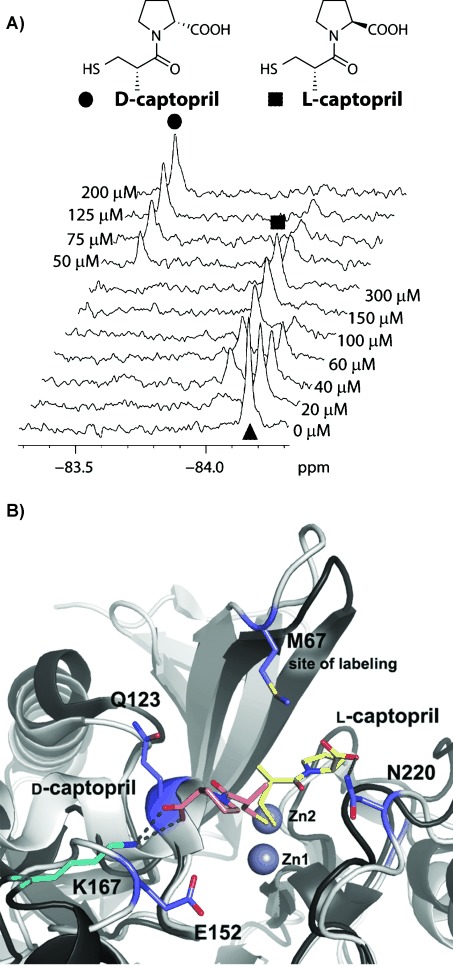
The New Delhi metallo-β-lactamase (NDM-1) is involved in the emerging antibiotic resistance problem. Development of metallo-β-lactamases (MBLs) inhibitors has proven challenging, due to their conformational flexibility. Here we report site-selective labeling of NDM-1 with 1,1,1-trifluoro-3-bromo acetone (BFA), and its use to study binding events and conformational changes upon ligand-metal binding using (19) F NMR spectroscopy. The results demonstrate different modes of binding of known NDM-1 inhibitors, including L- and D-captopril by monitoring the changing chemical environment of the active-site loop of NDM-1. The method described will be applicable to other MBLs and more generally to monitoring ligand-induced conformational changes.
新德里金属β-内酰胺酶(NDM-1)与新出现的抗生素耐药性问题有关。由于金属β-内酰胺酶(MBLs)构象的灵活性,开发其抑制剂已被证明具有挑战性。在此,我们报告了用1,1,1-三氟-3-溴丙酮(BFA)对NDM-1进行位点选择性标记,并利用(19)F核磁共振波谱研究配体-金属结合时的结合事件和构象变化。结果通过监测NDM-1活性位点环化学环境的变化,证明了已知NDM-1抑制剂(包括L-和D-卡托普利)的不同结合模式。所描述的方法将适用于其他MBLs,更广泛地适用于监测配体诱导的构象变化。