Kim Ye-Hwan, Kim Won Tae, Jeong Pildu, Ha Yun-Sok, Kang Ho Won, Yun Seok Joong, Moon Sung-Kwon, Choi Yung Hyun, Kim Isaac Yi, Kim Wun-Jae
Department of Urology, College of Medicine, Chungbuk National University, Cheongju, Korea.
Department of Urology, College of Medicine, Chungbuk National University, Cheongju, Korea. ; Section of Urological Oncology, The Cancer Institute of New Jersey, Robert Wood Johnson Medical School, New Brunswick, NJ, USA.
J Korean Med Sci. 2014 Mar;29(3):351-6. doi: 10.3346/jkms.2014.29.3.351. Epub 2014 Feb 27.
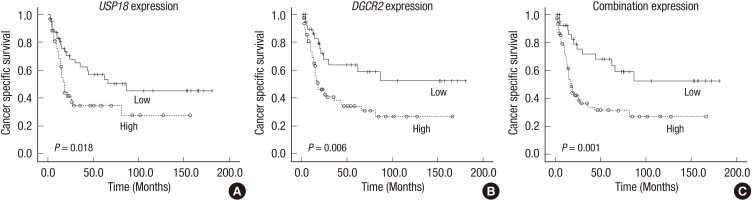
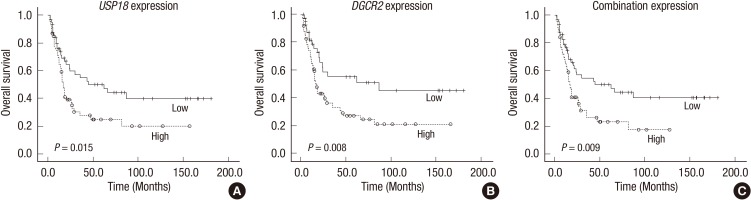
We performed gene expression profiling in bladder cancer patients to identify cancer-specific survival-related genes in muscle invasive bladder cancer (MIBC) patients. Sixty-two patients with MIBC were selected as the original cohort and another 118 MIBC patients were chosen as a validation cohort. The expression of USP18, DGCR2, and ZNF699 genes were measured and we analyzed the association between gene signatures and survival. USP18 and DGCR2, were significantly correlated to cancer-specific death (P=0.020, P=0.007, respectively). Cancer-specific survival in the low USP18 or DGCR2 expression group was significantly longer than the high expression group (P=0.018, P=0.006, respectively). In multivariate Cox regression analysis, a combination of USP18 and DGCR2 mRNA expression levels were significant risk factors for cancer-specific death (HR, 2.106; CI, 1.043-4.254, P=0.038). Overall survival and cancer-specific survival rates in the low-combination group were significantly longer than those in the high-expression group (P=0.001, both). In conclusion, decreased expressions of USP18 and DGCR2 were significantly associated with longer cancer-specific survival, and also the combination of two genes was correlated to a longer survival for MIBC patients. Thus, the combination of USP18 and DGCR2 expression was shown to be a reliable prognostic marker for cancer-specific survival in MIBC.
我们对膀胱癌患者进行了基因表达谱分析,以确定肌肉浸润性膀胱癌(MIBC)患者中与癌症特异性生存相关的基因。选择62例MIBC患者作为原始队列,另外118例MIBC患者作为验证队列。检测了USP18、DGCR2和ZNF699基因的表达,并分析了基因特征与生存之间的关联。USP18和DGCR2与癌症特异性死亡显著相关(分别为P=0.020,P=0.007)。USP18或DGCR2低表达组的癌症特异性生存期明显长于高表达组(分别为P=0.018,P=0.006)。在多变量Cox回归分析中,USP18和DGCR2 mRNA表达水平的组合是癌症特异性死亡的显著危险因素(HR,2.106;CI,1.043 - 4.254,P=0.038)。低表达组合组的总生存期和癌症特异性生存率明显长于高表达组(均为P=0.001)。总之,USP18和DGCR2表达降低与更长的癌症特异性生存期显著相关,并且这两个基因的组合与MIBC患者更长的生存期相关。因此,USP18和DGCR2表达的组合被证明是MIBC患者癌症特异性生存的可靠预后标志物。