Biomedical Engineering Division, Department of Signals and Systems, Chalmers University of Technology Gothenburg, Sweden ; Department of Orthopaedics, Centre of Orthopaedic Osseointegration, Sahlgrenska University Hospital Gothenburg, Sweden.
Biomedical Engineering Division, Department of Signals and Systems, Chalmers University of Technology Gothenburg, Sweden.
Front Neurosci. 2014 Feb 25;8:24. doi: 10.3389/fnins.2014.00024. eCollection 2014.
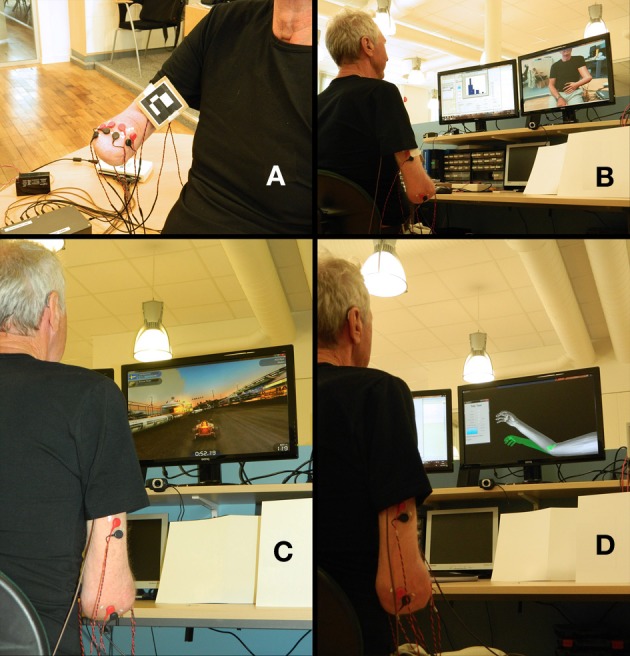
A variety of treatments have been historically used to alleviate phantom limb pain (PLP) with varying efficacy. Recently, virtual reality (VR) has been employed as a more sophisticated mirror therapy. Despite the advantages of VR over a conventional mirror, this approach has retained the use of the contralateral limb and is therefore restricted to unilateral amputees. Moreover, this strategy disregards the actual effort made by the patient to produce phantom motions. In this work, we investigate a treatment in which the virtual limb responds directly to myoelectric activity at the stump, while the illusion of a restored limb is enhanced through augmented reality (AR). Further, phantom motions are facilitated and encouraged through gaming. The proposed set of technologies was administered to a chronic PLP patient who has shown resistance to a variety of treatments (including mirror therapy) for 48 years. Individual and simultaneous phantom movements were predicted using myoelectric pattern recognition and were then used as input for VR and AR environments, as well as for a racing game. The sustained level of pain reported by the patient was gradually reduced to complete pain-free periods. The phantom posture initially reported as a strongly closed fist was gradually relaxed, interestingly resembling the neutral posture displayed by the virtual limb. The patient acquired the ability to freely move his phantom limb, and a telescopic effect was observed where the position of the phantom hand was restored to the anatomically correct distance. More importantly, the effect of the interventions was positively and noticeably perceived by the patient and his relatives. Despite the limitation of a single case study, the successful results of the proposed system in a patient for whom other medical and non-medical treatments have been ineffective justifies and motivates further investigation in a wider study.
历史上已经有多种治疗方法被用于缓解幻肢痛(PLP),但疗效各异。最近,虚拟现实(VR)已被用作一种更复杂的镜像疗法。尽管 VR 相对于传统的镜子有优势,但这种方法仍然保留了对健侧肢体的使用,因此仅限于单侧截肢者。此外,这种策略忽略了患者为产生幻肢运动而实际付出的努力。在这项工作中,我们研究了一种治疗方法,其中虚拟肢体直接响应残端的肌电活动,同时通过增强现实(AR)增强恢复肢体的幻觉。此外,通过游戏来促进和鼓励幻肢运动。我们将这套技术应用于一位慢性幻肢痛患者,他对多种治疗方法(包括镜像疗法)都有 48 年的抗药性。通过肌电模式识别预测个体和同时的幻肢运动,然后将其用作 VR 和 AR 环境以及赛车游戏的输入。患者报告的持续疼痛水平逐渐降低到完全无痛期。最初报告的强烈紧握的幻肢姿势逐渐放松,有趣的是,类似于虚拟肢体显示的中立姿势。患者获得了自由移动幻肢的能力,并观察到了一种伸缩效果,即幻手的位置恢复到解剖学上正确的距离。更重要的是,患者及其家属明显感受到了干预措施的积极效果。尽管这是一项单一案例研究的局限性,但该系统在一位对其他医学和非医学治疗均无效的患者中取得了成功,这为更广泛的研究提供了进一步调查的理由和动力。