Pulmonary Department, First Affiliated Hospital of Anhui Medical University, Hefei, 230022 Anhui, China.
BMC Pulm Med. 2014 Mar 11;14:42. doi: 10.1186/1471-2466-14-42.
Chronic obstructive pulmonary disease (COPD) exacerbations are accompanied with increased systemic inflammation, which accelerate the pulmonary function injury and impair the quality of life. Prompt and effective treatments for COPD exacerbations slow down the disease progression, but an objective instrument to assess the efficacy of the treatments following COPD exacerbations is lacking nowadays. The COPD Assessment Test (CAT) is an 8-item questionnaire designed to assess and quantify health status and symptom burden in COPD patients. We hypothesize that the change in CAT score is related to the treatment response following COPD exacerbations.
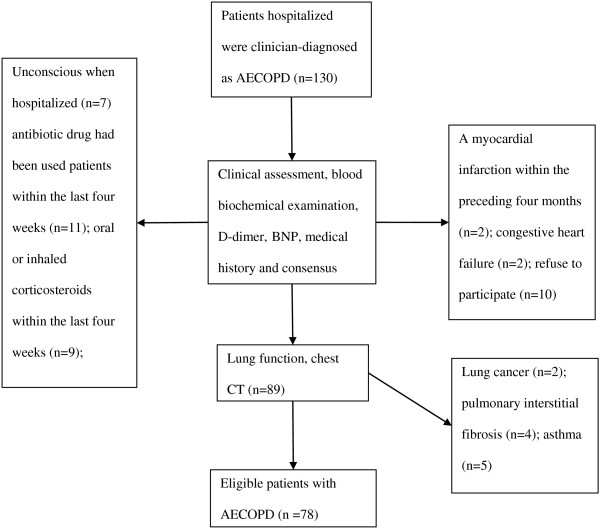
78 inpatients with clinician-diagnosed acute exacerbation of COPD (AECOPD) completed the CAT, St George's Respiratory Questionnaire (SGRQ) and modified Medical Research Council (mMRC) Dyspnea Scale both at exacerbation and the 7th day of therapy, and a subgroup of 39 patients performed the pulmonary function test. Concentrations of serum C-reactive protein (CRP) and plasma fibrinogen were assayed at the same time. Correlations between the CAT and other measurements were examined.
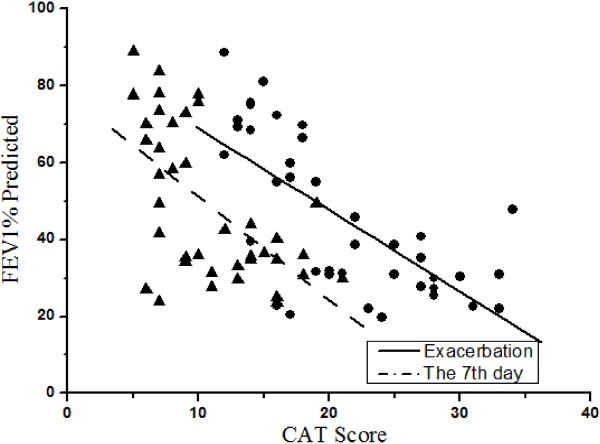
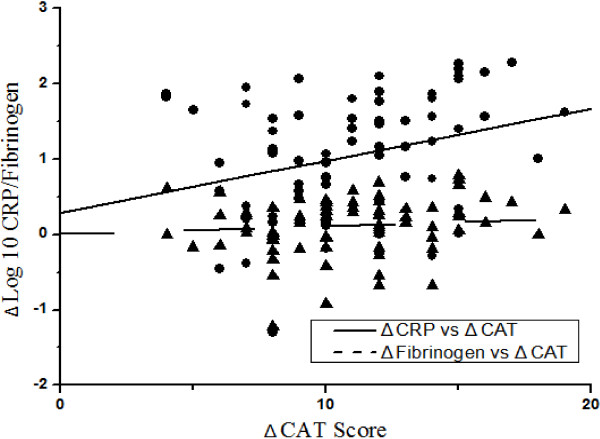
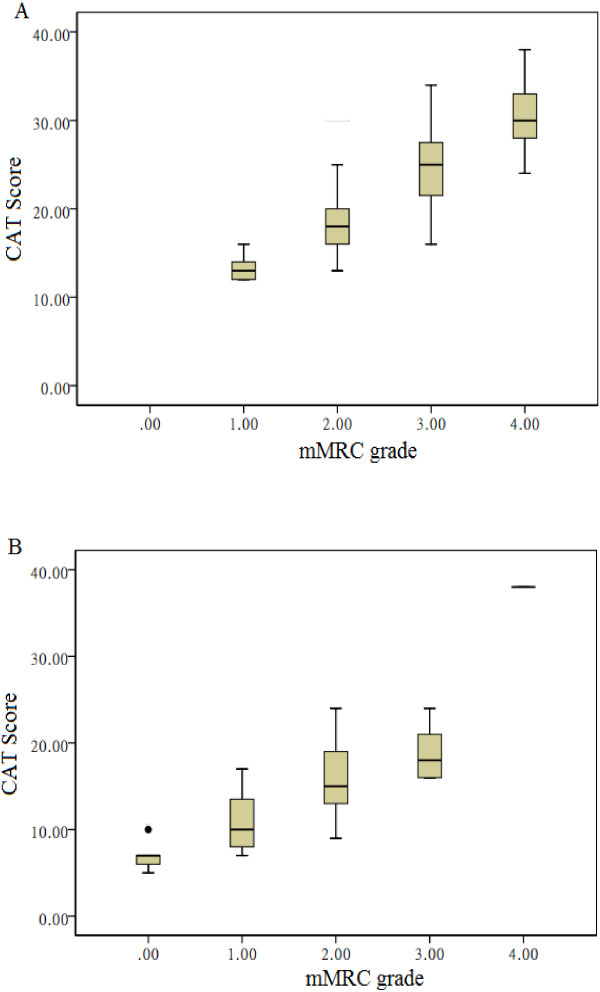
After 7 days' therapy, the CAT and SGRQ scores, mMRC grades, as well as the concentrations of CRP and fibrinogen all decreased significantly (P < 0.001). Meanwhile, the FEV1% predicted had a significant improvement (P < 0.001). The CAT scores were significantly correlated with concurrent concentrations of CRP and fibrinogen, SGRQ scores, FEV1% predicted and mMRC grades (P < 0.05). The change in CAT score was positively correlated with the change of CRP (r = 0.286, P < 0.05), SGRQ score (r = 0.725, P < 0.001) and mMRC grades (r = 0.593, P < 0.001), but not with fibrinogen (r = 0.137, P > 0.05) or FEV1% predicted (r = -0.101, P > 0.05). No relationship was found between the changes of SGRQ score and CRP and fibrinogen (P>0.05).
The CAT is associate with the changes of systemic inflammation following COPD exacerbations. Moreover, the CAT is responsive to the treatments, similar to other measures such as SGRQ, mMRC dyspnea scale and pulmonary function. Therefore, the CAT is a potentially useful instrument to assess the efficacy of treatments following COPD exacerbations.
慢性阻塞性肺疾病(COPD)加重时伴有全身炎症增加,这会加速肺功能损伤并降低生活质量。及时有效的 COPD 加重治疗可以减缓疾病进展,但目前缺乏评估 COPD 加重后治疗效果的客观工具。COPD 评估测试(CAT)是一个 8 项问卷,旨在评估和量化 COPD 患者的健康状况和症状负担。我们假设 CAT 评分的变化与 COPD 加重后的治疗反应有关。
78 例临床诊断为 COPD 急性加重(AECOPD)的住院患者在加重时和治疗第 7 天完成 CAT、圣乔治呼吸问卷(SGRQ)和改良的医学研究理事会呼吸困难量表(mMRC 呼吸困难量表),并对 39 例患者进行了肺功能检查。同时检测血清 C 反应蛋白(CRP)和血浆纤维蛋白原浓度。检测 CAT 与其他测量指标的相关性。
经过 7 天的治疗,CAT 和 SGRQ 评分、mMRC 分级以及 CRP 和纤维蛋白原浓度均显著降低(P<0.001)。同时,FEV1%预测值显著改善(P<0.001)。CAT 评分与同时期 CRP 和纤维蛋白原浓度、SGRQ 评分、FEV1%预测值和 mMRC 分级显著相关(P<0.05)。CAT 评分的变化与 CRP(r=0.286,P<0.05)、SGRQ 评分(r=0.725,P<0.001)和 mMRC 分级(r=0.593,P<0.001)的变化呈正相关,但与纤维蛋白原(r=0.137,P>0.05)或 FEV1%预测值(r=-0.101,P>0.05)无关。SGRQ 评分的变化与 CRP 和纤维蛋白原无相关性(P>0.05)。
CAT 与 COPD 加重后全身炎症的变化有关。此外,CAT 对治疗有反应,与 SGRQ、mMRC 呼吸困难量表和肺功能等其他测量方法相似。因此,CAT 是一种评估 COPD 加重后治疗效果的潜在有用工具。