Laboratoire de Psychologie Médicale et d'Addictologie, ULB Neuroscience Institute, CHU Brugmann-Université Libre de Bruxelles Brussels, Belgium.
Front Hum Neurosci. 2014 Mar 3;8:106. doi: 10.3389/fnhum.2014.00106. eCollection 2014.
Previous studies have highlighted the advantage of using audio-visual oddball tasks (instead of unimodal ones) in order to electrophysiologically index subclinical behavioral differences. Since alexithymia is highly prevalent in the general population, we investigated whether the use of various bimodal tasks could elicit emotional effects in low- vs. high-alexithymic scorers.
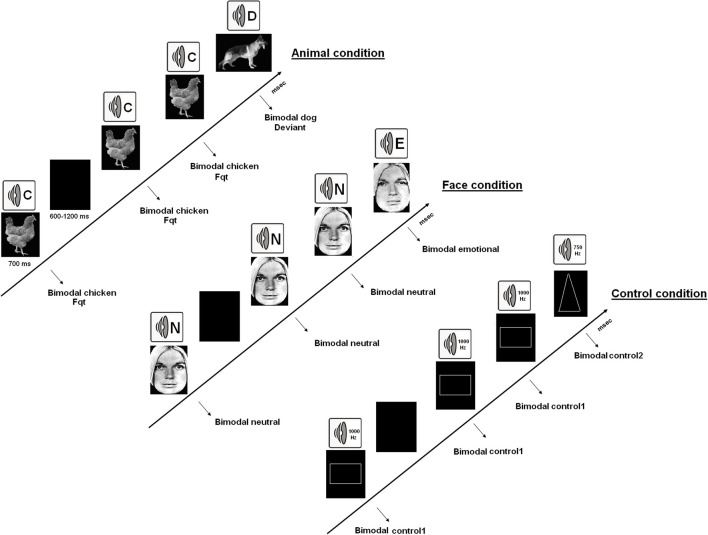
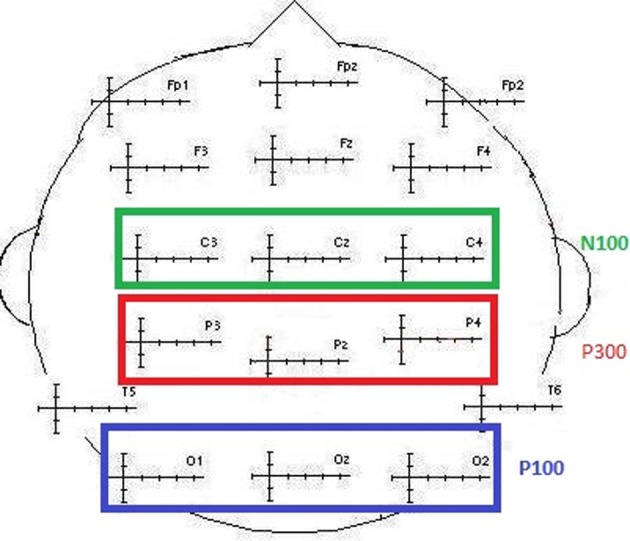
Fifty students (33 females and 17 males) were split into groups based on low and high scores on the Toronto Alexithymia Scale (TAS-20). During event-related potential (ERP) recordings, they were exposed to three kinds of audio-visual oddball tasks: neutral-AVN-(geometrical forms and bips), animal-AVA-(dog and cock with their respective shouts), or emotional-AVE-(faces and voices) stimuli. In each condition, participants were asked to quickly detect deviant events occurring amongst a train of repeated and frequent matching stimuli (e.g., push a button when a sad face-voice pair appeared amongst a train of neutral face-voice pairs). P100, N100, and P300 components were analyzed: P100 refers to visual perceptive and attentional processing, N100 to auditory ones, and the P300 relates to response-related stages, involving memory processes.
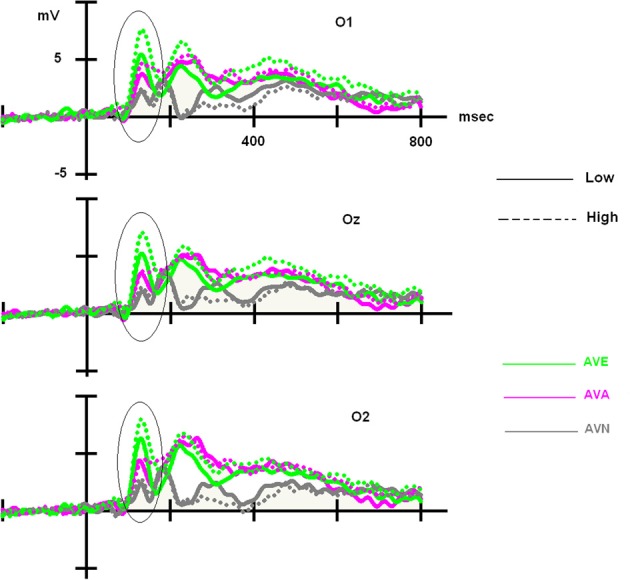
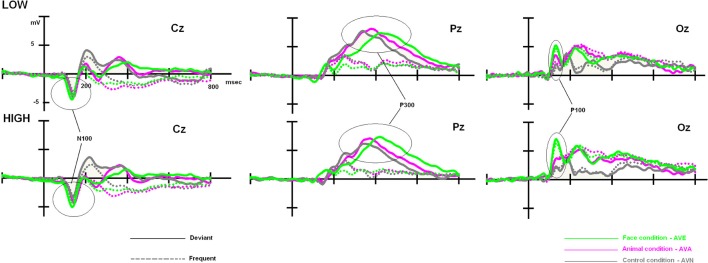
High-alexithymic scorers presented a particular pattern of results when processing the emotional stimulations, reflected in early ERP components by increased P100 and N100 amplitudes in the emotional oddball tasks [P100: F (2, 48) = 20,319, p < 0.001; N100: F (2, 96) = 8,807, p = 0.001] as compared to the animal or neutral ones. Indeed, regarding the P100, subjects exhibited a higher amplitude in the AVE condition (8.717 μV), which was significantly different from that observed during the AVN condition (4.382 μV, p < 0.001). For the N100, the highest amplitude was found in the AVE condition (-4.035 μV) and the lowest was observed in the AVN condition (-2.687 μV, p = 0.003). However, no effect was found on the later P300 component.
Our findings suggest that high-alexithymic scorers require heightened early attentional resources in comparison to low scorers, particularly when confronted with emotional bimodal stimuli.
先前的研究强调了使用视听Oddball 任务(而不是单模态任务)在电生理上指数化亚临床行为差异的优势。由于述情障碍在普通人群中很常见,我们研究了使用各种双模态任务是否可以在低述情障碍评分者和高述情障碍评分者中引起情绪效应。
50 名学生(33 名女性和 17 名男性)根据多伦多述情障碍量表(TAS-20)的低得分和高得分进行分组。在事件相关电位(ERP)记录期间,他们接受了三种视听Oddball 任务:中性-AVN-(几何形状和哔哔声)、动物-AVA-(狗和公鸡及其各自的叫声)或情绪-AVE-(面孔和声音)刺激。在每种情况下,参与者被要求在重复和频繁出现的匹配刺激的火车中快速检测到偏差事件(例如,当悲伤的面孔-声音对出现在中性面孔-声音对的火车中时,按下按钮)。分析了 P100、N100 和 P300 成分:P100 指视觉感知和注意力处理,N100 指听觉处理,而 P300 与反应相关阶段有关,涉及记忆过程。
高述情障碍评分者在处理情绪刺激时表现出一种特殊的结果模式,这反映在情绪Oddball 任务中的早期 ERP 成分中,表现为 P100 和 N100 振幅增加[P100:F(2,48)=20.319,p<0.001;N100:F(2,96)=8.807,p=0.001]与动物或中性刺激相比。实际上,就 P100 而言,与 AVN 条件(4.382 μV)相比,在 AVE 条件下观察到的受试者振幅更高(8.717 μV,p<0.001)。对于 N100,最大振幅出现在 AVE 条件下(-4.035 μV),而在 AVN 条件下观察到的最小振幅为(-2.687 μV,p=0.003)。然而,在后 P300 成分中没有发现效果。
我们的研究结果表明,与低评分者相比,高述情障碍评分者需要更多的早期注意力资源,尤其是在面对情绪双模态刺激时。