Cohen-Kutner Moshe, Khomsky Lena, Trus Michael, Ben-Yehuda Hila, Lenhard James M, Liang Yin, Martin Tonya, Atlas Daphne
Department of Biological Chemistry, Institute of Life Sciences, The Hebrew University of Jerusalem, Jerusalem 91904 Israel.
Cardiovascular and Metabolic Research, Janssen Research & Development, LLC of Johnson and Johnson, Welsh and McKean Roads, Springhouse, PA 19477, USA.
Redox Biol. 2014 Jan 9;2:447-56. doi: 10.1016/j.redox.2013.12.018. eCollection 2014.
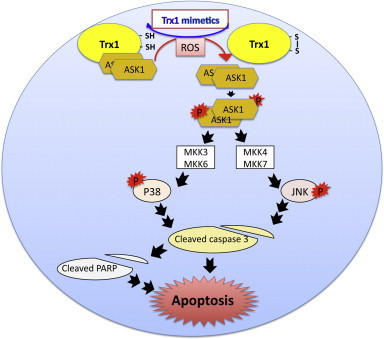
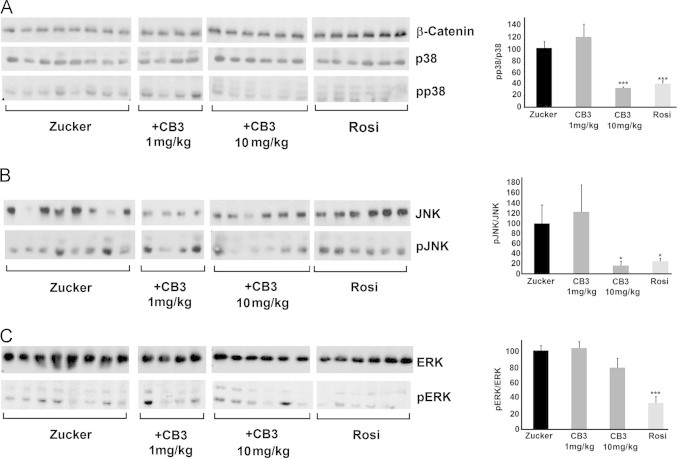
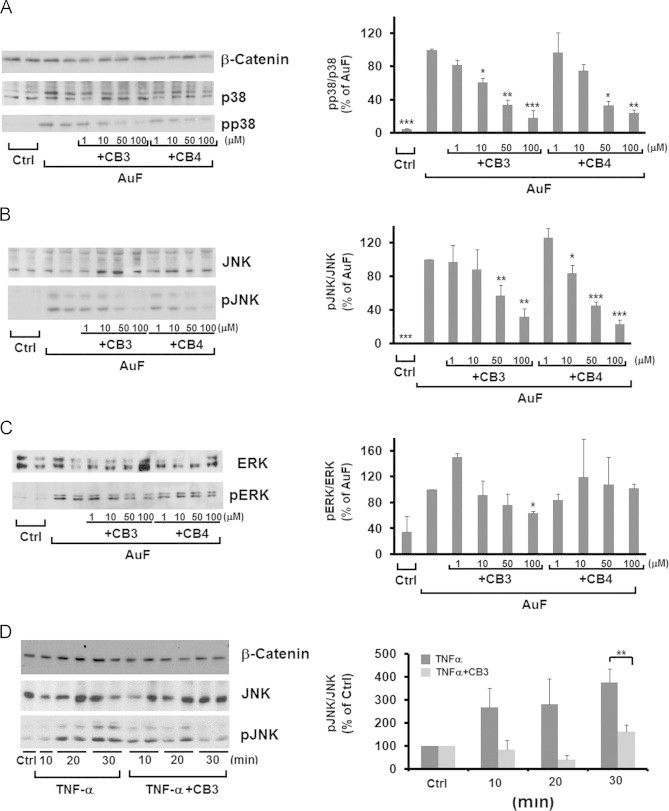
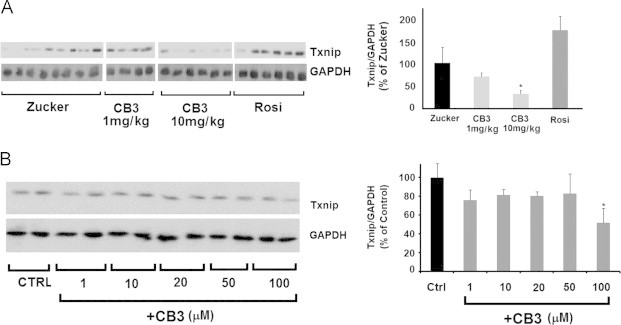
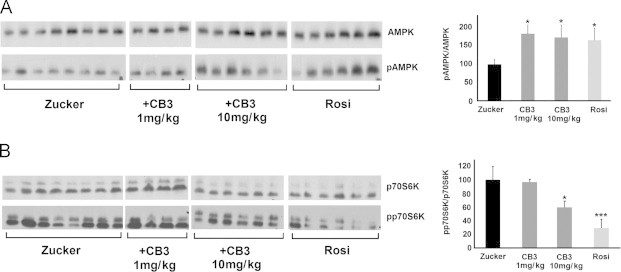
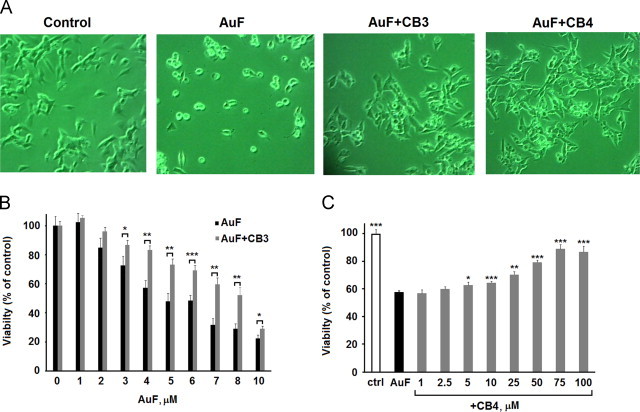
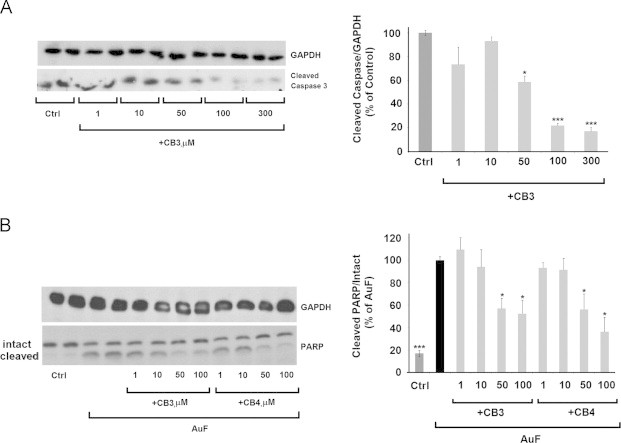
Diabetes is a high risk factor for dementia. High glucose may be a risk factor for dementia even among persons without diabetes, and in transgenic animals it has been shown to cause a potentiation of indices that are pre-symptomatic of Alzheimer's disease. To further elucidate the underlying mechanisms linking inflammatory events elicited in the brain during oxidative stress and diabetes, we monitored the activation of mitogen-activated kinsase (MAPKs), c-jun NH2-terminal kinase (JNK), p38 MAP kinases (p38(MAPK)), and extracellular activating kinsae1/2 (ERK1/2) and the anti-inflammatory effects of the thioredoxin mimetic (TxM) peptides, Ac-Cys-Pro-Cys-amide (CB3) and Ac-Cys-Gly-Pro-Cys-amide (CB4) in the brain of male leptin-receptor-deficient Zucker diabetic fatty (ZDF) rats and human neuroblastoma SH-SY5Y cells. Daily i.p. injection of CB3 to ZDF rats inhibited the phosphorylation of JNK and p38(MAPK), and prevented the expression of thioredoxin-interacting-protein (TXNIP/TBP-2) in ZDF rat brain. Although plasma glucose/insulin remained high, CB3 also increased the phosphorylation of AMP-ribose activating kinase (AMPK) and inhibited p70(S6K) kinase in the brain. Both CB3 and CB4 reversed apoptosis induced by inhibiting thioredoxin reductase as monitored by decreasing caspase 3 cleavage and PARP dissociation in SH-SY5Y cells. The decrease in JNK and p38(MAPK) activity in the absence of a change in plasma glucose implies a decrease in oxidative or neuroinflammatory stress in the ZDF rat brain. CB3 not only attenuated MAPK phosphorylation and activated AMPK in the brain, but it also diminished apoptotic markers, most likely acting via the MAPK-AMPK-mTOR pathway. These results were correlated with CB3 and CB4 inhibiting inflammation progression and protection from oxidative stress induced apoptosis in human neuronal cells. We suggest that by attenuating neuro-inflammatory processes in the brain Trx1 mimetic peptides could become beneficial for preventing neurological disorders associated with diabetes.
糖尿病是痴呆症的一个高风险因素。即使在没有糖尿病的人群中,高血糖也可能是痴呆症的一个风险因素,并且在转基因动物中,高血糖已被证明会导致阿尔茨海默病症状前指标的增强。为了进一步阐明氧化应激和糖尿病期间大脑中引发的炎症事件之间的潜在机制,我们监测了丝裂原活化激酶(MAPKs)、c-jun氨基末端激酶(JNK)、p38丝裂原活化蛋白激酶(p38(MAPK))和细胞外活化激酶1/2(ERK1/2)的激活情况,以及硫氧还蛋白模拟肽(TxM)、乙酰半胱氨酸-脯氨酸-半胱氨酸酰胺(CB3)和乙酰半胱氨酸-甘氨酸-脯氨酸-半胱氨酸酰胺(CB4)对雄性瘦素受体缺陷型Zucker糖尿病脂肪大鼠(ZDF)和人神经母细胞瘤SH-SY5Y细胞大脑的抗炎作用。每天腹腔注射CB3给ZDF大鼠可抑制JNK和p38(MAPK)的磷酸化,并阻止ZDF大鼠大脑中硫氧还蛋白相互作用蛋白(TXNIP/TBP-2)的表达。尽管血浆葡萄糖/胰岛素水平仍然很高,但CB3还增加了大脑中AMP-核糖活化激酶(AMPK)的磷酸化并抑制了p70(S6K)激酶。通过监测SH-SY5Y细胞中caspase 3切割和PARP解离的减少,CB3和CB4都逆转了抑制硫氧还蛋白还原酶诱导的细胞凋亡。在血浆葡萄糖没有变化的情况下JNK和p38(MAPK)活性的降低意味着ZDF大鼠大脑中氧化或神经炎症应激的减少。CB3不仅减弱了大脑中MAPK的磷酸化并激活了AMPK,而且还减少了凋亡标志物,很可能是通过MAPK-AMPK-mTOR途径起作用。这些结果与CB3和CB4抑制炎症进展以及保护人神经元细胞免受氧化应激诱导的细胞凋亡相关。我们认为,通过减弱大脑中的神经炎症过程,Trx1模拟肽可能对预防与糖尿病相关的神经疾病有益。