Krouchev Nedialko I, Danner Simon M, Vinet Alain, Rattay Frank, Sawan Mohamad
Polystim Neurotechnologies, Ecole Polytechnique, Montreal, Quebec, Canada.
Institute for Analysis and Scientific Computing, University of Technology, Vienna, Austria; Center for Medical Physics and Biomedical Engineering, Medical University, Vienna, Austria.
PLoS One. 2014 Mar 13;9(3):e90480. doi: 10.1371/journal.pone.0090480. eCollection 2014.
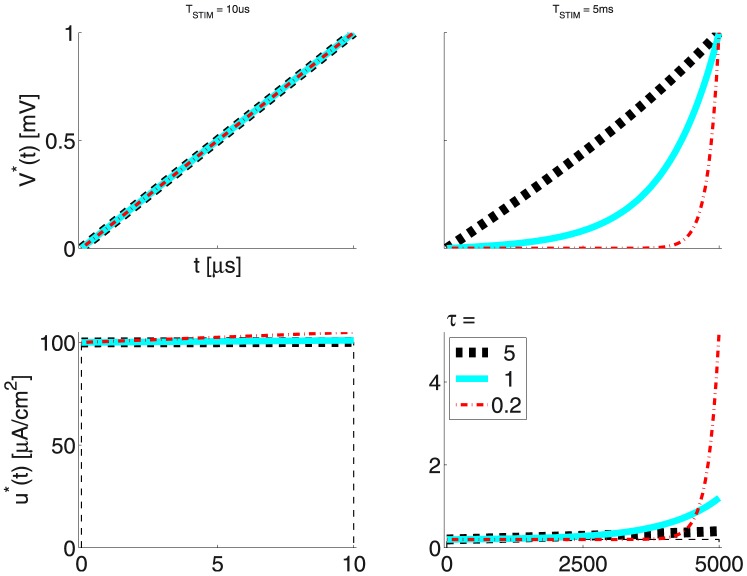
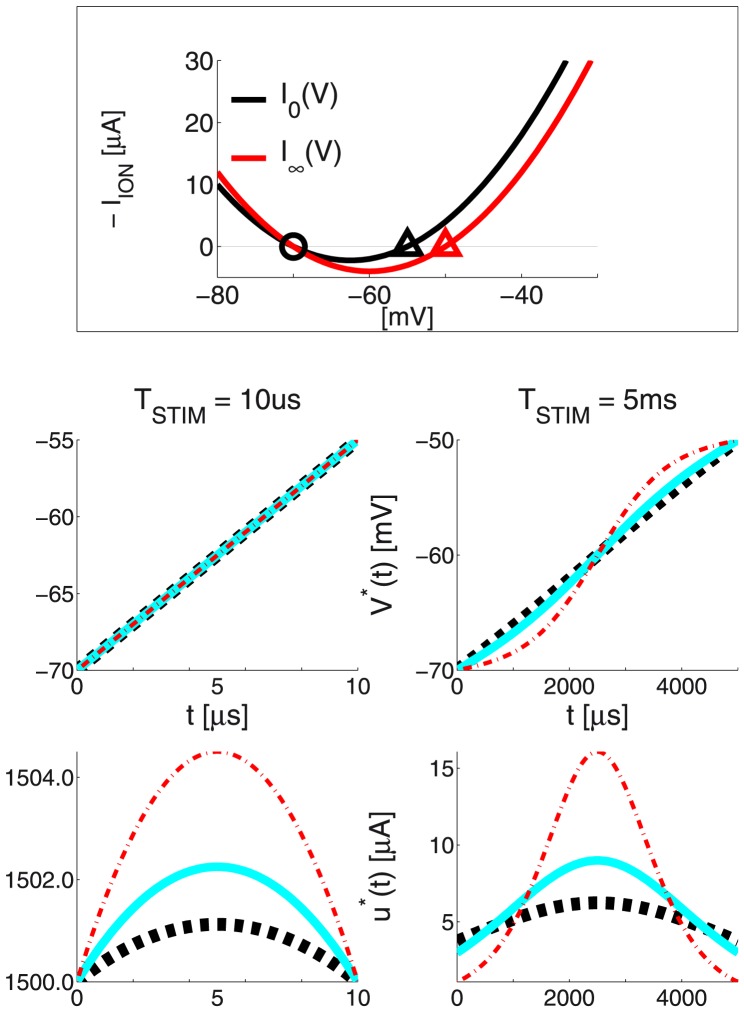
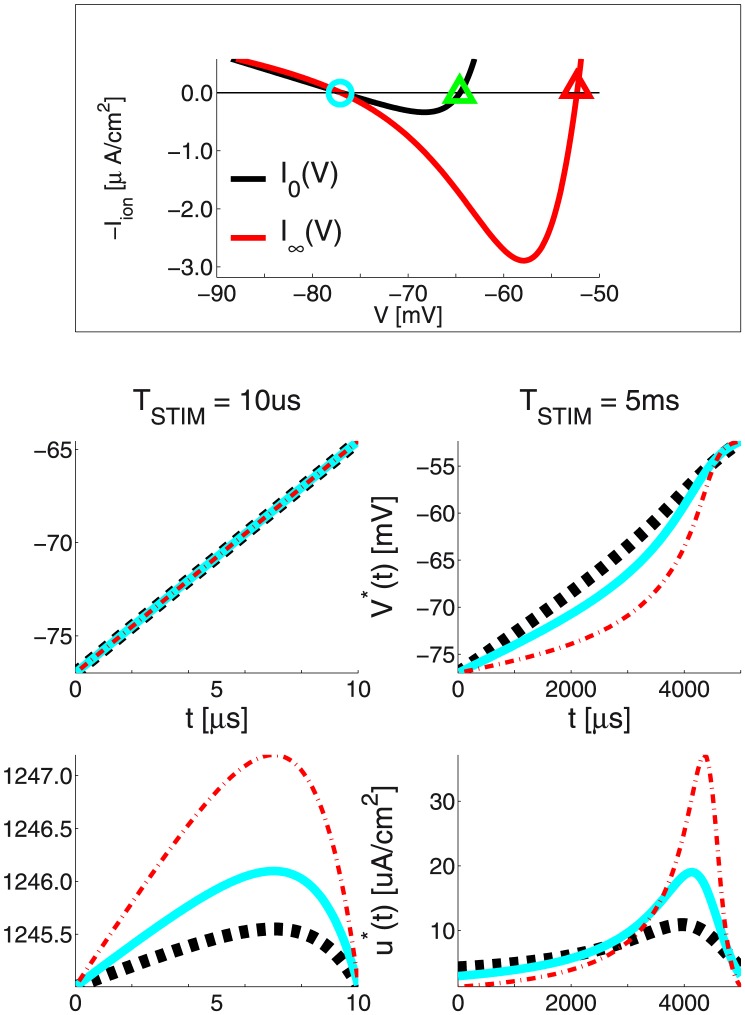
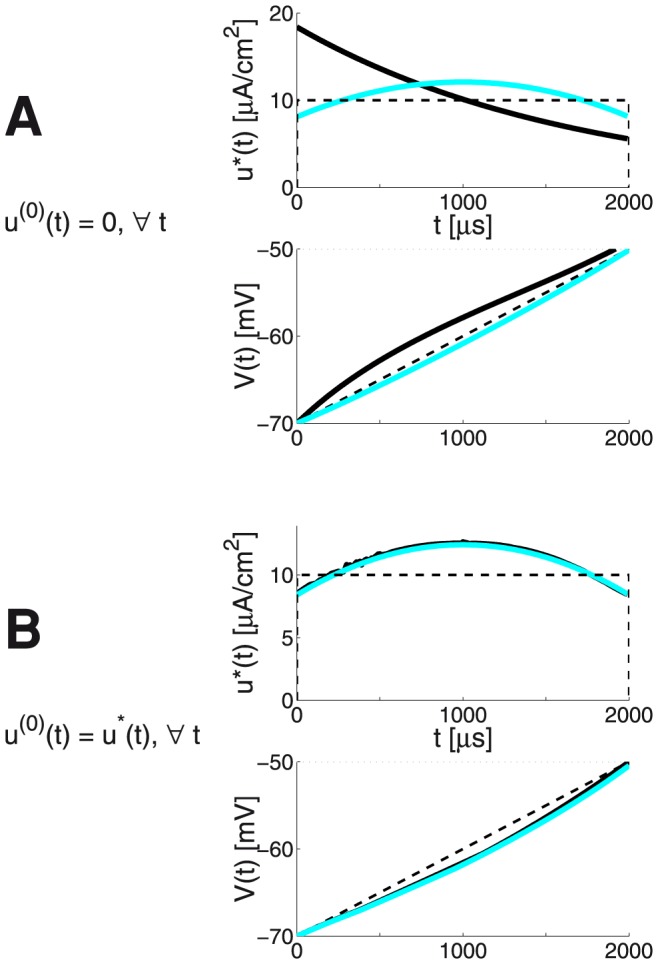
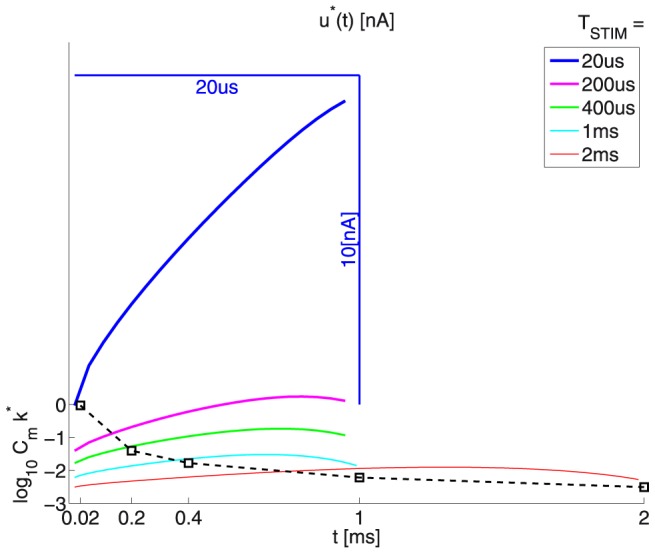
Electrical stimulation (ES) devices interact with excitable neural tissue toward eliciting action potentials (AP's) by specific current patterns. Low-energy ES prevents tissue damage and loss of specificity. Hence to identify optimal stimulation-current waveforms is a relevant problem, whose solution may have significant impact on the related medical (e.g. minimized side-effects) and engineering (e.g. maximized battery-life) efficiency. This has typically been addressed by simulation (of a given excitable-tissue model) and iterative numerical optimization with hard discontinuous constraints--e.g. AP's are all-or-none phenomena. Such approach is computationally expensive, while the solution is uncertain--e.g. may converge to local-only energy-minima and be model-specific. We exploit the Least-Action Principle (LAP). First, we derive in closed form the general template of the membrane-potential's temporal trajectory, which minimizes the ES energy integral over time and over any space-clamp ionic current model. From the given model we then obtain the specific energy-efficient current waveform, which is demonstrated to be globally optimal. The solution is model-independent by construction. We illustrate the approach by a broad set of example situations with some of the most popular ionic current models from the literature. The proposed approach may result in the significant improvement of solution efficiency: cumbersome and uncertain iteration is replaced by a single quadrature of a system of ordinary differential equations. The approach is further validated by enabling a general comparison to the conventional simulation and optimization results from the literature, including one of our own, based on finite-horizon optimal control. Applying the LAP also resulted in a number of general ES optimality principles. One such succinct observation is that ES with long pulse durations is much more sensitive to the pulse's shape whereas a rectangular pulse is most frequently optimal for short pulse durations.
电刺激(ES)设备通过特定电流模式与可兴奋神经组织相互作用以引发动作电位(AP)。低能量电刺激可防止组织损伤和特异性丧失。因此,确定最佳刺激电流波形是一个相关问题,其解决方案可能对相关医学(例如最小化副作用)和工程(例如最大化电池寿命)效率产生重大影响。这通常通过(给定可兴奋组织模型的)模拟以及具有硬不连续约束的迭代数值优化来解决——例如动作电位是全或无现象。这种方法计算成本高昂,而解决方案是不确定的——例如可能仅收敛到局部能量最小值且具有模型特异性。我们利用最小作用原理(LAP)。首先,我们以封闭形式推导膜电位时间轨迹的一般模板,该模板使电刺激能量积分在时间和任何空间钳制离子电流模型上最小化。然后从给定模型中获得特定的节能电流波形,该波形被证明是全局最优的。该解决方案在构建上与模型无关。我们通过文献中一些最流行的离子电流模型的广泛示例情况来说明该方法。所提出的方法可能会显著提高解决方案效率:繁琐且不确定的迭代被常微分方程组的单个求积所取代。通过与文献中的传统模拟和优化结果(包括我们自己基于有限时域最优控制的结果)进行一般比较,进一步验证了该方法。应用最小作用原理还产生了一些一般的电刺激最优性原则。一个这样简洁的观察结果是,长脉冲持续时间的电刺激对脉冲形状更为敏感,而矩形脉冲对于短脉冲持续时间最常是最优的。