Liu Zhengtao, Ning Huaijun, Que Shuping, Wang Linlin, Qin Xue, Peng Tao
Department of Hepatobiliary Surgery, First Affiliated Hospital of Guangxi Medical University, Nanning, China; National Center for International Research of Biological Targeting Diagnosis and Therapy, Guangxi Medical University, Nanning, China.
Department of Pediatrics, Women and children's hospital of Guangxi, Nanning, China.
PLoS One. 2014 Mar 14;9(3):e91410. doi: 10.1371/journal.pone.0091410. eCollection 2014.
Controversy exists in using alanine aminotransferase (ALT) activity for predicting long-term survival. Therefore, this research study investigated the association between ALT activity and mortality through a systematic review and meta-analysis of previous prospective studies.
Electronic literature databases, including PubMed, Embase, and the Institute for Scientific Information (ISI), were searched for relevant prospective observational studies (published before Dec 30, 2013) on the association between baseline ALT activity and ensuing all-cause/disease-specific mortality. Information on nationality, sample size, participant characteristics, follow-up duration, comparison, outcome assessment, hazard ratios (HRs) and adjusted covariates was extracted. Pooled HRs and corresponding 95% confidence intervals (CIs) were separately calculated for categorical risk estimates (highest vs. lowest ALT categories) and continuous risk estimates (per 5 U/l of ALT increment) in subgroups separated by age (<70/≥ 70 years).
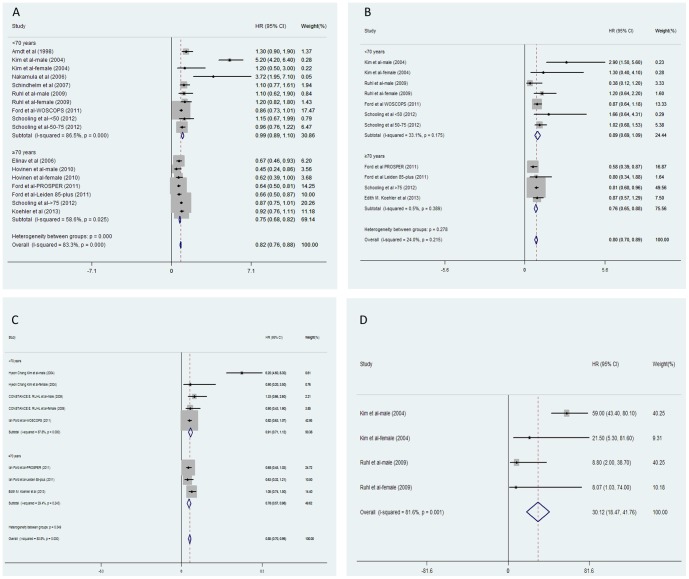
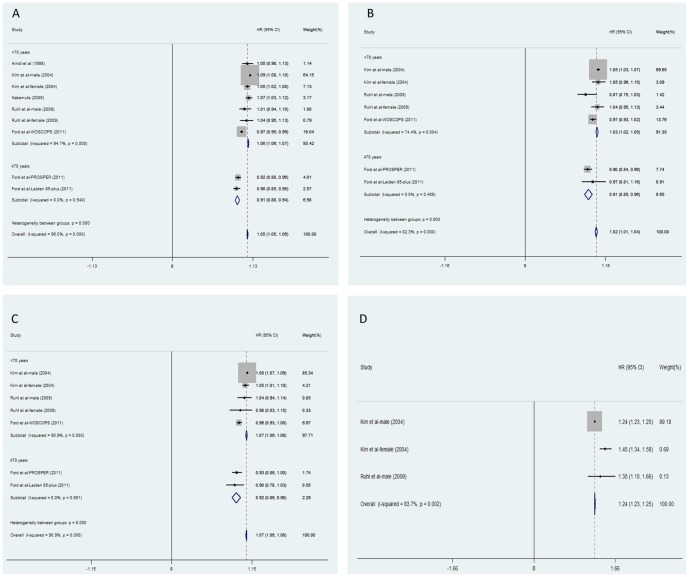
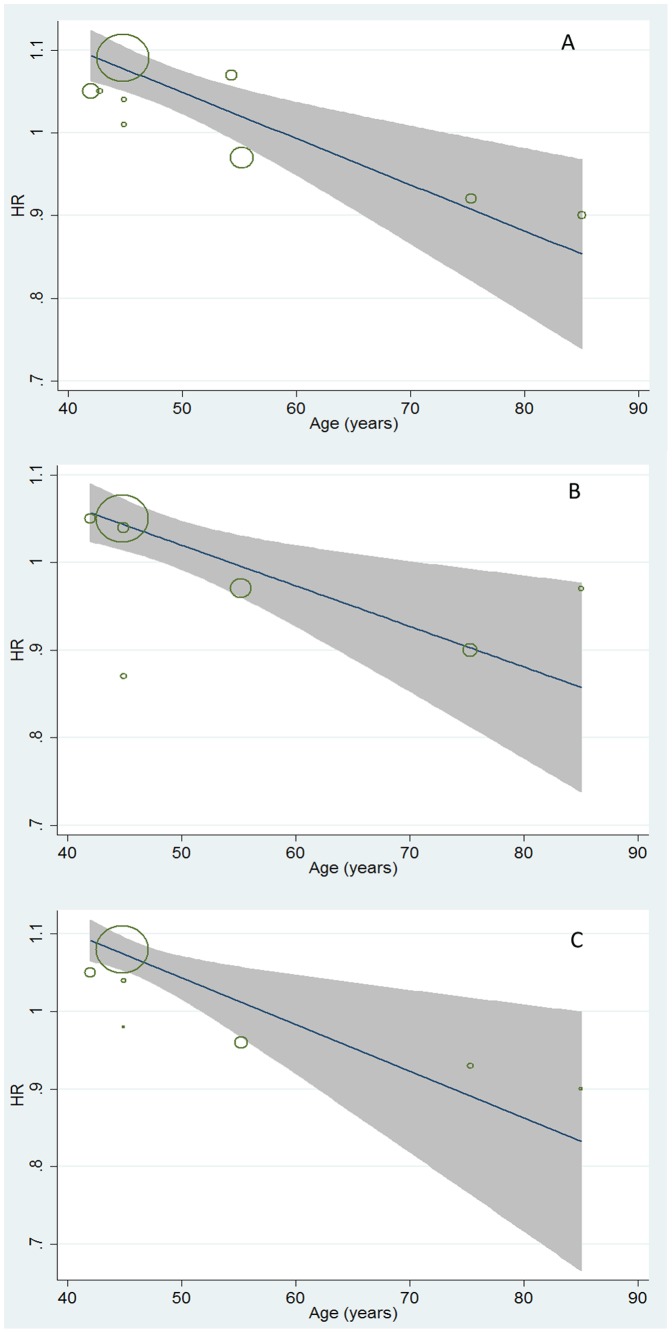
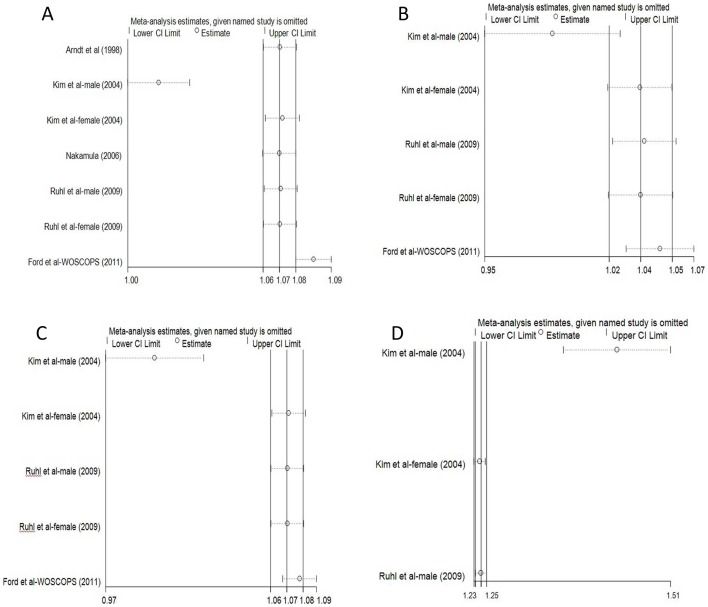
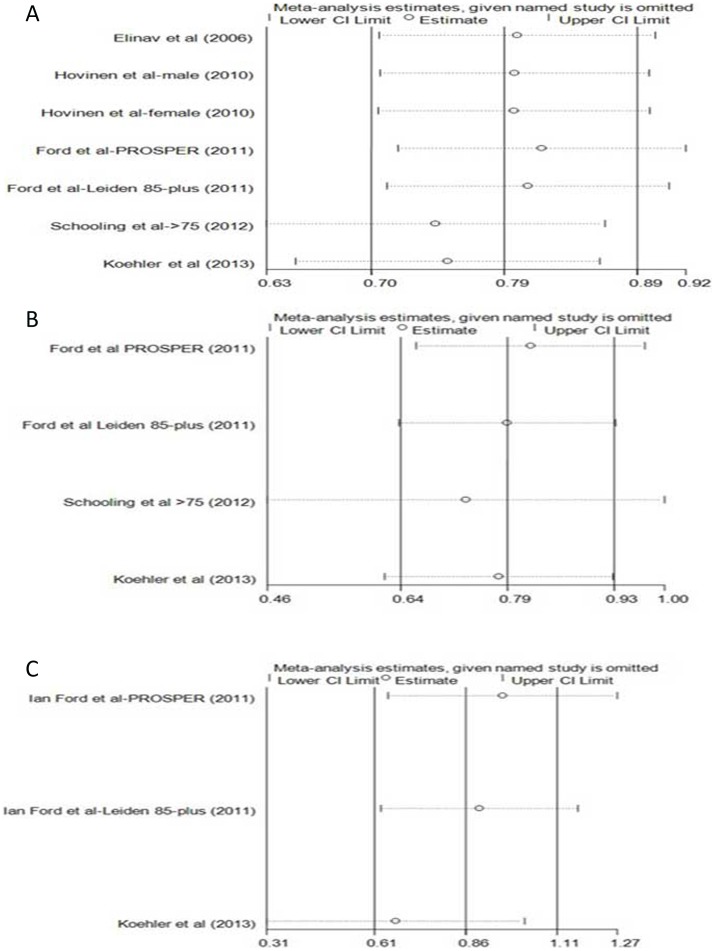
A total of twelve prospective cohort studies, totaling 206,678 participants and 16,249 deaths, were identified and analyzed. In the younger age group, the pooled HR for mortality related to liver-disease was about 1.24 (95% CI: 1.23-1.25) per 5 U/l of ALT increment. The dose-response HRs of all-cause mortality, cardiovascular (CV) disease-related mortality, and cancer-related mortality were 0.91 (0.88-0.94), 0.91 (0.85-0.96), 0.92 (0.86-0.98) respectively per 5 U/l of ALT elevation, with insignificant heterogeneity in the older population. There was an approximate decrease of 4‰ observed on HRs of all-cause, CV-related, and cancer-related mortality followed with one year's increment through meta-regression (all P<0.05).
The ALT-mortality association was inconsistent and seems particularly susceptible to age after synthesizing the previous prospective studies. In terms of the age, ALT activity was more valuable in predicting mortality in the older population; extremely low ALT levels indicated a higher all-cause, CV-related, and cancer-related mortality. ALT activity may therefore be a useful biomarker when predicting the long-term survival of elderly patients.
使用丙氨酸氨基转移酶(ALT)活性预测长期生存率存在争议。因此,本研究通过对既往前瞻性研究进行系统评价和荟萃分析,探讨ALT活性与死亡率之间的关联。
检索电子文献数据库,包括PubMed、Embase和科学信息研究所(ISI),以查找有关基线ALT活性与随后的全因/疾病特异性死亡率之间关联的相关前瞻性观察性研究(2013年12月30日前发表)。提取有关国籍、样本量、参与者特征、随访持续时间、比较、结局评估、风险比(HRs)和调整后的协变量的信息。分别针对按年龄(<70/≥70岁)划分的亚组中的分类风险估计值(最高ALT类别与最低ALT类别)和连续风险估计值(每增加5 U/l的ALT)计算合并HRs和相应的95%置信区间(CIs)。
共识别并分析了12项前瞻性队列研究,总计206,678名参与者和16,249例死亡。在较年轻年龄组中,每增加5 U/l的ALT,与肝病相关的死亡率的合并HR约为1.24(95%CI:1.23 - 1.25)。每升高5 U/l的ALT,全因死亡率、心血管(CV)疾病相关死亡率和癌症相关死亡率的剂量反应HR分别为0.91(0.88 - 0.94)、0.91(0.85 - 0.96)、0.92(0.86 - 0.98),在老年人群中异质性不显著。通过meta回归观察到,随着随访时间每增加一年,全因、CV相关和癌症相关死亡率的HRs约下降4‰(所有P<0.05)。
综合既往前瞻性研究后,ALT与死亡率之间的关联并不一致,且似乎特别受年龄影响。就年龄而言,ALT活性在预测老年人群的死亡率方面更有价值;极低的ALT水平表明全因、CV相关和癌症相关死亡率更高。因此,ALT活性在预测老年患者的长期生存率时可能是一种有用的生物标志物。