Peng Liu-Sheng, Zhuang Yuan, Li Wen-Hua, Zhou Yuan-Yuan, Wang Ting-Ting, Chen Na, Cheng Ping, Li Bo-Sheng, Guo Hong, Yang Shi-Ming, Chen Wei-San, Zou Quan-Ming
National Engineering Research Center of Immunological Products, Department of Microbiology and Biochemical Pharmacy, College of Pharmacy, Third Military Medical University, Chongqing, PR China.
Department of Gastroenterology, Xinqiao Hospital, Third Military Medical University, Chongqing, PR China.
PLoS One. 2014 Mar 14;9(3):e88270. doi: 10.1371/journal.pone.0088270. eCollection 2014.
Interleukin-32 (IL-32) is a recently discovered proinflammatory cytokine involved in inflammatory diseases. We investigated the expression of IL-32 and its regulation mechanism in the inflammatory response of patients with Helicobacter pylori (H. pylori) infection.
IL-32 mRNA and protein expression in gastric tissues was detected by quantitative real-time PCR and immunohistochemistry. The regulation of IL-32 in human gastric epithelia cell line AGS was investigated by different cytokine stimulation and different H. pylori strain infection.
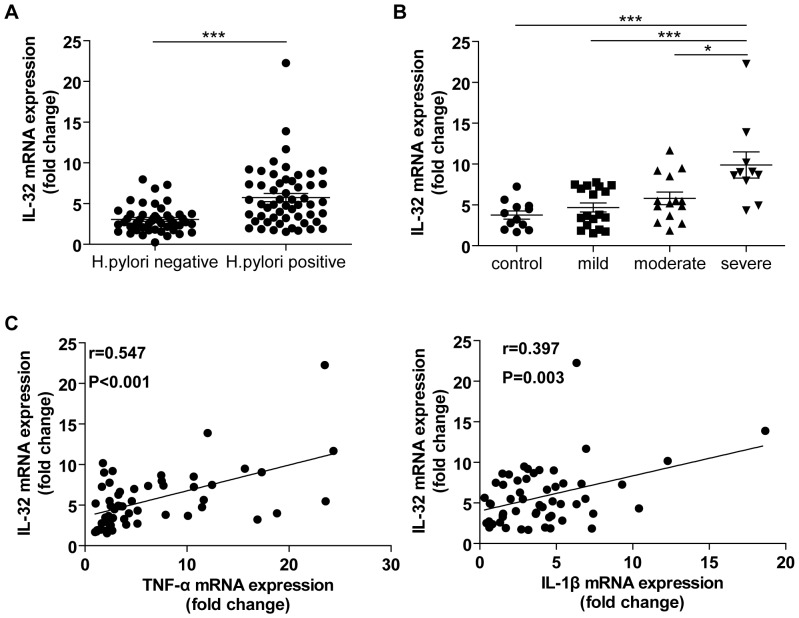
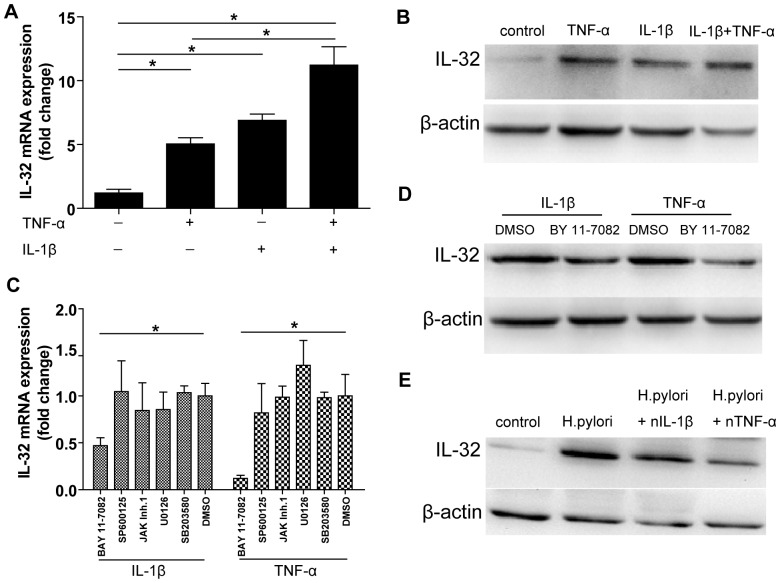
Gastric IL-32 mRNA and protein expression were elevated in patients with H. pylori infection and positively correlated with gastritis. In H. pylori-infected patients, the mRNA level of IL-32 was also correlated with that of proinflammatory cytokines IL-1β and TNF-α. In vitro IL-1β and TNF-α could upregulate IL-32 mRNA and protein level in AGS cells, which was dependent on NF-κB signal pathway. The regulation of IL-32 expression in response to H. pylori-infection could be weakened by using neutralizing antibodies to block IL-1β and TNF-α. Moreover, H. pylori-infected AGS cells also induced IL-32 mRNA and protein expression, which was dependent on CagA.
IL-32 level is elevated in patients with H. pylori infection and its expression is regulated by proinflammatory stimuli, suggesting that IL-32 may play a role in the pathogenesis of H. pylori-related gastritis.
白细胞介素-32(IL-32)是最近发现的一种参与炎症性疾病的促炎细胞因子。我们研究了幽门螺杆菌(H. pylori)感染患者炎症反应中IL-32的表达及其调控机制。
采用定量实时PCR和免疫组织化学检测胃组织中IL-32 mRNA和蛋白的表达。通过不同细胞因子刺激和不同幽门螺杆菌菌株感染,研究人胃上皮细胞系AGS中IL-32的调控情况。
幽门螺杆菌感染患者胃组织中IL-32 mRNA和蛋白表达升高,且与胃炎呈正相关。在幽门螺杆菌感染患者中,IL-32的mRNA水平也与促炎细胞因子IL-1β和TNF-α的水平相关。体外实验中,IL-1β和TNF-α可上调AGS细胞中IL-32 mRNA和蛋白水平,这依赖于NF-κB信号通路。使用中和抗体阻断IL-1β和TNF-α可减弱幽门螺杆菌感染对IL-32表达的调控。此外,幽门螺杆菌感染的AGS细胞也诱导IL-32 mRNA和蛋白表达,这依赖于CagA。
幽门螺杆菌感染患者的IL-32水平升高,其表达受促炎刺激调控,提示IL-32可能在幽门螺杆菌相关性胃炎的发病机制中起作用。