Huang Teng-Han, Yang Po-Kang, Lien Der-Hsien, Kang Chen-Fang, Tsai Meng-Lin, Chueh Yu-Lun, He Jr-Hau
Institute of Photonics and Optoelectronics & Department of Electrical Engineering, National Taiwan University, Taipei 10617, Taiwan, ROC.
Department of Materials Science and Engineering, National Tsing Hua University, Hsinchu 30013, Taiwan, ROC.
Sci Rep. 2014 Mar 18;4:4402. doi: 10.1038/srep04402.
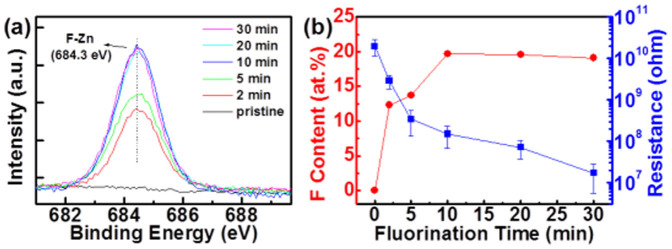
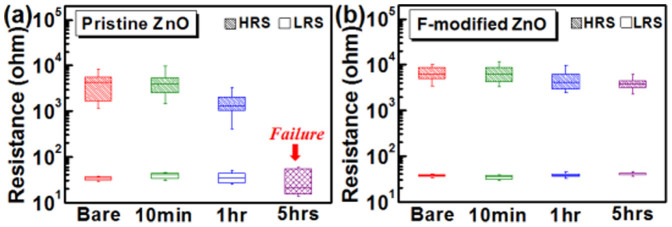
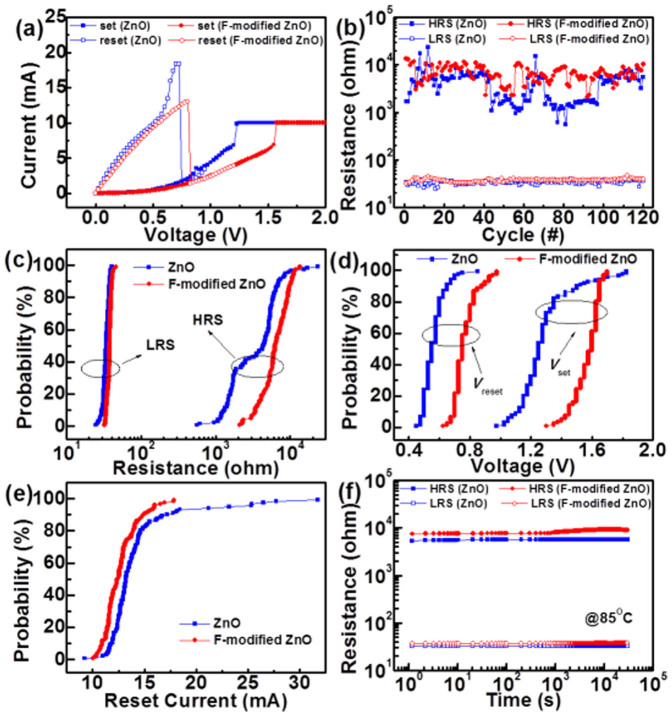
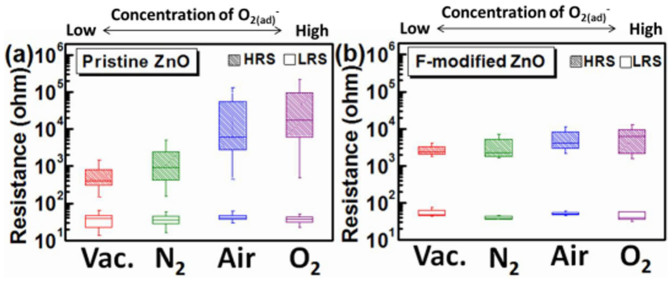
The tolerance/resistance of the electronic devices to extremely harsh environments is of supreme interest. Surface effects and chemical corrosion adversely affect stability and operation uniformity of metal oxide resistive memories. To achieve the surrounding-independent behavior, the surface modification is introduced into the ZnO memristors via incorporating fluorine to replace the oxygen sites. F-Zn bonds is formed to prevent oxygen chemisorption and ZnO dissolution upon corrosive atmospheric exposure, which effectively improves switching characteristics against harmful surroundings. In addition, the fluorine doping stabilizes the cycling endurance and narrows the distribution of switching parameters. The outcomes provide valuable insights for future nonvolatile memory developments in harsh electronics.
电子设备在极端恶劣环境下的耐受性/抗性备受关注。表面效应和化学腐蚀会对金属氧化物电阻式存储器的稳定性和操作均匀性产生不利影响。为实现与环境无关的性能,通过掺入氟来取代氧位点,将表面改性引入到氧化锌忆阻器中。形成F-Zn键以防止在腐蚀性大气暴露下的氧化学吸附和氧化锌溶解,这有效地改善了在有害环境中的开关特性。此外,氟掺杂稳定了循环耐久性并缩小了开关参数的分布。这些结果为未来恶劣环境下电子设备中的非易失性存储器发展提供了有价值的见解。