Institut de Pharmacologie Moléculaire et Cellulaire, UMR 7275 Centre National de la Recherche Scientifique/Université Nice Sophia Antipolis Valbonne, France.
Front Cell Neurosci. 2014 Mar 6;8:65. doi: 10.3389/fncel.2014.00065. eCollection 2014.
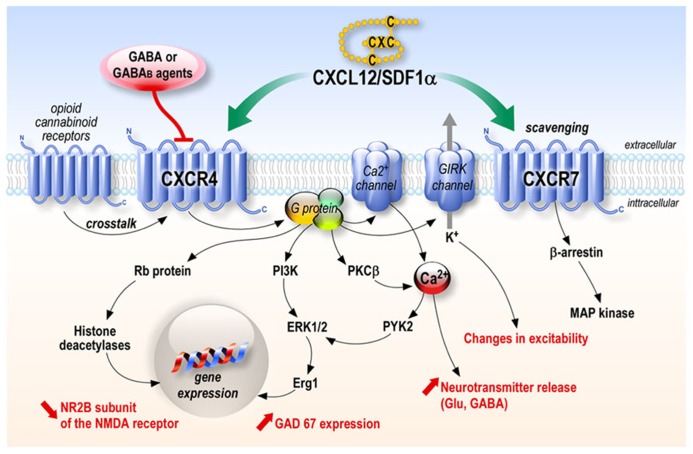
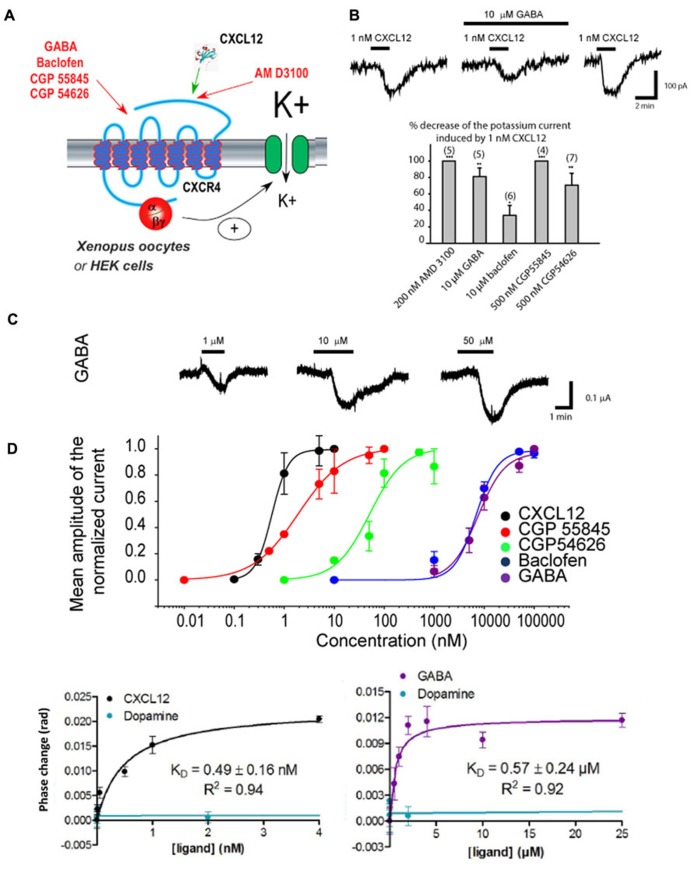
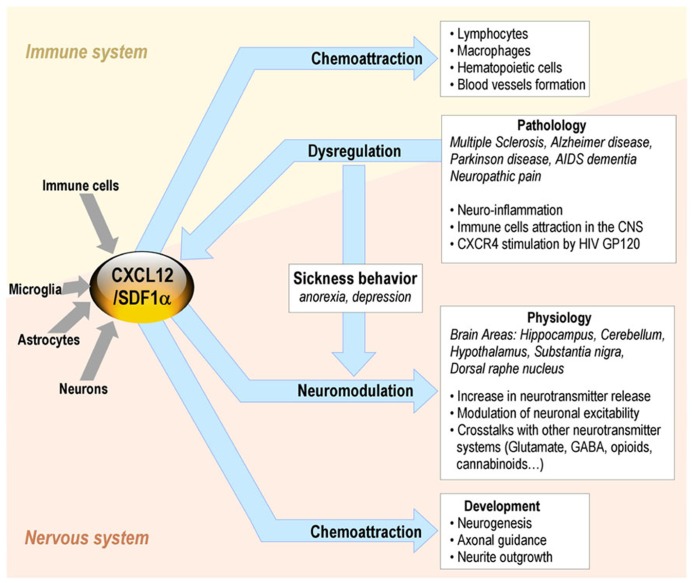
The chemokine CXCL12/stromal cell-derived factor 1 alpha has first been described in the immune system where it functions include chemotaxis for lymphocytes and macrophages, migration of hematopoietic cells from fetal liver to bone marrow and the formation of large blood vessels. Among other chemokines, CXCL12 has recently attracted much attention in the brain as it has been shown that it can be produced not only by glial cells but also by neurons. In addition, its receptors CXCR4 and CXCR7, which are belonging to the G protein-coupled receptors family, are abundantly expressed in diverse brain area, CXCR4 being a major co-receptor for human immunodeficiency virus 1 entry. This chemokine system has been shown to play important roles in brain plasticity processes occurring during development but also in the physiology of the brain in normal and pathological conditions. For example, in neurons, CXCR4 stimulation has been shown regulate the synaptic release of glutamate and γ-aminobutyric acid (GABA). It can also act post-synaptically by activating a G protein activated inward rectifier K(+) (GIRK), a voltage-gated K channel Kv2.1 associated to neuronal survival, and by increasing high voltage activated Ca(2+) currents. In addition, it has been recently evidenced that there are several cross-talks between the CXCL12/CXCR4-7 system and other neurotransmitter systems in the brain (such as GABA, glutamate, opioids, and cannabinoids). Overall, this chemokine system could be one of the key players of the neuro-immune interface that participates in shaping the brain in response to changes in the environment.
趋化因子 CXCL12/基质细胞衍生因子 1α 最初在免疫系统中被描述,其功能包括淋巴细胞和巨噬细胞的趋化作用、造血细胞从胎肝迁移到骨髓以及大血管的形成。在其他趋化因子中,CXCL12 最近在大脑中引起了广泛关注,因为已经表明它不仅可以由神经胶质细胞产生,也可以由神经元产生。此外,其受体 CXCR4 和 CXCR7,属于 G 蛋白偶联受体家族,在大脑的各种区域中大量表达,CXCR4 是人类免疫缺陷病毒 1 进入的主要共受体。已经表明,这个趋化因子系统在发育过程中发生的脑可塑性过程中以及在正常和病理条件下的大脑生理学中发挥着重要作用。例如,在神经元中,已经表明 CXCR4 刺激调节谷氨酸和 γ-氨基丁酸(GABA)的突触释放。它还可以通过激活 G 蛋白激活内向整流钾(GIRK)、与神经元存活相关的电压门控 K 通道 Kv2.1 和增加高电压激活的 Ca(2+)电流来发挥突触后作用。此外,最近已经证明,CXCL12/CXCR4-7 系统与大脑中的其他神经递质系统(如 GABA、谷氨酸、阿片类和大麻素)之间存在几种串扰。总的来说,这个趋化因子系统可能是参与响应环境变化塑造大脑的神经-免疫界面的关键参与者之一。