Hajizadeh Mohammad Reza, Eftekhar Ebrahim, Zal Fatemeh, Jafarian Aida, Mostafavi-Pour Zohreh
Department of Biochemistry, Rafsanjan University of Medical Sciences, Rafsanjan, Iran;
Molecular Medicine Research Center, Department of Biochemistry, Hormozgan University of Medical Sciences, Bandar Abbas, Iran;
Iran J Med Sci. 2014 Mar;39(2):123-9.
It has been proposed that oxidative stress may contribute to the development of testicular abnormalities in diabetes. Morus alba leaf extract (MAE) has hypoglycemic and antioxidant properties. We, therefore, explored the impact of the administration of MAE on steroidogenesis in diabetic rats.
To address this hypothesis, we measured the serum level of glucose, insulin, and free testosterone (Ts) as well as oxidative stress parameters (including glutathione peroxidase, glutathione reductase, total antioxidant capacity, and malondialdehyde) in the testis of control, untreated and MAE-treated (1 g/day/kg) diabetic rats. In order to determine the likely mechanism of MAE action on Ts levels, we analyzed the quantitative mRNA expression level of the two key steroidogenic proteins, namely steroid acute regulatory protein (StAR) and P450 cholesterol side-chain cleavage enzyme (P450scc), by real-time PCR.
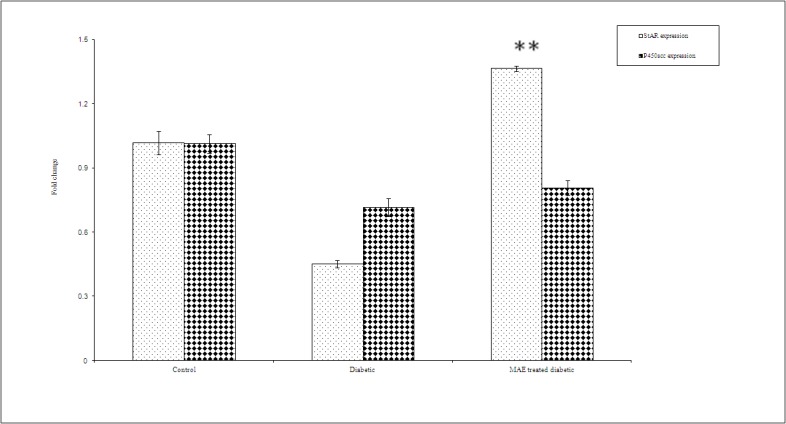
The MAE-treated diabetic rats had significantly decreased glucose levels and on the other hand increased insulin and free Ts levels than the untreated diabetic rats. In addition, the administration of MAE to the diabetic rats restored the oxidative stress parameters toward control. Induction of diabetes decreased testicular StAR mRNA expression by 66% and MAE treatment enhanced mRNA expression to the same level of the control group. However, the expression of P540scc was not significantly decreased in the diabetic group as compared to the control group.
Our findings indicated that MAE significantly increased Ts production in the diabetic rats, probably through the induction of StAR mRNA expression levels. Administration of MAE to experimental models of diabetes can effectively attenuate oxidative stress-mediated testosterone depletion.
有人提出氧化应激可能促成糖尿病患者睾丸异常的发展。桑叶提取物(MAE)具有降血糖和抗氧化特性。因此,我们探究了给予MAE对糖尿病大鼠类固醇生成的影响。
为验证这一假设,我们测量了对照组、未治疗组和MAE治疗组(1克/天/千克)糖尿病大鼠睾丸中的血糖、胰岛素和游离睾酮(Ts)血清水平以及氧化应激参数(包括谷胱甘肽过氧化物酶、谷胱甘肽还原酶、总抗氧化能力和丙二醛)。为确定MAE对Ts水平作用的可能机制,我们通过实时PCR分析了两种关键类固醇生成蛋白,即类固醇急性调节蛋白(StAR)和P450胆固醇侧链裂解酶(P450scc)的定量mRNA表达水平。
与未治疗的糖尿病大鼠相比,MAE治疗的糖尿病大鼠血糖水平显著降低,而胰岛素和游离Ts水平升高。此外,给糖尿病大鼠给予MAE可使氧化应激参数恢复至对照水平。糖尿病的诱导使睾丸StAR mRNA表达降低了66%,MAE治疗使mRNA表达增强至与对照组相同水平。然而,与对照组相比,糖尿病组中P540scc的表达没有显著降低。
我们的研究结果表明,MAE可能通过诱导StAR mRNA表达水平显著增加糖尿病大鼠的Ts生成。给糖尿病实验模型给予MAE可有效减轻氧化应激介导的睾酮耗竭。