Department of Veterinary Sciences, School of Agrarian and Veterinary Sciences, Universidade de Trás-os-Montes e Alto Douro (UTAD), Vila Real, Portugal.
Parasit Vectors. 2014 Mar 24;7:114. doi: 10.1186/1756-3305-7-114.
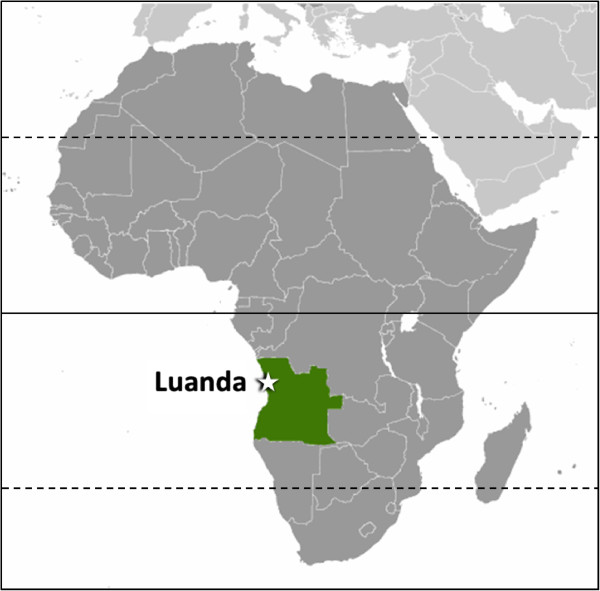
Canine leishmaniosis (CanL) due to Leishmania infantum is a global zoonosis endemic in more than 70 countries in Europe, North Africa, Asia and America; however, data on this infection is scarce from southern Africa. The aim of this study was to survey dogs in Luanda, Angola, for Leishmania infection.
One hundred-and-three dogs presented to a veterinary medical centre in Luanda were serologically and molecularly assessed for Leishmania with the direct agglutination test (DAT) and polymerase chain reaction (PCR). Two dogs were seropositive, with DAT titres of 800 and ≥6400; the latter was also found to be PCR-positive and confirmed to be infected with L. infantum by DNA sequence analysis. No other dog was found to be PCR-positive. The first dog had been imported from Portugal, but the latter had never left Angola (neither had its parents), strongly suggesting an autochthonous infection.
Although other cases of CanL have previously been described in the country, this is the first reported study of canine Leishmania infection at the population level, as well as the first report on the molecular characterization of L. infantum in dogs from Angola.
犬利什曼病(CanL)由婴儿利什曼原虫引起,是一种在欧洲、北非、亚洲和美洲 70 多个国家流行的全球性人畜共患病;然而,来自南部非洲的数据对此感染情况却很少。本研究旨在调查安哥拉罗安达的犬类是否感染利什曼原虫。
对罗安达一家兽医医疗中心的 103 只犬进行了血清学和分子学评估,以检测直接凝集试验(DAT)和聚合酶链反应(PCR)是否存在利什曼原虫感染。两只狗呈血清阳性,DAT 滴度分别为 800 和≥6400;后者还被发现 PCR 阳性,并通过 DNA 序列分析证实感染了婴儿利什曼原虫。没有其他狗被发现 PCR 阳性。第一只狗是从葡萄牙进口的,但第二只狗从未离开过安哥拉(它的父母也没有),强烈表明这是一种本地感染。
尽管该国以前曾描述过其他犬利什曼病病例,但这是首次在人群水平上对犬类利什曼原虫感染进行的研究,也是首次对来自安哥拉的犬类婴儿利什曼原虫的分子特征进行的报告。