Ambio. 2014 Sep;43(5):579-91. doi: 10.1007/s13280-014-0501-3.
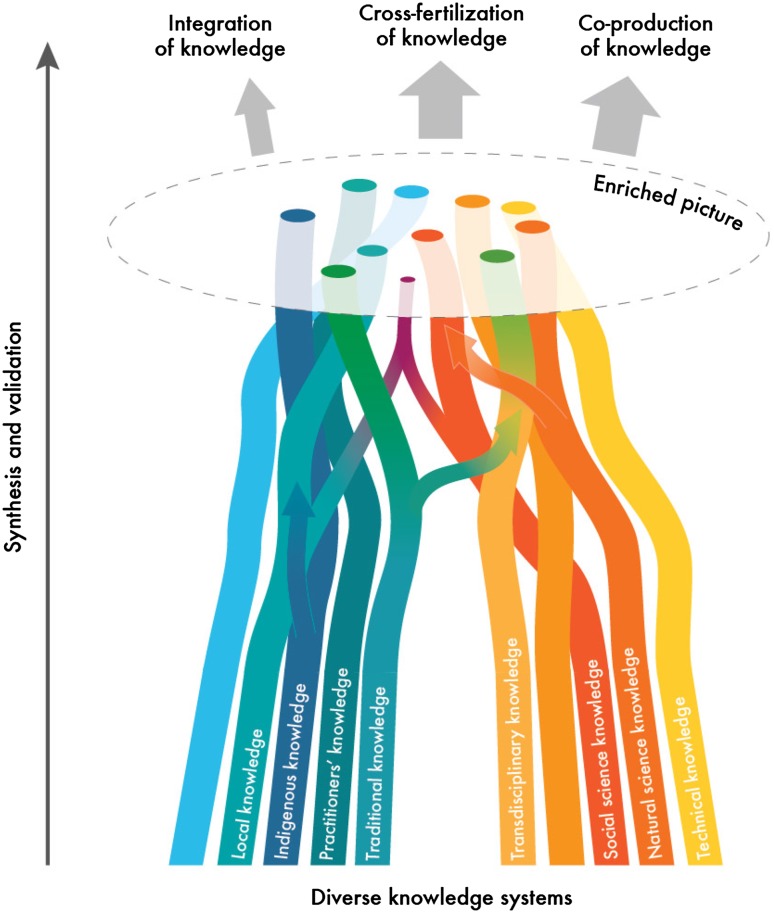
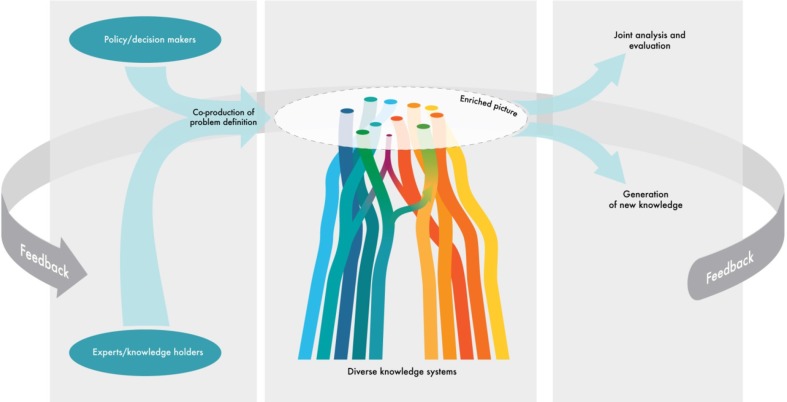
Indigenous and local knowledge systems as well as practitioners' knowledge can provide valid and useful knowledge to enhance our understanding of governance of biodiversity and ecosystems for human well-being. There is, therefore, a great need within emerging global assessment programs, such as the IPBES and other international efforts, to develop functioning mechanisms for legitimate, transparent, and constructive ways of creating synergies across knowledge systems. We present the multiple evidence base (MEB) as an approach that proposes parallels whereby indigenous, local and scientific knowledge systems are viewed to generate different manifestations of knowledge, which can generate new insights and innovations through complementarities. MEB emphasizes that evaluation of knowledge occurs primarily within rather than across knowledge systems. MEB on a particular issue creates an enriched picture of understanding, for triangulation and joint assessment of knowledge, and a starting point for further knowledge generation.
本土和本地知识体系以及从业者的知识可以提供有效和有用的知识,增强我们对生物多样性和生态系统治理以造福人类的理解。因此,新兴的全球评估计划,如生物多样性和生态系统服务政府间科学政策平台(IPBES)和其他国际努力,非常需要制定有效的机制,以合法、透明和建设性的方式在知识体系之间创造协同作用。我们提出了多元证据基础(MEB)方法,该方法提出了平行观点,即本土、本地和科学知识体系被视为产生不同形式的知识,这些知识可以通过互补性产生新的见解和创新。MEB 强调,知识的评估主要发生在知识体系内部,而不是在知识体系之间。关于特定问题的 MEB 为知识的三角和联合评估创造了一个丰富的理解图景,并为进一步的知识生成提供了起点。