Shariat Moharari Reza, Motalebi Majid, Najafi Atabak, Zamani Mohammad Mahdi, Imani Farsad, Etezadi Farhad, Pourfakhr Pejman, Khajavi Mohammad Reza
Department of Anesthesiology and Critical Care, Tehran University of Medical Sciences, Tehran, Iran.
Department of Anesthesiology and Critical Care, Iran University of Medical Sciences, Tehran, Iran.
Anesth Pain Med. 2013 Dec 6;4(1):e12750. doi: 10.5812/aapm.12750. eCollection 2014 Feb.
Magnesium is an antagonist of (N-methyl D-Aspartate) NMDA receptor and its related canals, and may affect perceived pain.
The aim of this study was to evaluate the impact of intravenous magnesium on the hemodynamic parameters, analgesic consumption and ileus.
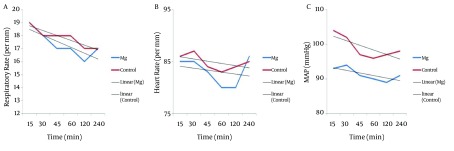
A randomized, double blind, placebo controlled study was performed. Thirty two patients of ASA I or II, scheduled for major gastrointestinal (GI) surgery, were divided into magnesium and control groups. Magnesium group received a bolus of 40 mg/kg of magnesium sulphate, followed by a continuous perfusion of 10 mg/kg/h for the intraoperative hours. Postoperative analgesia was ensured by Morphine patient-controlled analgesia (PCA). The patients were evaluated by Intraoperative hemodynamic parameters, the postoperative pain by numeral rating scale (NRS), and the total dose of intraoperative and postoperative analgesic consumption. Postoperative hemodynamic, respiratory parameters, physiological gastrointestinal obstruction (ileus), and side effects were also recorded.
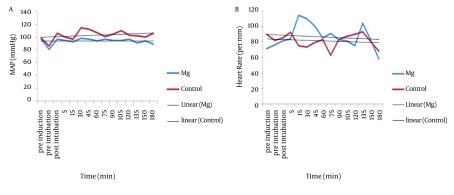
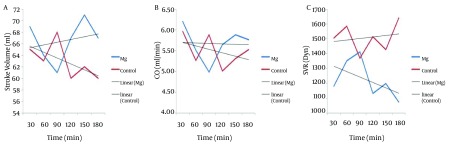
The study included 14 males and 18 females. Age range of patients was 17 to 55 years old. The average age in the magnesium group was 41.33 ± 10.06 years and45.13 ± 11.74 years in control group. Mean arterial pressure (MAP) of magnesium group decreased during the operation but increased in control group (P < 0.001), and systemic vascular resistance (SVR) of magnesium group decreased during the operation also (P < 0.02) but increased in control group. Postoperative cumulative Morphine consumption in magnesium group, was significantly in lower level (P = 0.026). For NRS, severe pain was significantly lower, in magnesium group, at all intervals of postoperative evaluations, but moderate and mild pain were not lower significantly. Duration of postoperative ileus was 2.3 ± 0.5 days in magnesium group, and 4.2 ± 0.6 days in control group (P = 0.01).
Intravenous magnesium reduces postoperative ileus, postoperative severe pain and intra/post operative analgesic requirements in patients after major GI surgery. No side effects of magnesium in these doses were seen, so it seems to be beneficial along with routine general anesthesia in major GI surgeries.
镁是(N - 甲基 - D - 天冬氨酸)NMDA受体及其相关通道的拮抗剂,可能会影响痛觉。
本研究旨在评估静脉注射镁对血流动力学参数、镇痛药物用量及肠梗阻的影响。
进行了一项随机、双盲、安慰剂对照研究。32例美国麻醉医师协会(ASA)分级为I或II级、计划行重大胃肠道(GI)手术的患者被分为镁组和对照组。镁组静脉推注40mg/kg硫酸镁,随后在手术期间以10mg/kg/h的速度持续输注。术后通过吗啡患者自控镇痛(PCA)确保镇痛效果。通过术中血流动力学参数对患者进行评估,术后疼痛采用数字评分量表(NRS)评估,并记录术中和术后镇痛药物的总用量。还记录了术后的血流动力学、呼吸参数、生理性胃肠道梗阻(肠梗阻)及副作用。
该研究纳入了14名男性和18名女性。患者年龄范围为17至55岁。镁组的平均年龄为41.33±10.06岁,对照组为45.13±11.74岁。镁组的平均动脉压(MAP)在手术期间下降,而对照组上升(P<0.001),镁组的全身血管阻力(SVR)在手术期间也下降(P<0.02),而对照组上升。镁组术后吗啡累积用量显著较低(P = 0.026)。对于NRS,在术后评估的所有时间段内,镁组的重度疼痛显著较低,但中度和轻度疼痛并无显著降低。镁组术后肠梗阻持续时间为2.3±0.5天,对照组为4.2±0.