Fujioka Kazumichi, Shibata Akio, Yokota Tomoyuki, Koda Tsubasa, Nagasaka Miwako, Yagi Mariko, Takeshima Yasuhiro, Yamada Hideto, Iijima Kazumoto, Morioka Ichiro
Department of Pediatrics, Kobe University Hospital, Kobe, Japan.
Department of Obstetrics and Gynecology, Kobe University Hospital, Kobe, Japan.
Sci Rep. 2014 Mar 25;4:4459. doi: 10.1038/srep04459.
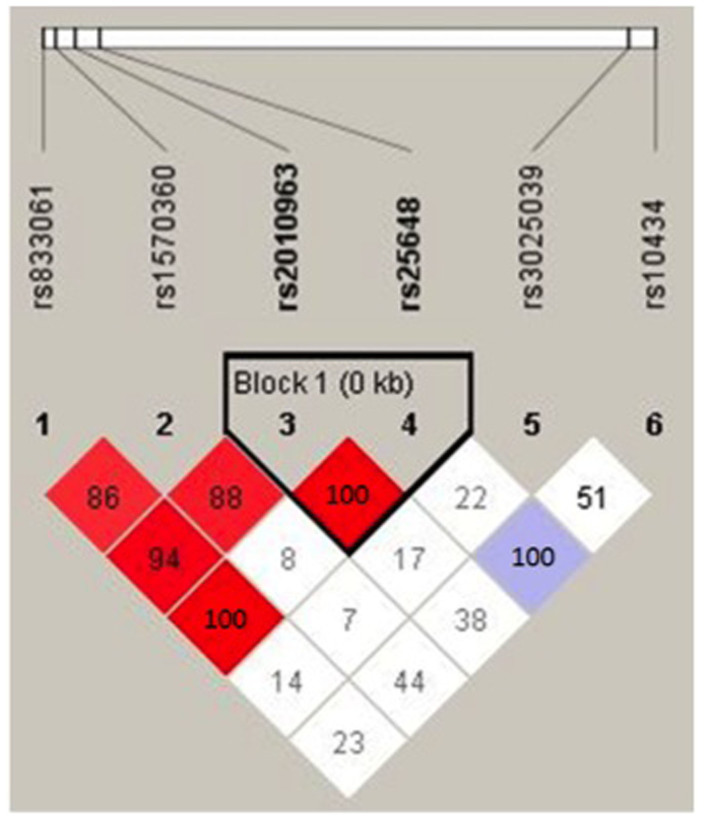
Our objective was to correlate vascular endothelial growth factor (VEGF) genetic polymorphisms with the risk of bronchopulmonary dysplasia (BPD) development in premature newborns. Fifty-five newborns with BPD (BPD: median gestational age [GA]: 27 weeks, birthweight [BW]: 786 g) and 42 newborns without BPD (non-BPD: median GA: 29 weeks, BW: 1,165 g), who were born at <32 weeks gestational age and were admitted to Kobe University Hospital, were included. BPD was defined as oxygen dependency at 36 weeks postmenstrual age. Genomic DNA was extracted from the umbilical cord, cord blood, or buccal mucosa. Six VEGF genotypes (-1498T > C, -1154G > A, -634C > G, -7C > T, 936C > T, and 1612G > A) were determined by DNA sequencing. Clinical characteristics, and allele and genotype frequencies of VEGF in the BPD and non-BPD groups were analyzed. G allele frequencies in -634C > G of the BPD group were significantly higher than in the non-BPD group (66.4% vs. 50%, P = 0.02). -634C > G genotype distributions differed significantly between the BPD and non-BPD groups (BPD: CC 7%/CG 53%/GG 40%; non-BPD: CC 24%/CG 52%/GG 24%; P = 0.04). Multivariate logistic regression showed that duration of ventilation, VEGF-634G > C G alleles, and male gender were independent risk factors for BPD. In conclusion, polymorphism VEGF -634C > G may influence the risk of BPD.
我们的目的是将血管内皮生长因子(VEGF)基因多态性与早产儿支气管肺发育不良(BPD)的发生风险相关联。纳入了55例患有BPD的新生儿(BPD:中位胎龄[GA]:27周,出生体重[BW]:786 g)和42例未患BPD的新生儿(非BPD:中位GA:29周,BW:1165 g),这些新生儿均在孕32周前出生并入住神户大学医院。BPD定义为月经龄36周时需氧依赖。从脐带、脐血或颊黏膜中提取基因组DNA。通过DNA测序确定6种VEGF基因型(-1498T>C、-1154G>A、-634C>G、-7C>T、936C>T和1612G>A)。分析了BPD组和非BPD组的临床特征以及VEGF的等位基因和基因型频率。BPD组- _634C>G_中G等位基因频率显著高于非BPD组(66.4%对50%,P = 0.02)。BPD组和非BPD组之间-634C>G基因型分布差异显著(BPD:CC 7%/CG 53%/GG 40%;非BPD:CC 24%/CG 52%/GG 24%;P = 0.04)。多因素logistic回归显示,机械通气时间、VEGF -634G>C G等位基因和男性性别是BPD的独立危险因素。总之,VEGF -634C>G多态性可能影响BPD的发生风险。