Jia Wei, Li Gang, Wang Wen
Medical Experimental Center, General Hospital of Ningxia Medical University, 804 Shengli Street, Yinchuan City 750004, Ningxia Hui Autonomous Region, China.
Int J Environ Res Public Health. 2014 Mar 21;11(3):3424-42. doi: 10.3390/ijerph110303424.
to investigate the prevalence and antimicrobial resistance of Enterococcus species isolated from a university hospital, and explore the mechanisms underlying the antimicrobial resistance, so as to provide clinical evidence for the inappropriate clinical use of antimicrobial agents and the control and prevention of enterococcal infections.
a total of 1,157 enterococcal strains isolated from various clinical specimens from January 2010 to December 2012 in the General Hospital of Ningxia Medical University were identified to species level with a VITEK-2 COMPACT fully automated microbiological system, and the antimicrobial susceptibility of Enterococcus species was determined using the Kirby-Bauer disc diffusion method. The multiple-drug resistant enterococcal isolates were screened from the clinical isolates of Enterococcus species from the burns department. The minimal inhibitory concentration (MIC) of Enterococcus species to the three fluoroquinolones, including ciprofloxacin, gatifloxacin and levofloxacin was determined with the agar dilution method, and the changes in the MIC of Enterococcus species to the three fluoroquinolones following reserpine treatment were evaluated. The β-lactam, aminoglycoside, tetracycline, macrolide, glycopeptide resistance genes and the efflux pump emeA genes were detected in the enterococcal isolates using a polymerase chain reaction (PCR) assay.
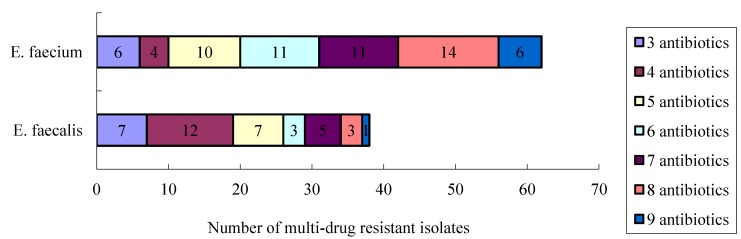
the 1,157 clinical isolates of Enterococcus species included 679 E. faecium isolates (58.7%), 382 E. faecalis isolates (33%), 26 E. casseliflavus isolates (2.2%), 24 E. avium isolates (2.1%), and 46 isolates of other Enterococcus species (4%). The prevalence of antimicrobial resistance varied significantly between E. faecium and E. faecalis, and ≤ 1.1% of these two Enterococcus species were found to be resistant to vancomycin, teicoplanin or linezolid. In addition, the Enterococcus species isolated from different departments of the hospital exhibited various resistances to the same antimicrobial agent, while reserpine treatment reduced the resistance of Enterococcus species to ciprofloxacin, gatifloxacin and levofloxacin. The β-lactamase gene TEM, aminoglycoside-modifying-enzyme genes aac(6')-aph(2"), aph(3')-III, ant(6)-I and ant(2")-I, tetracycline resistance gene tetM, erythromycin resistance gene ermB, vancomycin resistance gene vanA and the enterococcal multidrug resistance efflux emeA gene were detected in 77%, 62%, 26%, 13%, 36%, 31%, 66%, 5% and 55% of the 100 multiple-drug resistant enterococcal isolates.
similar to previous findings, E. faecium and E. faecalis are predominant conditionally pathogenic bacteria that cause hospital-acquired infections that can cause urinary and respiratory system infections. Multiple and high-level antimicrobial resistance is highly prevalent in the hospital isolates of Enterococcus species. Reserpine treatment inhibits the active efflux of Enterococcus species to ciprofloxacin, gatifloxacin and levofloxacin in vitro and reduces the MIC of Enterococcus species to these three fluoroquinolones. The presence of the enterococcal multidrug resistance efflux emeA gene is associated with the resistance to antibiotics in Enterococcus species. The monitoring of the prevalence and antimicrobial resistance of Enterococcus species is of great significance to guide the control and prevention of enterococcal infections.
调查某大学医院分离出的肠球菌属的流行情况及抗菌药物耐药性,探讨其耐药机制,为抗菌药物临床不合理使用及肠球菌感染的防控提供临床依据。
采用VITEK-2 COMPACT全自动微生物系统对2010年1月至2012年12月宁夏医科大学总医院从各类临床标本中分离出的1157株肠球菌进行菌种鉴定,采用 Kirby-Bauer 纸片扩散法测定肠球菌属的抗菌药物敏感性。从烧伤科肠球菌属临床分离株中筛选出多重耐药肠球菌分离株。采用琼脂稀释法测定肠球菌属对环丙沙星、加替沙星和左氧氟沙星这三种氟喹诺酮类药物的最低抑菌浓度(MIC),并评估利血平处理后肠球菌属对这三种氟喹诺酮类药物MIC的变化。采用聚合酶链反应(PCR)检测肠球菌分离株中的β-内酰胺、氨基糖苷、四环素、大环内酯、糖肽类耐药基因及外排泵emeA基因。
1157株肠球菌属临床分离株中,粪肠球菌679株(58.7%),屎肠球菌382株(33%),格氏肠球菌26株(2.2%),鸟肠球菌24株(2.1%),其他肠球菌属46株(4%)。粪肠球菌和屎肠球菌的抗菌药物耐药率差异显著,这两种肠球菌对万古霉素、替考拉宁或利奈唑胺的耐药率均≤1.1%。此外,从医院不同科室分离出的肠球菌属对同一抗菌药物表现出不同的耐药性,而利血平处理降低了肠球菌属对环丙沙星、加替沙星和左氧氟沙星的耐药性。在100株多重耐药肠球菌分离株中,β-内酰胺酶基因TEM、氨基糖苷类修饰酶基因aac(6')-aph(2")、aph(3')-III、ant(6)-I和ant(2")-I、四环素耐药基因tetM、红霉素耐药基因ermB、万古霉素耐药基因vanA及肠球菌多重耐药外排emeA基因的检出率分别为77%、62%、26%、13%、36%、31%、66%、5%和55%。
与以往研究结果相似,粪肠球菌和屎肠球菌是引起医院获得性感染的主要条件致病菌,可导致泌尿系统和呼吸系统感染。肠球菌属医院分离株中多重及高水平抗菌药物耐药现象普遍存在。利血平处理在体外可抑制肠球菌属对环丙沙星、加替沙星和左氧氟沙星的主动外排,降低肠球菌属对这三种氟喹诺酮类药物的MIC。肠球菌多重耐药外排emeA基因的存在与肠球菌属对抗生素的耐药性有关。监测肠球菌属的流行情况及抗菌药物耐药性对指导肠球菌感染的防控具有重要意义。
