Psychological Institute, Department of Neuropsychology, University of Zurich, Zurich, Switzerland.
Behav Brain Funct. 2014 Mar 26;10:10. doi: 10.1186/1744-9081-10-10.
Whether listening to background music enhances verbal learning performance is still a matter of dispute. In this study we investigated the influence of vocal and instrumental background music on verbal learning.
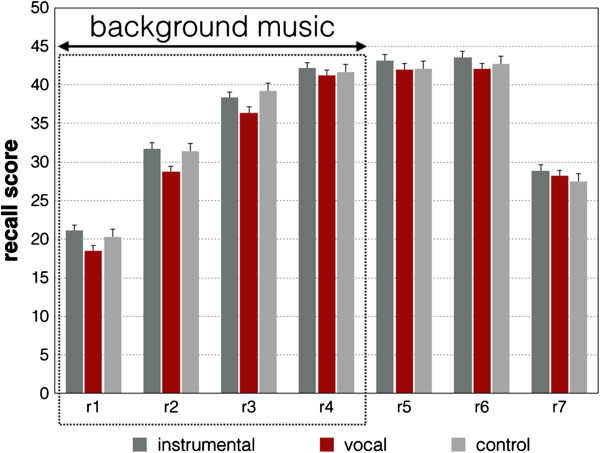
226 subjects were randomly assigned to one of five groups (one control group and 4 experimental groups). All participants were exposed to a verbal learning task. One group served as control group while the 4 further groups served as experimental groups. The control group learned without background music while the 4 experimental groups were exposed to vocal or instrumental musical pieces during learning with different subjective intensity and valence. Thus, we employed 4 music listening conditions (vocal music with high intensity: VOC_HIGH, vocal music with low intensity: VOC_LOW, instrumental music with high intensity: INST_HIGH, instrumental music with low intensity: INST_LOW) and one control condition (CONT) during which the subjects learned the word lists. Since it turned out that the high and low intensity groups did not differ in terms of the rated intensity during the main experiment these groups were lumped together. Thus, we worked with 3 groups: one control group and two groups, which were exposed to background music (vocal and instrumental) during verbal learning. As dependent variable, the number of learned words was used. Here we measured immediate recall during five learning sessions (recall 1 - recall 5) and delayed recall for 15 minutes (recall 6) and 14 days (recall 7) after the last learning session.
Verbal learning improved during the first 5 recall sessions without any strong difference between the control and experimental groups. Also the delayed recalls were similar for the three groups. There was only a trend for attenuated verbal learning for the group passively listened to vocals. This learning attenuation diminished during the following learning sessions.
The exposure to vocal or instrumental background music during encoding did not influence verbal learning. We suggest that the participants are easily able to cope with this background stimulation by ignoring this information channel in order to focus on the verbal learning task.
听背景音乐是否能提高语言学习表现仍然存在争议。在这项研究中,我们调查了声乐和器乐背景音乐对语言学习的影响。
226 名受试者被随机分配到五组之一(一个对照组和 4 个实验组)。所有参与者都接受了语言学习任务。一组作为对照组,而另外四组作为实验组,在学习过程中暴露于不同主观强度和效价的声乐或器乐乐曲中。因此,我们在学习过程中采用了 4 种音乐聆听条件(高强度声乐:VOC_HIGH、低强度声乐:VOC_LOW、高强度器乐:INST_HIGH、低强度器乐:INST_LOW)和一种控制条件(CONT),在控制条件下,受试者学习单词列表。由于在主要实验中高、低强度组在评定强度方面没有差异,因此将这两组合并。因此,我们使用了 3 个组:一个对照组和两个在语言学习过程中暴露于背景音乐(声乐和器乐)的组。作为因变量,使用学习单词的数量。在这里,我们在五个学习阶段(回忆 1-回忆 5)中测量了即时回忆,在最后一个学习阶段 15 分钟(回忆 6)和 14 天后(回忆 7)测量了延迟回忆。
在最初的 5 次回忆阶段,语言学习有所提高,对照组和实验组之间没有明显差异。三组的延迟回忆也相似。只有被动听声乐的组语言学习有减弱的趋势。这种学习衰减在随后的学习阶段逐渐减弱。
在编码过程中暴露于声乐或器乐背景音乐不会影响语言学习。我们认为,参与者很容易通过忽略这个信息通道来应对这种背景刺激,以便专注于语言学习任务。