University of Florida, Whitney Marine Laboratory, 9505 Oceanshore Boulevard, St, Augustine, FL 32080, USA.
BMC Biol. 2014 Mar 26;12:24. doi: 10.1186/1741-7007-12-24.
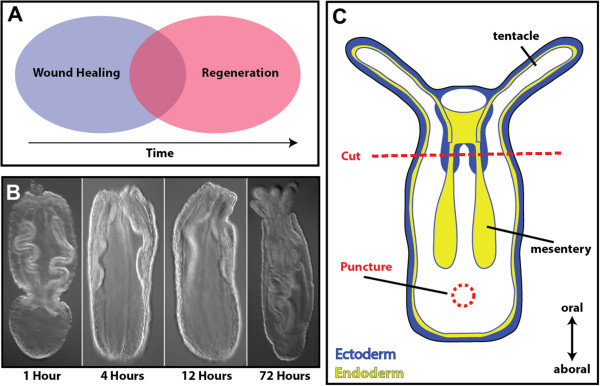
Wound healing is the first stage of a series of cellular events that are necessary to initiate a regenerative response. Defective wound healing can block regeneration even in animals with a high regenerative capacity. Understanding how signals generated during wound healing promote regeneration of lost structures is highly important, considering that virtually all animals have the ability to heal but many lack the ability to regenerate missing structures. Cnidarians are the phylogenetic sister taxa to bilaterians and are highly regenerative animals. To gain a greater understanding of how early animals generate a regenerative response, we examined the cellular and molecular components involved during wound healing in the anthozoan cnidarian Nematostella vectensis.
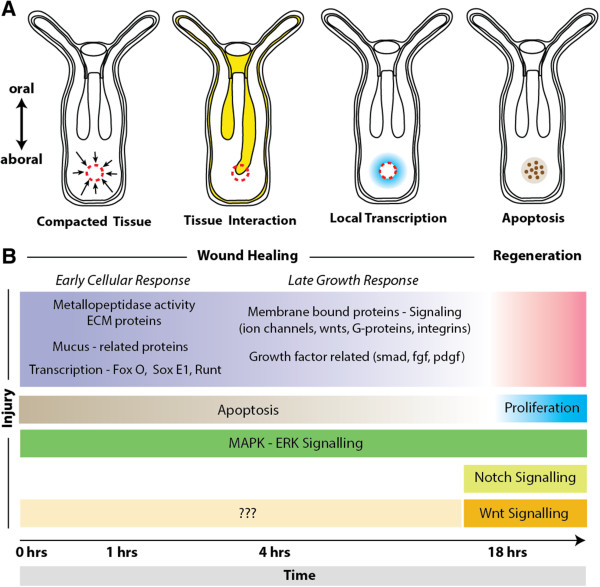
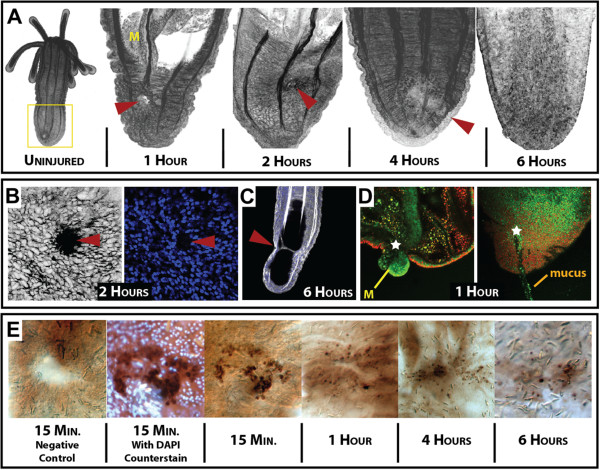
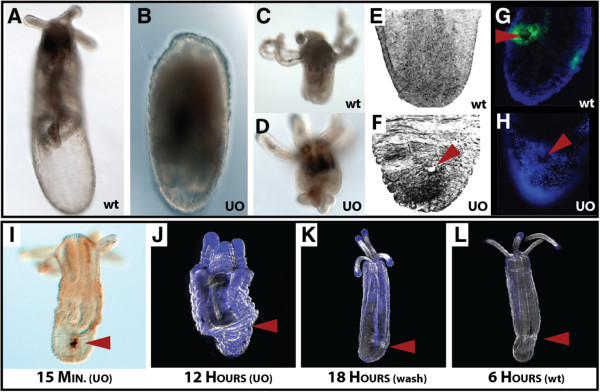
Pharmacological inhibition of extracellular signal-regulated kinases (ERK) signaling blocks regeneration and wound healing in Nematostella. We characterized early and late wound healing events through genome-wide microarray analysis, quantitative PCR, and in situ hybridization to identify potential wound healing targets. We identified a number of genes directly related to the wound healing response in other animals (metalloproteinases, growth factors, transcription factors) and suggest that glycoproteins (mucins and uromodulin) play a key role in early wound healing events. This study also identified a novel cnidarian-specific gene, for a thiamine biosynthesis enzyme (vitamin B synthesis), that may have been incorporated into the genome by lateral gene transfer from bacteria and now functions during wound healing. Lastly, we suggest that ERK signaling is a shared element of the early wound response for animals with a high regenerative capacity.
This research describes the temporal events involved during Nematostella wound healing, and provides a foundation for comparative analysis with other regenerative and non-regenerative species. We have shown that the same genes that heal puncture wounds are also activated after oral-aboral bisection, indicating a clear link with the initiation of regenerative healing. This study demonstrates the strength of using a forward approach (microarray) to characterize a developmental phenomenon (wound healing) at a phylogenetically important crossroad of animal evolution (cnidarian-bilaterian ancestor). Accumulation of data on the early wound healing events across numerous systems may provide clues as to why some animals have limited regenerative abilities.
伤口愈合是一系列细胞事件的第一阶段,这些事件对于启动再生反应是必要的。在具有高再生能力的动物中,伤口愈合缺陷甚至可以阻止再生。了解在伤口愈合过程中产生的信号如何促进丢失结构的再生非常重要,因为几乎所有动物都有愈合伤口的能力,但许多动物缺乏再生缺失结构的能力。刺胞动物是两侧对称动物的系统发育姊妹群,是高度再生的动物。为了更深入地了解早期动物如何产生再生反应,我们研究了刺胞动物 Nematostella vectensis 中参与伤口愈合的细胞和分子成分。
细胞外信号调节激酶 (ERK) 信号的药理学抑制阻断了 Nematostella 的再生和伤口愈合。我们通过全基因组微阵列分析、定量 PCR 和原位杂交来描述早期和晚期伤口愈合事件,以鉴定潜在的伤口愈合靶标。我们鉴定了许多与其他动物的伤口愈合反应直接相关的基因(金属蛋白酶、生长因子、转录因子),并认为糖蛋白(粘蛋白和尿调素)在早期伤口愈合事件中起关键作用。这项研究还鉴定了一种新的刺胞动物特异性基因,用于硫胺素生物合成酶(维生素 B 合成),它可能通过来自细菌的侧向基因转移被整合到基因组中,现在在伤口愈合过程中发挥作用。最后,我们认为 ERK 信号是具有高再生能力的动物早期伤口反应的共同元素。
这项研究描述了 Nematostella 伤口愈合过程中涉及的时间事件,并为与其他再生和非再生物种进行比较分析提供了基础。我们已经表明,愈合穿刺伤口的相同基因也在口-肛二分体后被激活,这表明与再生愈合的启动有明显的联系。这项研究表明,使用正向方法(微阵列)来描述发育现象(伤口愈合)在动物进化的重要交汇点(刺胞动物-两侧对称动物的祖先)具有优势。在许多系统中积累有关早期伤口愈合事件的数据,可能为某些动物再生能力有限的原因提供线索。