Herrera Blanca, Dooley Steven, Breitkopf-Heinlein Katja
Department of Biochemistry and Molecular Biology II, Faculty of Pharmacy, Complutense University of Madrid, San Carlos Clinical Hospital Health Research Institute (IdISSC), Madrid 28040, Spain.
Department of Medicine II, Section Molecular Hepatology-Alcohol Associated Diseases, Medical Faculty Mannheim, Heidelberg University, Mannheim 68167, Germany.
Int J Mol Sci. 2014 Mar 25;15(4):5199-220. doi: 10.3390/ijms15045199.
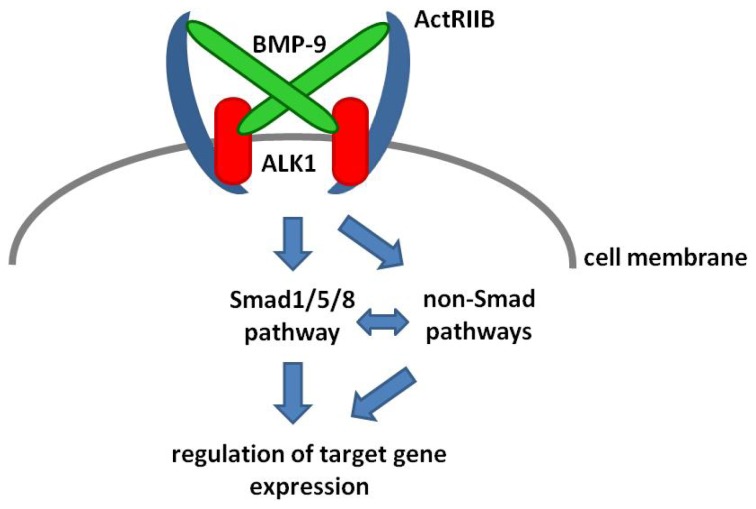
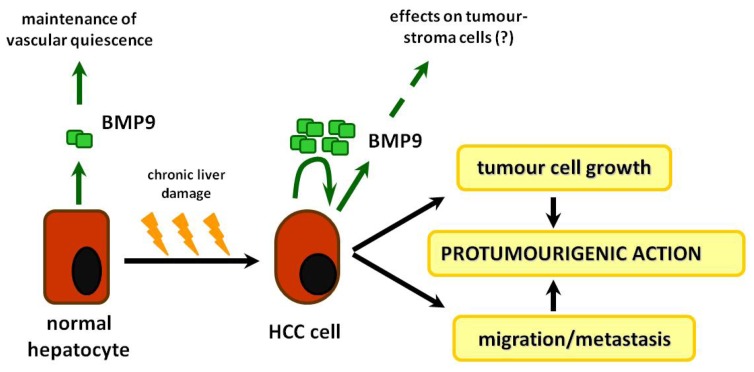
Bone morphogenetic proteins (BMP-2 to BMP-15) belong to the Transforming Growth Factor (TGF)-β superfamily and, besides their well-documented roles during embryogenesis and bone formation, some of them have recently been described to be involved in the pathogenesis of different organs, including the liver. The role of BMPs in liver damage responses including hepatocellular carcinoma (HCC) development has only begun to be addressed and strong evidence supports the concept of a pro-tumorigenic role of BMP signaling in HCC cells. BMP-9 (also termed Growth and Differentiation Factor (GDF)-2) represents the most recently discovered member of the BMP family. We have previously demonstrated that in HCC patient samples BMP-9 expression was positively associated with the tumor seize ("T stage") and that it enhanced cell migration and induced epithelial to mesenchymal transition (EMT) in HCC cells in vitro. In another study we recently found that BMP-9 promotes growth in HCC cells, but not in non-transformed hepatocytes. Published as well as unpublished results obtained with primary hepatocytes support the concept of a dual function of BMP-9 in the liver: while in primary, non-malignant cells BMP-9 stabilizes the epithelial phenotype and inhibits proliferation, in HCC cells it induces cell growth and the acquisition of a migratory phenotype. In this review article we summarize current knowledge about BMPs in liver diseases, with special focus on the role of BMP-9 in HCC development and progression, that may provide new clues for a better understanding of the contribution of BMP-signaling to chronic liver diseases.
骨形态发生蛋白(BMP - 2至BMP - 15)属于转化生长因子(TGF)-β超家族,除了在胚胎发育和骨形成过程中具有充分记录的作用外,最近还发现其中一些蛋白参与包括肝脏在内的不同器官的发病机制。骨形态发生蛋白在肝脏损伤反应(包括肝细胞癌(HCC)发展)中的作用才刚刚开始被研究,有力证据支持骨形态发生蛋白信号在肝癌细胞中具有促肿瘤作用的概念。BMP - 9(也称为生长分化因子(GDF)-2)是骨形态发生蛋白家族中最新发现的成员。我们之前已经证明,在肝癌患者样本中,BMP - 9的表达与肿瘤大小(“T分期”)呈正相关,并且它在体外增强了肝癌细胞的迁移并诱导上皮-间质转化(EMT)。在另一项研究中,我们最近发现BMP - 9促进肝癌细胞的生长,但不促进未转化的肝细胞生长。用原代肝细胞获得的已发表和未发表的结果都支持BMP - 9在肝脏中具有双重功能的概念:在原代非恶性细胞中,BMP - 9稳定上皮表型并抑制增殖,而在肝癌细胞中,它诱导细胞生长并获得迁移表型。在这篇综述文章中,我们总结了关于骨形态发生蛋白在肝脏疾病中的现有知识,特别关注BMP - 9在肝癌发展和进展中的作用,这可能为更好地理解骨形态发生蛋白信号对慢性肝病的贡献提供新线索。