Saez de Urabain Irati R, Johnson Mark H, Smith Tim J
Centre for Brain and Cognitive Development, Birkbeck College, University of London, Malet Street, WC1E 7HX, London, UK,
Behav Res Methods. 2015 Mar;47(1):53-72. doi: 10.3758/s13428-014-0456-0.
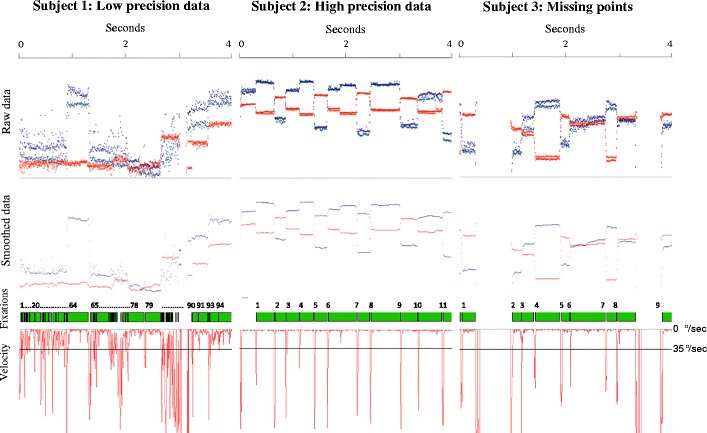
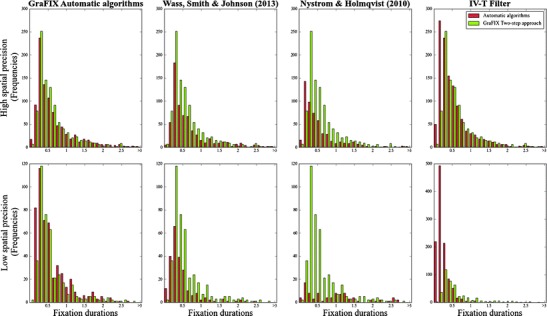
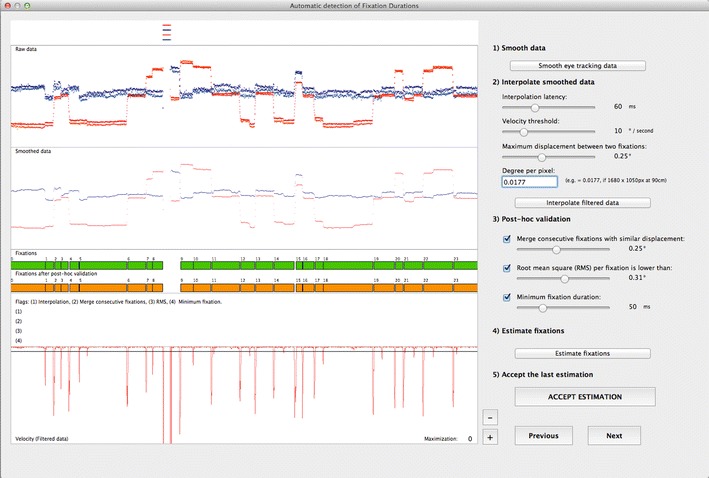
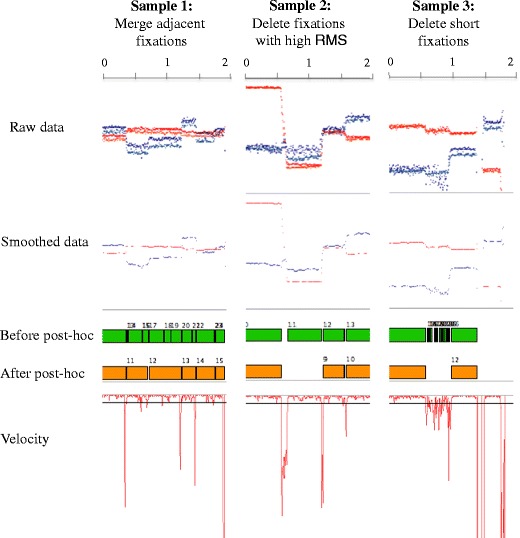
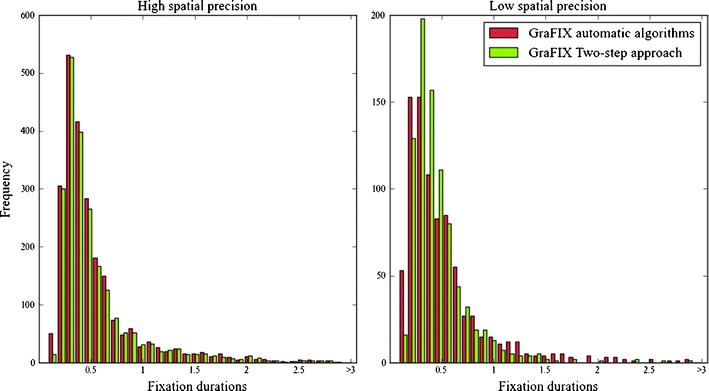
Fixation durations (FD) have been used widely as a measurement of information processing and attention. However, issues like data quality can seriously influence the accuracy of the fixation detection methods and, thus, affect the validity of our results (Holmqvist, Nyström, & Mulvey, 2012). This is crucial when studying special populations such as infants, where common issues with testing (e.g., high degree of movement, unreliable eye detection, low spatial precision) result in highly variable data quality and render existing FD detection approaches highly time consuming (hand-coding) or imprecise (automatic detection). To address this problem, we present GraFIX, a novel semiautomatic method consisting of a two-step process in which eye-tracking data is initially parsed by using velocity-based algorithms whose input parameters are adapted by the user and then manipulated using the graphical interface, allowing accurate and rapid adjustments of the algorithms' outcome. The present algorithms (1) smooth the raw data, (2) interpolate missing data points, and (3) apply a number of criteria to automatically evaluate and remove artifactual fixations. The input parameters (e.g., velocity threshold, interpolation latency) can be easily manually adapted to fit each participant. Furthermore, the present application includes visualization tools that facilitate the manual coding of fixations. We assessed this method by performing an intercoder reliability analysis in two groups of infants presenting low- and high-quality data and compared it with previous methods. Results revealed that our two-step approach with adaptable FD detection criteria gives rise to more reliable and stable measures in low- and high-quality data.
注视持续时间(FD)已被广泛用作信息处理和注意力的一种度量。然而,诸如数据质量等问题会严重影响注视检测方法的准确性,进而影响我们结果的有效性(霍尔姆奎斯特、尼斯特伦和马尔维,2012年)。在研究特殊人群(如婴儿)时,这一点至关重要,因为测试中常见的问题(如高度的运动、不可靠的眼睛检测、低空间精度)会导致数据质量高度可变,使现有的FD检测方法要么非常耗时(手工编码),要么不准确(自动检测)。为了解决这个问题,我们提出了GraFIX,这是一种新颖的半自动方法,包括两步过程。在第一步中,使用基于速度的算法对眼动追踪数据进行初步解析,其输入参数由用户调整,然后使用图形界面进行处理,从而能够准确快速地调整算法的结果。目前的算法(1)对原始数据进行平滑处理,(2)对缺失的数据点进行插值,(3)应用一些标准来自动评估和去除伪注视。输入参数(如速度阈值、插值延迟)可以很容易地手动调整以适合每个参与者。此外,本应用程序还包括有助于手动编码注视的可视化工具。我们通过对两组呈现低质量和高质量数据的婴儿进行编码者间信度分析来评估这种方法,并将其与以前的方法进行比较。结果表明,我们具有可调整FD检测标准的两步法在低质量和高质量数据中能产生更可靠、更稳定的测量结果。