Cognition and Action Laboratory, Moss Rehabilitation Research Institute, Einstein Healthcare Network Philadelphia, PA, USA ; Department of Psychology, School of Humanities and Health Sciences, Neapolis University Pafos Pafos, Cyprus.
Cognition and Action Laboratory, Moss Rehabilitation Research Institute, Einstein Healthcare Network Philadelphia, PA, USA.
Front Hum Neurosci. 2014 Mar 18;8:140. doi: 10.3389/fnhum.2014.00140. eCollection 2014.
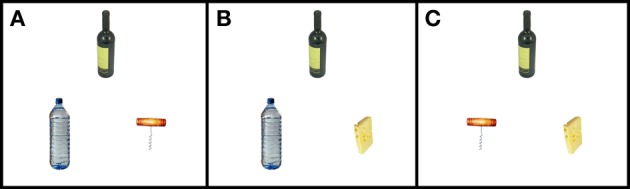
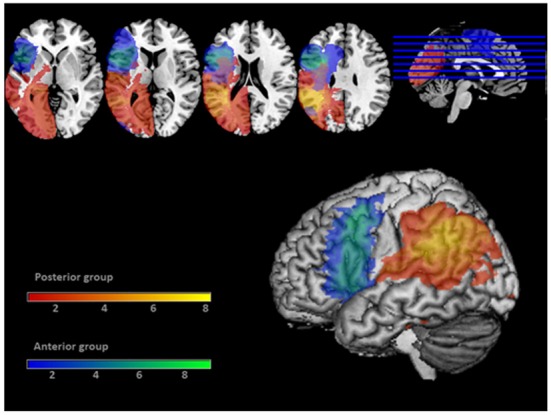
A number of studies have explored the role of associative/event-based (thematic) and categorical (taxonomic) relations in the organization of object representations. Recent evidence suggests that thematic information may be particularly important in determining relationships between manipulable artifacts. However, although sensorimotor information is on many accounts an important component of manipulable artifact representations, little is known about the role that action may play during the processing of semantic relationships (particularly thematic relationships) between multiple objects. In this study, we assessed healthy and left hemisphere stroke participants to explore three questions relevant to object relationship processing. First, we assessed whether participants tended to favor thematic relations including action (Th+A, e.g., wine bottle-corkscrew), thematic relationships without action (Th-A, e.g., wine bottle-cheese), or taxonomic relationships (Tax, e.g., wine bottle-water bottle) when choosing between them in an association judgment task with manipulable artifacts. Second, we assessed whether the underlying constructs of event relatedness, action relatedness, and categorical relatedness determined the choices that participants made. Third, we assessed the hypothesis that degraded action knowledge and/or damage to temporo-parietal cortex, a region of the brain associated with the representation of action knowledge, would reduce the influence of action on the choice task. Experiment 1 showed that explicit ratings of event, action, and categorical relatedness were differentially predictive of healthy participants' choices, with action relatedness determining choices between Th+A and Th-A associations above and beyond event and categorical ratings. Experiment 2 focused more specifically on these Th+A vs. Th-A choices and demonstrated that participants with left temporo-parietal lesions, a brain region known to be involved in sensorimotor processing, were less likely than controls and tended to be less likely than patients with lesions sparing that region to use action relatedness in determining their choices. These data indicate that action knowledge plays a critical role in processing of thematic relations for manipulable artifacts.
一些研究探索了联想/事件(主题)和类别(分类)关系在物体表示组织中的作用。最近的证据表明,主题信息在确定可操作人工制品之间的关系时可能特别重要。然而,尽管感觉运动信息在许多方面都是可操作人工制品表示的重要组成部分,但对于动作在处理多个物体之间的语义关系(特别是主题关系)中可能发挥的作用知之甚少。在这项研究中,我们评估了健康参与者和左半球中风患者,以探讨与物体关系处理相关的三个问题。首先,我们评估了参与者在可操作人工制品的联想判断任务中,在选择主题关系(包括动作)、无动作的主题关系和分类关系之间时,是否倾向于选择主题关系包括动作(例如,酒瓶-开瓶器)、无动作的主题关系(例如,酒瓶-奶酪)或分类关系(例如,酒瓶-水瓶)。其次,我们评估了事件相关性、动作相关性和分类相关性的潜在结构是否决定了参与者的选择。第三,我们评估了这样一种假设,即动作知识的退化和/或与动作知识表示相关的颞顶叶皮层的损伤会降低动作对选择任务的影响。实验 1 表明,事件、动作和分类相关性的明确评分可预测健康参与者的选择,而动作相关性决定了 Th+A 和 Th-A 联想之间的选择,超过了事件和分类评分。实验 2 更具体地关注这些 Th+A 与 Th-A 的选择,并表明与控制组相比,颞顶叶损伤患者(已知参与感觉运动处理的大脑区域)不太可能利用动作相关性来确定他们的选择,并且他们可能不如该区域的病变患者更倾向于利用动作相关性来确定他们的选择。这些数据表明,动作知识在处理可操作人工制品的主题关系方面起着关键作用。