Chen Jinhu, Guan Zhenlong, Wang Liqin, Song Guangyao, Ma Boqing, Wang Yanqin
Department of Endocrinology, Hebei General Hospital, Shijiazhuang 050017, China.
Department of Physiology, College of Life Science, Hebei Normal University, Shijiazhuang 050024, China.
Int J Endocrinol. 2014;2014:203930. doi: 10.1155/2014/203930. Epub 2014 Feb 5.
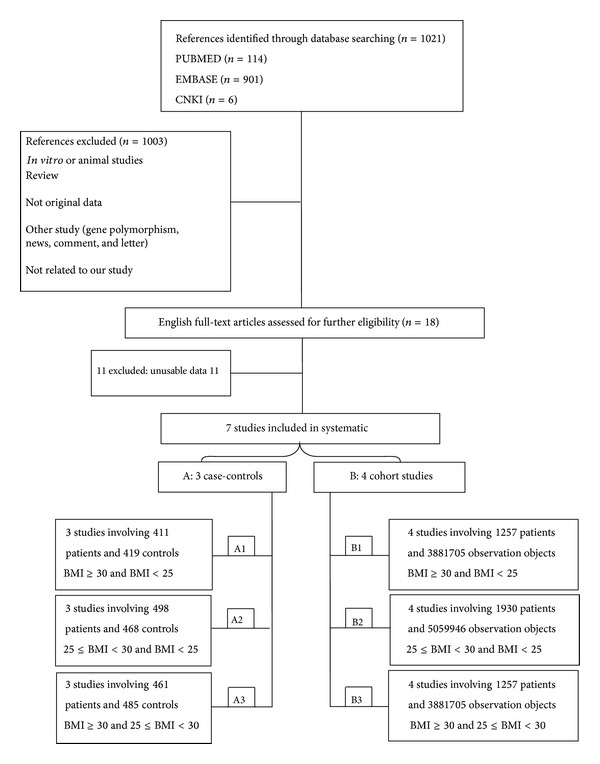
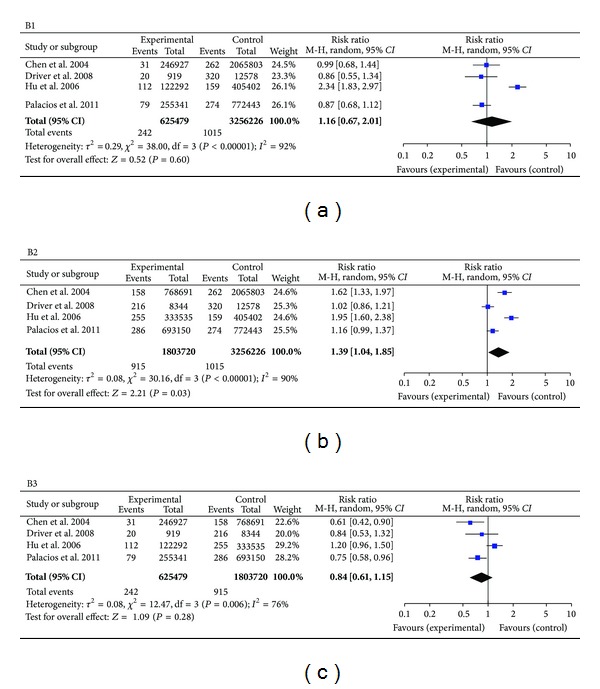
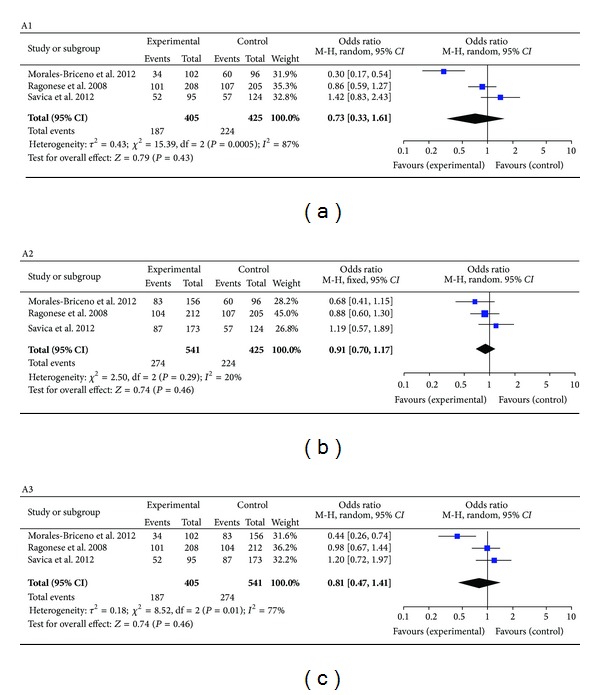
Objective. Parkinson's disease (PD) is a severe neurological disease and its risk factors remain largely unknown. A meta-analysis was carried out to investigate the relationship of overweight and obesity with PD. Methods. We used PubMed, EMBASE, and the Chinese National Knowledge Infrastructure (CNKI) databases to identify studies of associations between overweight/obesity and PD. Overweight, obesity, and PD were used as keywords, and published works were retrieved until September 30, 2013. The extracted data were classified (BMI ≥ 30, 25 ≤ BMI < 30, and BMI < 25) according to BMI values and analyzed using RevMan5.2 and Stata11.0. Results. Four cohort studies and three case-control studies were used to evaluate the association between overweight/obesity and PD, including 2857 PD patients and 5, 683, 939 cases of non-PD controls. There was a statistically significant difference between 25 ≤ BMI < 30 and BMI < 25 in the cohort study (RR = 1.17, 95% CI, 1.03-1.32, P = 0.03), but there was no difference between BMI ≥ 30 and BMI < 25 or BMI ≥ 30 and 25 ≤ BMI < 30, where the respective RR was 1.16 and 0.84; the respective 95% CI was 0.67-2.01 and 0.61-1.15, respectively, and the P values were 0.60 and 0.28, respectively. Case-control studies showed that there was no statistical difference between any two groups. Conclusion. Meta-analysis showed that overweight might be a potential risk factor of PD. Demonstration of a causal role of overweight/obesity in PD development could have important therapeutic implications.
目的。帕金森病(PD)是一种严重的神经疾病,其风险因素在很大程度上仍然未知。开展一项荟萃分析以研究超重和肥胖与帕金森病的关系。方法。我们使用PubMed、EMBASE和中国知网(CNKI)数据库来识别超重/肥胖与帕金森病之间关联的研究。以超重、肥胖和帕金森病作为关键词,检索截至2013年9月30日发表的作品。根据体重指数(BMI)值对提取的数据进行分类(BMI≥30、25≤BMI<30和BMI<25),并使用RevMan5.2和Stata11.0进行分析。结果。四项队列研究和三项病例对照研究用于评估超重/肥胖与帕金森病之间的关联,包括2857例帕金森病患者和5683939例非帕金森病对照。队列研究中,25≤BMI<30与BMI<25之间存在统计学显著差异(RR = 1.17,95%CI为1.03 - 1.32,P = 0.03),但BMI≥30与BMI<25之间或BMI≥30与25≤BMI<30之间无差异,各自的RR分别为1.16和0.84;各自的95%CI分别为0.67 - 2.01和0.61 - 1.15,P值分别为0.60和0.28。病例对照研究表明,任何两组之间均无统计学差异。结论。荟萃分析表明超重可能是帕金森病的一个潜在风险因素。证明超重/肥胖在帕金森病发展中的因果作用可能具有重要的治疗意义。