Chai Weidong, Zakrzewski Silke S, Günzel Dorothee, Pieper Robert, Wang Zhenya, Twardziok Sven, Janczyk Pawel, Osterrieder Nikolaus, Burwinkel Michael
Institut für Virologie, Freie Universität Berlin, Berlin, Germany.
BMC Vet Res. 2014 Mar 28;10:75. doi: 10.1186/1746-6148-10-75.
Zinc (Zn) supplementation has been shown to reduce the incidence of diarrhea and to protect animals from intestinal diseases, but the mechanisms of this protective effect against virus infection in vivo have not yet been elucidated. Transmissible gastroenteritis virus (TGEV) causes diarrhea in piglets with an age-dependent decrease of severity.
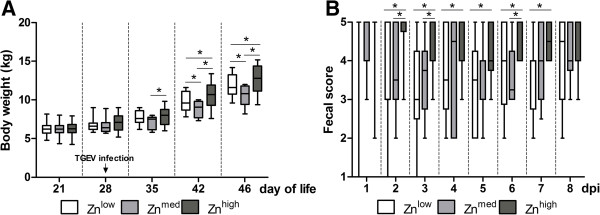
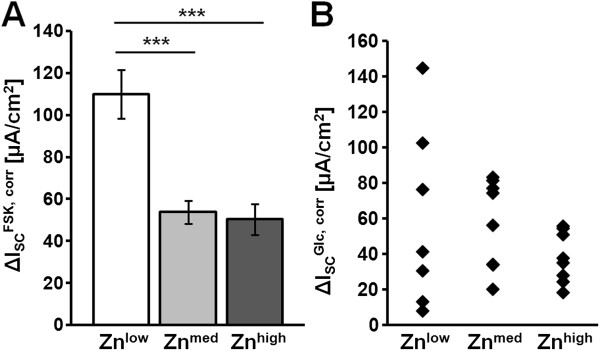
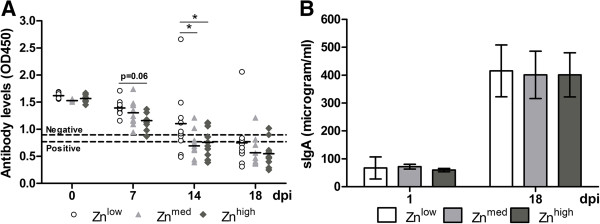
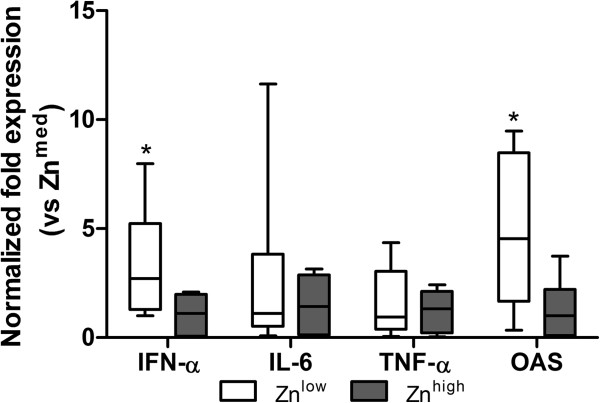
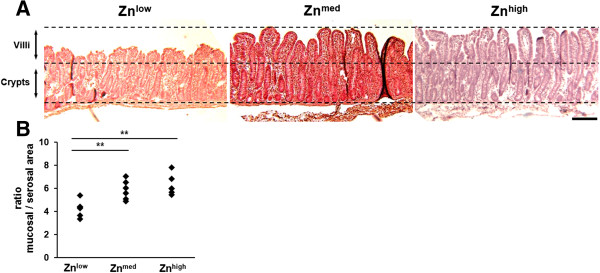
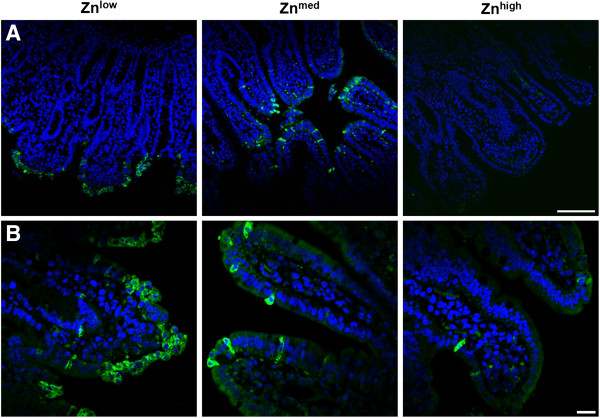
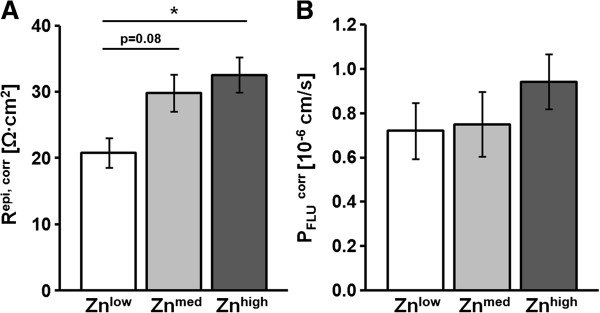
We used 60 weaned piglets that were divided into three groups to evaluate the effect of different Zn levels added to a conventional diet (50 mg Zn/kg diet, Znlow, control group). The other groups received the diet supplemented with ZnO at final concentrations of 150 mg Zn/kg diet (Znmed), or 2,500 mg/kg diet (Znhigh). Oral challenge infection with TGEV was performed when the pigs had been fed for 1 week with the respective diet. Half of the piglets of each group were sacrificed at day 1 and 18 after challenge infection. Fecal consistency was improved and body weights increased in the Znhigh group when compared to the other groups, but no direct effect of Zn concentrations in the diet on fecal TGEV shedding and mucosal immune responses was detectable. However, in the Znhigh group, we found a prevention of villus atrophy and decreased caspase-3-mediated apoptosis of jejunal epithelium. Furthermore, pigs receiving high Zn diet showed a down-regulation of interferon (IFN)-α, oligoadenylate synthetase (OAS), Zn transporter SLC39A4 (ZIP4), but up-regulation of metallothionein-1 (MT1), as well as the Zn transporters SLC30A1 (ZnT1) and SLC30A5 (ZnT5). In addition, forskolin-induced chloride secretion and epithelial resistance were controlled at a physiological level in the Znhigh but not the other groups. Finally, in the Znhigh group, we documented an earlier and higher systemic TGEV-specific serum antibody response.
These results suggest that high dietary Zn could provide enhanced protection in the intestinal tract and stimulate the systemic humoral immune response against TGEV infection.
锌(Zn)补充剂已被证明可降低腹泻发病率,并保护动物免受肠道疾病侵害,但这种对体内病毒感染的保护作用机制尚未阐明。传染性胃肠炎病毒(TGEV)可导致仔猪腹泻,且严重程度随年龄增长而降低。
我们使用60头断奶仔猪,将其分为三组,以评估在常规日粮(50毫克锌/千克日粮,低锌组,对照组)中添加不同锌水平的效果。其他两组分别接受终浓度为150毫克锌/千克日粮(中锌组)或2500毫克/千克日粮(高锌组)的日粮补充。在仔猪分别采食各自日粮1周后,进行TGEV口服攻毒感染。每组一半仔猪在攻毒感染后第1天和第18天处死。与其他组相比,高锌组粪便稠度改善,体重增加,但日粮中锌浓度对粪便中TGEV排毒和黏膜免疫反应无直接影响。然而,在高锌组中,我们发现可预防绒毛萎缩,并减少空肠上皮细胞中半胱天冬酶-3介导的细胞凋亡。此外,采食高锌日粮的猪,干扰素(IFN)-α、寡腺苷酸合成酶(OAS)、锌转运体SLC39A4(ZIP4)表达下调,但金属硫蛋白-1(MT1)以及锌转运体SLC30A1(ZnT1)和SLC30A5(ZnT5)表达上调。此外,高锌组而非其他组中,福司可林诱导的氯离子分泌和上皮电阻在生理水平得到控制。最后,在高锌组中,我们记录到更早且更高的全身性TGEV特异性血清抗体反应。
这些结果表明,高日粮锌可增强肠道保护作用,并刺激针对TGEV感染的全身性体液免疫反应。