van Beugen Sylvia, Ferwerda Maaike, Hoeve Dane, Rovers Maroeska M, Spillekom-van Koulil Saskia, van Middendorp Henriët, Evers Andrea Wm
Leiden University, Institute of Psychology, Health, Medical and Neuropsychology Unit, Leiden, Netherlands.
J Med Internet Res. 2014 Mar 27;16(3):e88. doi: 10.2196/jmir.2777.
Patients with chronic somatic conditions face unique challenges accessing mental health care outside of their homes due to symptoms and physical limitations. Internet-based cognitive behavioral therapy (ICBT) has shown to be effective for various psychological conditions. The increasing number of recent trials need to be systematically evaluated and quantitatively analyzed to determine whether ICBT is also effective for chronic somatic conditions and to gain insight into the types of problems that could be targeted.
Our goal was to describe and evaluate the effectiveness of guided ICBT interventions for chronic somatic conditions on general psychological outcomes, disease-related physical outcomes, and disease-related impact on daily life outcomes. The role of treatment length was also examined.
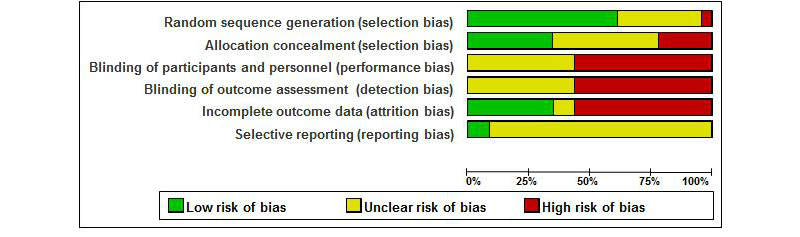
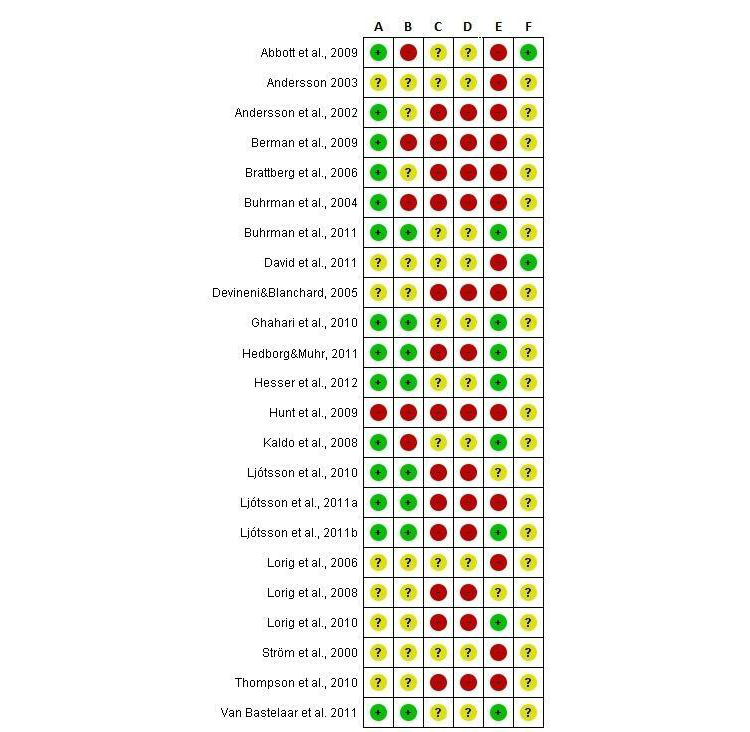
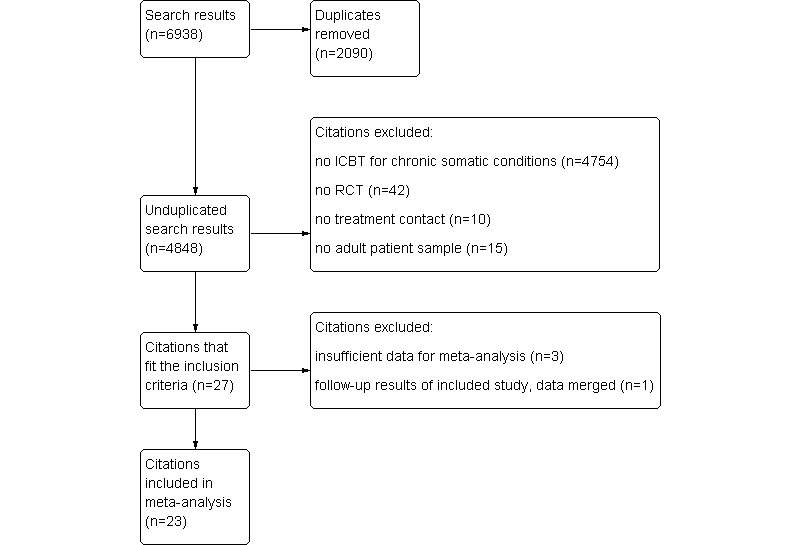
PubMed, PsycINFO, and Embase were searched from inception until February 2012, by combining search terms indicative of effect studies, Internet, and cognitive behavioral therapy. Studies were included if they fulfilled the following six criteria: (1) randomized controlled trial, (2) Internet-based interventions, (3) based on cognitive behavioral therapy, (4) therapist-guided, (5) adult (≥18 years old) patients with an existing chronic somatic condition, and (6) published in English. 23 randomized controlled trials of guided ICBT were selected by 2 independent raters after reviewing 4848 abstracts. Demographic, clinical, and methodological variables were extracted. Standardized mean differences were calculated between intervention and control conditions for each outcome and pooled using random effects models when appropriate.
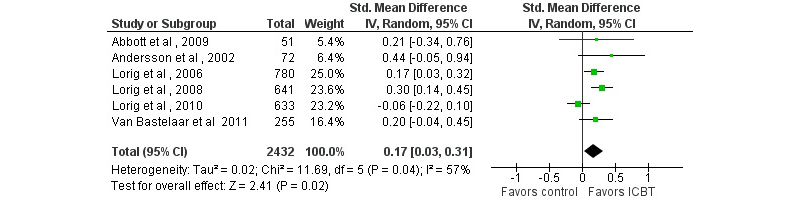
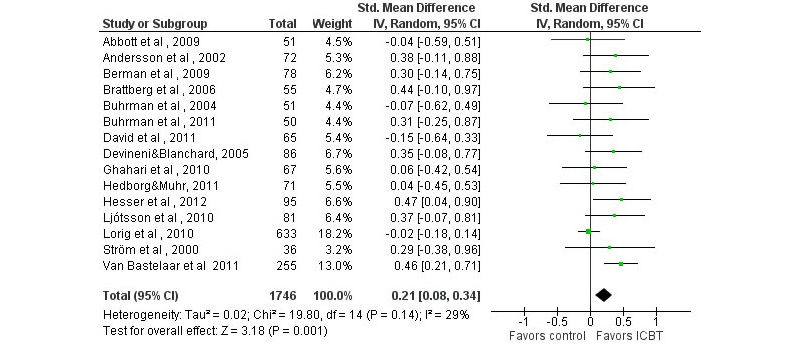
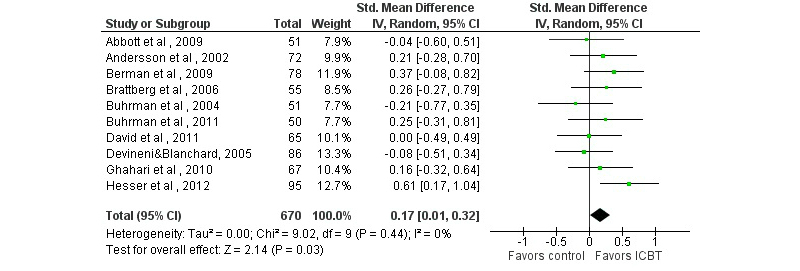
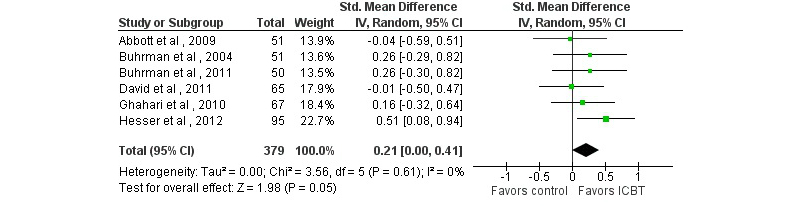
Guided ICBT was shown to improve all outcome categories with small effect sizes for generic psychological outcomes (effect size range 0.17-0.21) and occasionally larger effects for disease-specific physical outcomes (effect size range 0.07 to 1.19) and disease-related impact outcomes (effect size range 0.17-1.11). Interventions with a longer treatment duration (>6 weeks) led to more consistent effects on depression.
Guided ICBT appears to be a promising and effective treatment for chronic somatic conditions to improve psychological and physical functioning and disease-related impact. The most consistent improvements were found for disease-specific outcomes, which supports the possible relevance of tailoring interventions to specific patient groups. Explorative analyses revealed that longer treatment length holds the promise of larger treatment effects for the specific outcome of depression. While the current meta-analysis focused on several chronic somatic conditions, future meta-analyses for separate chronic somatic conditions can further consolidate these results, also in terms of cost-effectiveness.
患有慢性躯体疾病的患者由于症状和身体限制,在家庭以外获得心理健康护理面临独特挑战。基于互联网的认知行为疗法(ICBT)已被证明对各种心理状况有效。最近越来越多的试验需要进行系统评估和定量分析,以确定ICBT对慢性躯体疾病是否也有效,并深入了解可以针对的问题类型。
我们的目标是描述和评估针对慢性躯体疾病的指导性ICBT干预对一般心理结果、疾病相关身体结果以及疾病对日常生活结果的影响的有效性。还研究了治疗时长的作用。
从数据库建库至2012年2月,在PubMed、PsycINFO和Embase中进行检索,通过组合表示效果研究、互联网和认知行为疗法的检索词。如果研究符合以下六个标准,则纳入研究:(1)随机对照试验;(2)基于互联网的干预;(3)基于认知行为疗法;(4)有治疗师指导;(5)患有现有慢性躯体疾病的成年(≥18岁)患者;(6)以英文发表。在审查了4848篇摘要后,由2名独立评估人员选择了23项指导性ICBT的随机对照试验。提取了人口统计学、临床和方法学变量。计算每个结果在干预组和对照组之间的标准化均值差异,并在适当情况下使用随机效应模型进行汇总。
指导性ICBT被证明能改善所有结果类别,对一般心理结果的效应量较小(效应量范围为0.17 - 0.21),对疾病特异性身体结果(效应量范围为0.07至1.19)和疾病相关影响结果(效应量范围为0.17 - 1.11)偶尔有较大效应。治疗持续时间较长(>6周)的干预对抑郁症产生更一致的效果。
指导性ICBT似乎是一种有前景且有效的治疗慢性躯体疾病的方法,可改善心理和身体功能以及疾病相关影响。在疾病特异性结果方面发现了最一致的改善,这支持了针对特定患者群体量身定制干预措施的可能性。探索性分析表明,较长的治疗时长有望对抑郁症这一特定结果产生更大的治疗效果。虽然当前的荟萃分析关注了几种慢性躯体疾病,但未来针对单独慢性躯体疾病的荟萃分析可以进一步巩固这些结果,在成本效益方面也是如此。