Engert Veronika, Merla Arcangelo, Grant Joshua A, Cardone Daniela, Tusche Anita, Singer Tania
Max Planck Institute for Human Cognitive and Brain Sciences, Department of Social Neuroscience, Leipzig, Germany.
Institute of Advanced Biomedical Technologies (ITAB), G. d'Annunzio Foundation, Chieti, Italy; Department of Neuroscience and Imaging, G. d'Annunzio University, Chieti-Pescara, Italy.
PLoS One. 2014 Mar 27;9(3):e90782. doi: 10.1371/journal.pone.0090782. eCollection 2014.
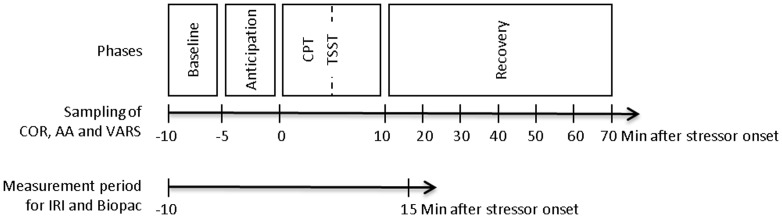
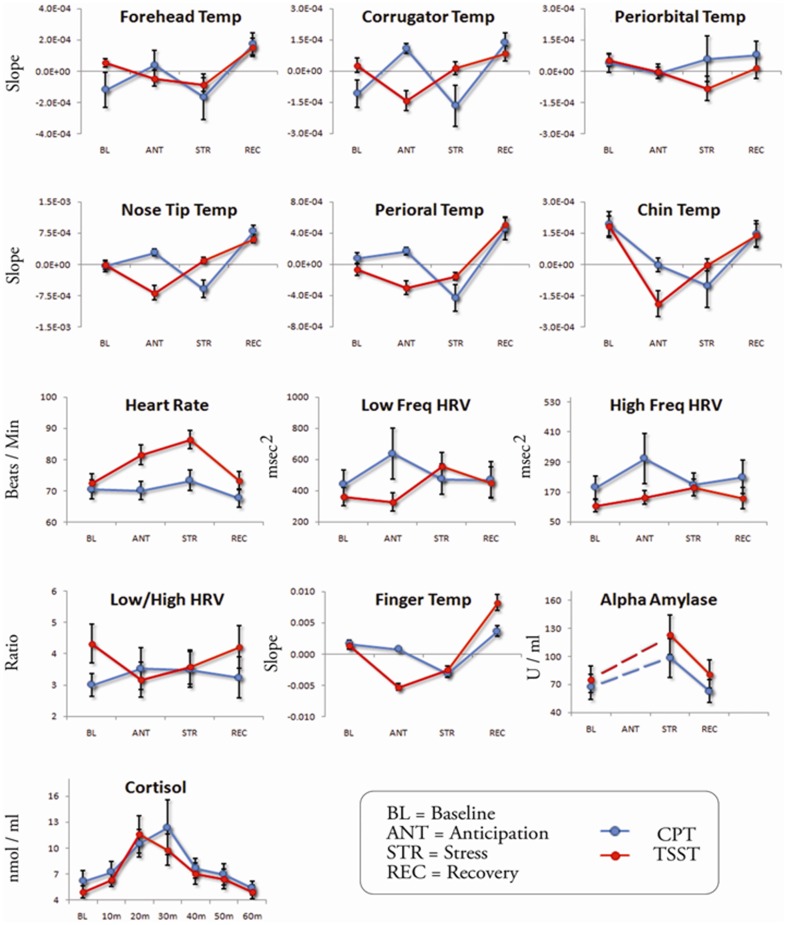
High resolution thermal infrared imaging is a pioneering method giving indices of sympathetic activity via the contact-free recording of facial tissues (thermal imprints). Compared to established stress markers, the great advantage of this method is its non-invasiveness. The goal of our study was to pilot the use of thermal infrared imaging in the classical setting of human stress research. Thermal imprints were compared to established stress markers (heart rate, heart rate variability, finger temperature, alpha-amylase and cortisol) in 15 participants undergoing anticipation, stress and recovery phases of two laboratory stress tests, the Cold Pressor Test and the Trier Social Stress Test. The majority of the thermal imprints proved to be change-sensitive in both tests. While correlations between the thermal imprints and established stress markers were mostly non-significant, the thermal imprints (but not the established stress makers) did correlate with stress-induced mood changes. Multivariate pattern analysis revealed that in contrast to the established stress markers the thermal imprints could not disambiguate anticipation, stress and recovery phases of both tests. Overall, these results suggest that thermal infrared imaging is a valuable method for the estimation of sympathetic activity in the stress laboratory setting. The use of this non-invasive method may be particularly beneficial for covert recordings, in the study of special populations showing difficulties in complying with the standard instruments of data collection and in the domain of psychophysiological covariance research. Meanwhile, the established stress markers seem to be superior when it comes to the characterization of complex physiological states during the different phases of the stress cycle.
高分辨率热红外成像是一种开创性方法,通过对面部组织(热印记)进行非接触式记录来给出交感神经活动指标。与既定的应激标志物相比,该方法的一大优势在于其非侵入性。我们研究的目的是在人类应激研究的经典环境中试用热红外成像。在15名参与者进行两项实验室应激测试(冷加压试验和特里尔社会应激测试)的预期、应激和恢复阶段时,将热印记与既定的应激标志物(心率、心率变异性、手指温度、α-淀粉酶和皮质醇)进行了比较。在两项测试中,大多数热印记都被证明对变化敏感。虽然热印记与既定应激标志物之间的相关性大多不显著,但热印记(而非既定的应激标志物)确实与应激引起的情绪变化相关。多变量模式分析表明,与既定应激标志物不同,热印记无法区分两项测试的预期、应激和恢复阶段。总体而言,这些结果表明热红外成像是应激实验室环境中评估交感神经活动的一种有价值的方法。这种非侵入性方法的使用可能对隐蔽记录特别有益,在研究难以遵守标准数据收集工具的特殊人群以及心理生理协方差研究领域中尤其如此。与此同时,在应激周期不同阶段复杂生理状态的表征方面,既定的应激标志物似乎更具优势。