Division of Infectious Diseases, Infection Control Unit and Medical Practice Evaluation Center, Massachusetts General Hospital and Harvard Medical School, Boston, MA, USA.
BMC Infect Dis. 2014 Mar 31;14:177. doi: 10.1186/1471-2334-14-177.
No published systematic reviews have assessed the natural history of colonization with methicillin-resistant Staphylococcus aureus (MRSA) or vancomycin-resistant Enterococcus (VRE). Time to clearance of colonization has important implications for patient care and infection control policy.
We performed parallel searches in OVID Medline for studies that reported the time to documented clearance of MRSA and VRE colonization in the absence of treatment, published between January 1990 and July 2012.
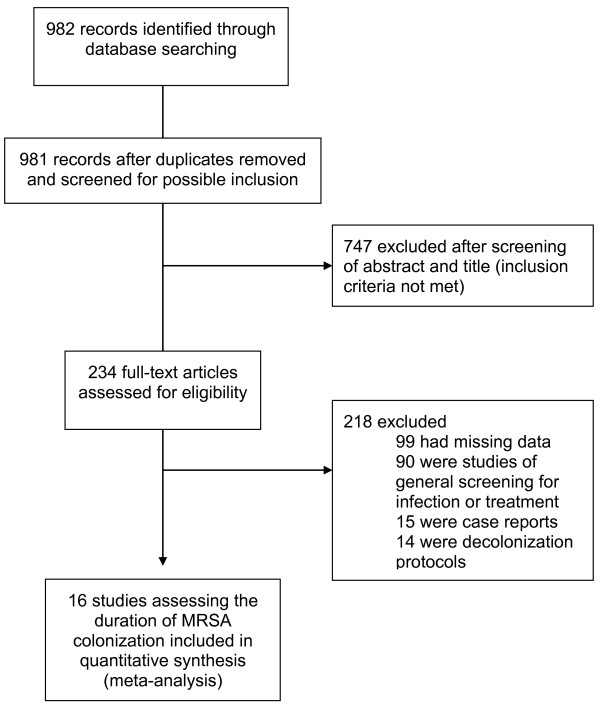
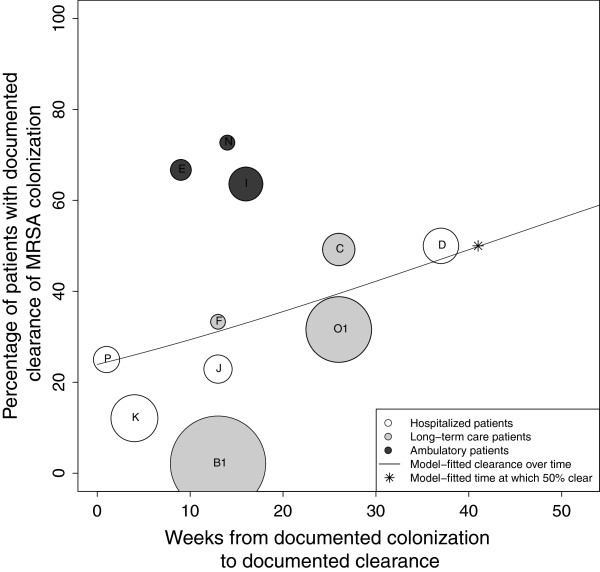
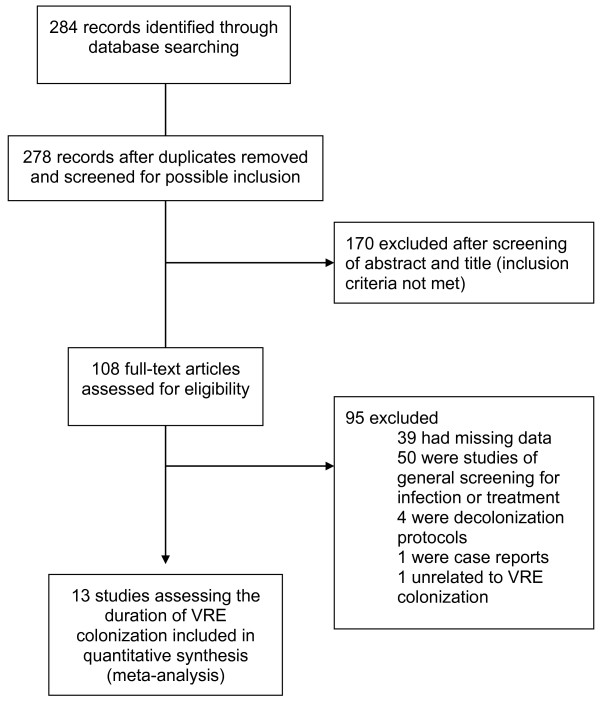
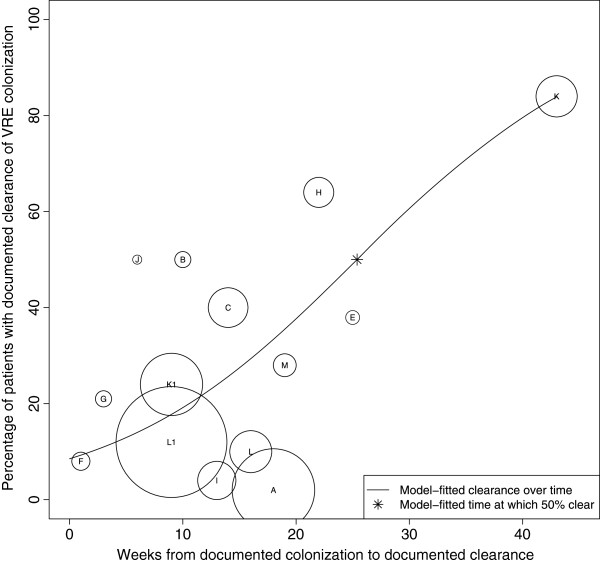
For MRSA, we screened 982 articles, identified 16 eligible studies (13 observational studies and 3 randomized controlled trials), for a total of 1,804 non-duplicated subjects. For VRE, we screened 284 articles, identified 13 eligible studies (12 observational studies and 1 randomized controlled trial), for a total of 1,936 non-duplicated subjects. Studies reported varying definitions of clearance of colonization; no study reported time of initial colonization. Studies varied in the frequency of sampling, assays used for sampling, and follow-up period. The median duration of total follow-up was 38 weeks for MRSA and 25 weeks for VRE. Based on pooled analyses, the model-estimated median time to clearance was 88 weeks after documented colonization for MRSA-colonized patients and 26 weeks for VRE-colonized patients. In a secondary analysis, clearance rates for MRSA and VRE were compared by restricting the duration of follow-up for the MRSA studies to the maximum observed time point for VRE studies (43 weeks). With this restriction, the model-fitted median time to documented clearance for MRSA would occur at 41 weeks after documented colonization, demonstrating the sensitivity of the pooled estimate to length of study follow-up.
Few available studies report the natural history of MRSA and VRE colonization. Lack of a consistent definition of clearance, uncertainty regarding the time of initial colonization, variation in frequency of sampling for persistent colonization, assays employed and variation in duration of follow-up are limitations of the existing published literature. The heterogeneity of study characteristics limits interpretation of pooled estimates of time to clearance, however, studies included in this review suggest an increase in documented clearance over time, a result which is sensitive to duration of follow-up.
目前尚无系统评价评估耐甲氧西林金黄色葡萄球菌(MRSA)或万古霉素耐药肠球菌(VRE)定植的自然史。清除定植的时间对于患者的护理和感染控制政策具有重要意义。
我们在 OVID Medline 上平行搜索了 1990 年 1 月至 2012 年 7 月期间发表的未接受治疗的 MRSA 和 VRE 定植清除的时间的相关文献。
对于 MRSA,我们筛选了 982 篇文章,确定了 16 项符合条件的研究(13 项观察性研究和 3 项随机对照试验),共纳入了 1804 名非重复的受试者。对于 VRE,我们筛选了 284 篇文章,确定了 13 项符合条件的研究(12 项观察性研究和 1 项随机对照试验),共纳入了 1936 名非重复的受试者。研究报告的定植清除定义各不相同;没有研究报告初始定植的时间。研究在采样频率、采样检测方法和随访时间上存在差异。MRSA 的总随访中位时间为 38 周,VRE 为 25 周。基于汇总分析,模型估计的 MRSA 定植患者清除的中位时间是在确诊定植后 88 周,VRE 定植患者为 26 周。在二次分析中,通过将 MRSA 研究的随访时间限制为 VRE 研究的最长观察时间点(43 周),比较了 MRSA 和 VRE 的清除率。在此限制下,模型拟合的 MRSA 确诊清除的中位时间将发生在确诊定植后 41 周,这表明汇总估计值对研究随访时间的敏感性。
少数现有研究报告了 MRSA 和 VRE 定植的自然史。缺乏清除的一致定义、初始定植时间的不确定性、持续定植时采样频率的差异、采用的检测方法以及随访时间的差异是现有文献的局限性。研究特征的异质性限制了对清除时间的汇总估计值的解释,但是,本综述中纳入的研究表明,随着时间的推移,确诊清除率有所提高,这一结果对随访时间敏感。