
在全球范围内可视化流感病毒在活细胞中依赖微管的运输行为。
Globally visualizing the microtubule-dependent transport behaviors of influenza virus in live cells.
作者信息
Liu Shu-Lin, Zhang Li-Juan, Wang Zhi-Gang, Zhang Zhi-Ling, Wu Qiu-Mei, Sun En-Ze, Shi Yun-Bo, Pang Dai-Wen
机构信息
Key Laboratory of Analytical Chemistry for Biology and Medicine (Ministry of Education), College of Chemistry and Molecular Sciences, State Key Laboratory of Virology, and Wuhan Institute of Biotechnology, Wuhan University , Wuhan, Hubei 430072, P.R. China.
出版信息
Anal Chem. 2014 Apr 15;86(8):3902-8. doi: 10.1021/ac500640u. Epub 2014 Mar 31.
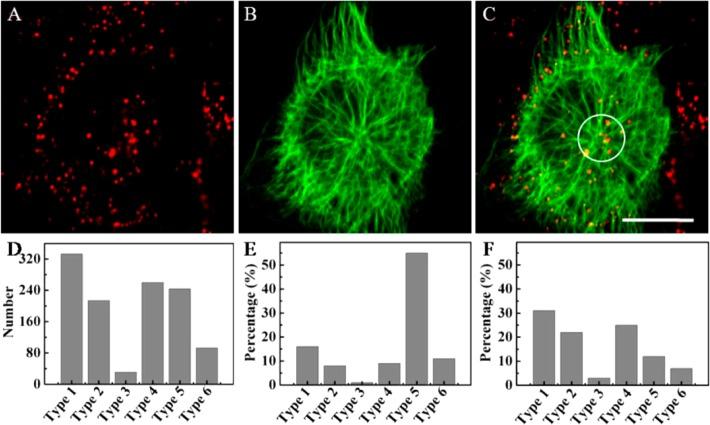
Understanding the microtubule-dependent behaviors of viruses in live cells is very meaningful for revealing the mechanisms of virus infection and endocytosis. Herein, we used a quantum dots-based single-particle tracking technique to dynamically and globally visualize the microtubule-dependent transport behaviors of influenza virus in live cells. We found that the intersection configuration of microtubules can interfere with the transport behaviors of the virus in live cells, which lead to the changing and long-time pausing of the transport behavior of viruses. Our results revealed that most of the viruses moved along straight microtubules rapidly and unidirectionally from the cell periphery to the microtubule organizing center (MTOC) near the bottom of the cell, and the viruses were confined in the grid of microtubules near the top of the cell and at the MTOC near the bottom of the cell. These results provided deep insights into the influence of entire microtubule geometry on the virus infection.
了解病毒在活细胞中依赖微管的行为对于揭示病毒感染和内吞作用机制具有重要意义。在此,我们使用基于量子点的单粒子追踪技术,动态、全面地观察活细胞中流感病毒依赖微管的运输行为。我们发现微管的交叉结构会干扰病毒在活细胞中的运输行为,导致病毒运输行为的改变和长时间停滞。我们的结果表明,大多数病毒沿着直的微管快速、单向地从细胞周边向细胞底部附近的微管组织中心(MTOC)移动,并且病毒被限制在细胞顶部附近和细胞底部MTOC处的微管网格中。这些结果为整个微管几何结构对病毒感染的影响提供了深刻见解。



 Zotero 插件