Wu Juan, Uchino Miki, Sastry Srinivas M, Schaumberg Debra A
Department of Nutrition, Harvard School of Public Health, Boston, Massachusetts, United States of America.
Department of Ophthalmology, Keio University School of Medicine, Tokyo, Japan.
PLoS One. 2014 Mar 28;9(3):e89600. doi: 10.1371/journal.pone.0089600. eCollection 2014.
Research has indicated some shared pathogenic mechanisms between age-related macular degeneration (AMD) and cardiovascular disease (CVD). However, results from prior epidemiologic studies have been inconsistent as to whether AMD is predictive of future CVD risk.
To systematically review population-based cohort studies of the association between AMD and risk of total CVD and CVD subtypes, coronary heart disease (CHD) and stroke.
A systematic search of the PubMed and EMBASE databases and reference lists of key retrieved articles up to December 20, 2012 without language restriction.
Two reviewers independently extracted data on baseline AMD status, risk estimates of CVD and methods used to assess AMD and CVD. We pooled relative risks using random or fixed effects models as appropriate.
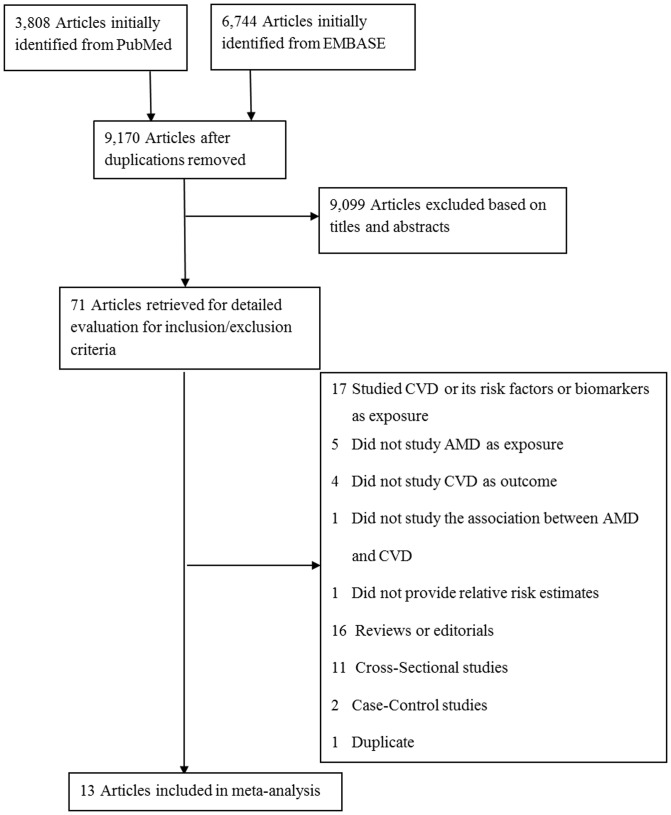
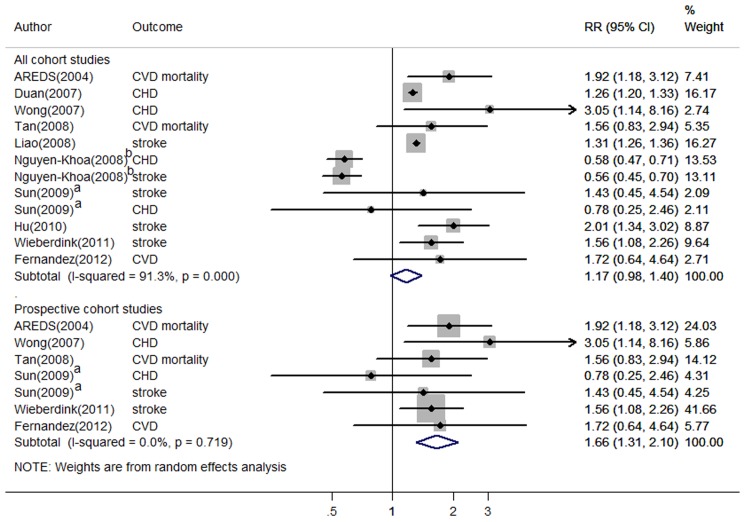
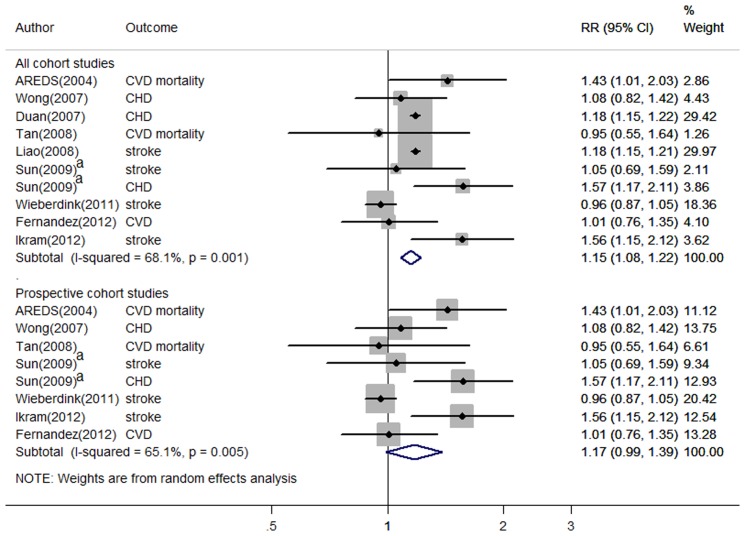
Thirteen cohort studies (8 prospective and 5 retrospective studies) with a total of 1,593,390 participants with 155,500 CVD events (92,039 stroke and 62,737 CHD) were included in this meta-analysis. Among all studies, early AMD was associated with a 15% (95% CI, 1.08-1.22) increased risk of total CVD. The relative risk was similar but not significant for late AMD (RR, 1.17; 95% CI, 0.98-1.40). In analyses restricted to the subset of prospective studies, the risk associated with early AMD did not appreciably change; however, there was a marked 66% (95% CI, 1.31-2.10) increased risk of CVD among those with late AMD.
Whereas the results from all cohort studies suggest that both early and late AMD are predictive of a small increase in risk of future CVD, subgroup analyses limited to prospective studies demonstrate a markedly increased risk of CVD among people with late AMD. Retrospective studies using healthcare databases may have inherent methodological limitations that obscure such association. Additional prospective studies are needed to further elucidate the associations between AMD and specific CVD outcomes.
研究表明年龄相关性黄斑变性(AMD)与心血管疾病(CVD)之间存在一些共同的致病机制。然而,既往流行病学研究结果对于AMD是否可预测未来CVD风险并不一致。
系统评价基于人群的队列研究中AMD与总CVD风险及CVD亚型、冠心病(CHD)和中风风险之间的关联。
对PubMed和EMBASE数据库以及截至2012年12月20日检索到的关键文章的参考文献列表进行系统检索,无语言限制。
两名研究者独立提取关于基线AMD状态、CVD风险估计以及用于评估AMD和CVD的方法的数据。我们根据情况使用随机或固定效应模型合并相对风险。
本荟萃分析纳入了13项队列研究(8项前瞻性研究和5项回顾性研究),共1,593,390名参与者,发生155,500例CVD事件(92,039例中风和62,737例CHD)。在所有研究中,早期AMD与总CVD风险增加15%(95%CI,1.08 - 1.22)相关。晚期AMD的相对风险相似但无统计学意义(RR,1.17;95%CI,0.98 - 1.40)。在仅限于前瞻性研究子集的分析中,与早期AMD相关的风险没有明显变化;然而,晚期AMD患者的CVD风险显著增加66%(95%CI,1.31 - 2.10)。
所有队列研究结果表明,早期和晚期AMD均预示未来CVD风险略有增加,但仅限于前瞻性研究的亚组分析显示,晚期AMD患者的CVD风险显著增加。使用医疗保健数据库的回顾性研究可能存在固有的方法学局限性,从而掩盖了这种关联。需要更多的前瞻性研究来进一步阐明AMD与特定CVD结局之间的关联。