Husted Steen, James Stefan K, Bach Richard G, Becker Richard C, Budaj Andrzej, Heras Magda, Himmelmann Anders, Horrow Jay, Katus Hugo A, Lassila Riita, Morais Joao, Nicolau José C, Steg Ph Gabriel, Storey Robert F, Wojdyla Daniel, Wallentin Lars
Medical Department, Hospital Unit West, GI, Landevej 61, Herning 7400, Denmark
Department of Medical Sciences and Uppsala Clinical Research Center, Uppsala University, Uppsala, Sweden.
Eur Heart J. 2014 Jun 14;35(23):1541-50. doi: 10.1093/eurheartj/ehu075. Epub 2014 Mar 28.
The aim of this study was to assess the relationship between sex and clinical outcomes and treatment-related complications in patients with ST-elevation or non-ST-elevation acute coronary syndromes (ACS) randomized to treatment with ticagrelor or clopidogrel in the PLATelet inhibition and patient Outcomes (PLATO) trial.
The associations between sex subgroup and the primary composite outcomes, secondary outcomes, and major bleeding endpoints as well as interaction of sex subgroup with treatment effects were analysed using Cox proportional-hazards models.
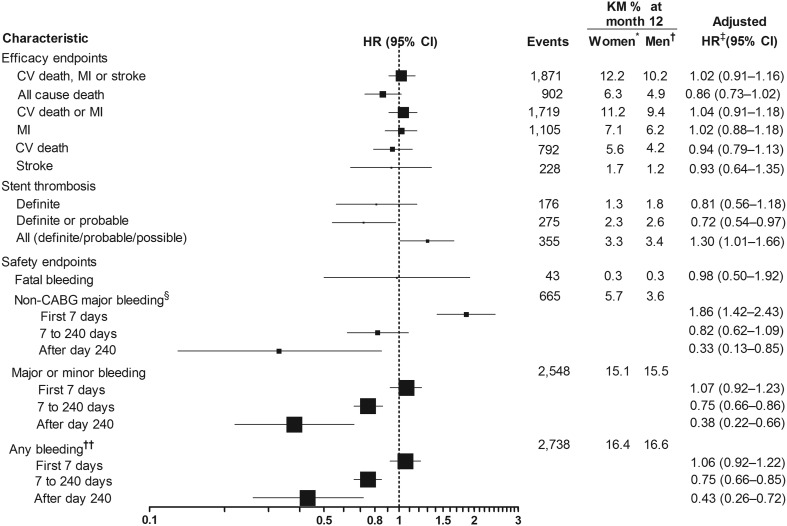
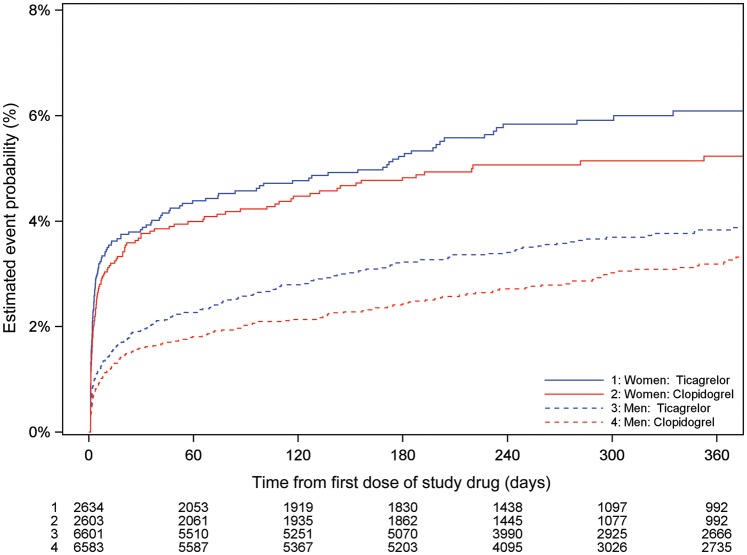
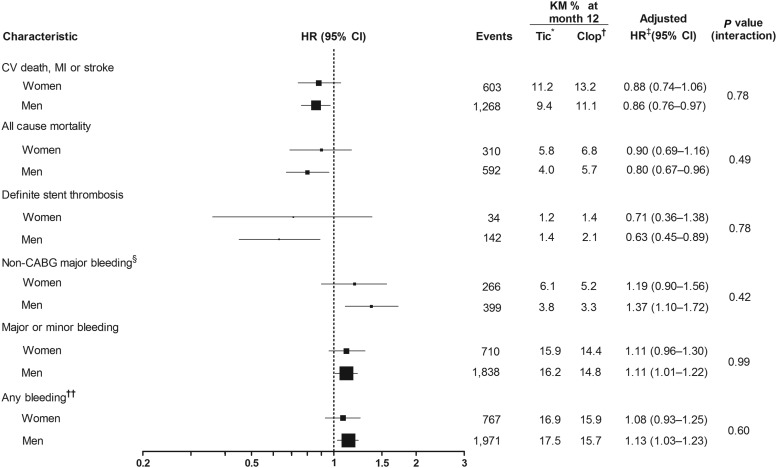
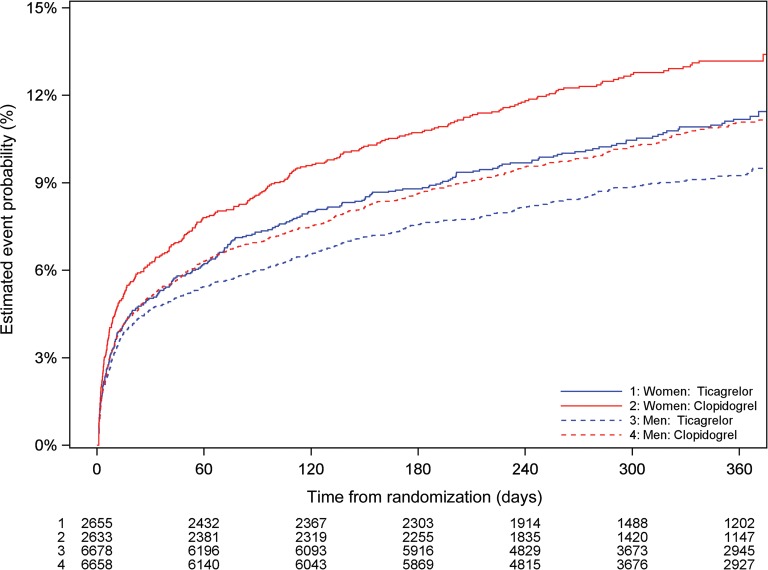
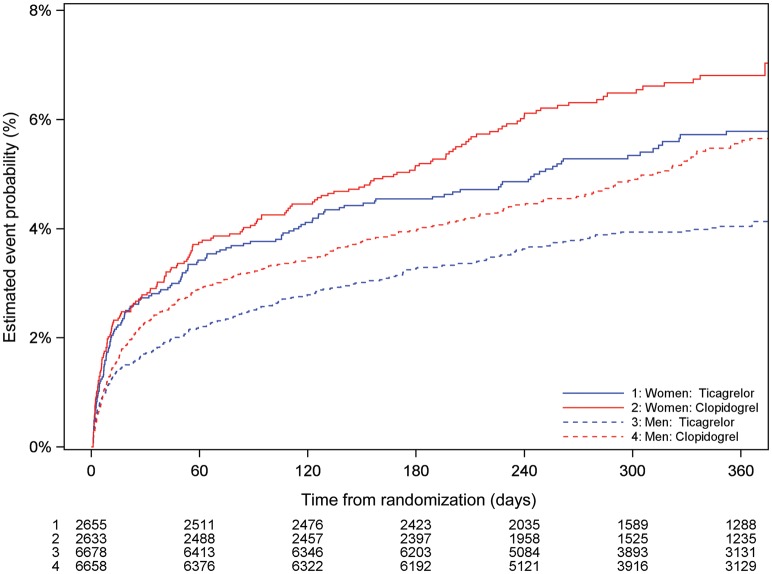
Sex was not significantly associated with the probability of the primary composite endpoint [adjusted hazard ratio (HR): 1.02 (0.91-1.16)], or other adverse cardiovascular endpoints. Ticagrelor was similarly more effective than clopidogrel in reducing rates of the primary endpoint in women 11.2 vs. 13.2% [adjusted HR: 0.88 (0.74-1.06)] and men 9.4 vs. 11.1% [adjusted HR: 0.86 (0.76-0.97)] (interaction P-value 0.78), all-cause death in women 5.8 vs. 6.8% [adjusted HR: 0.90 (0.69-1.16)] and men 4.0 vs. 5.7% [adjusted HR: 0.80 (0.67-0.96)] (interaction P-value 0.49), and definite stent thrombosis in women 1.2 vs. 1.4% [adjusted HR: 0.71 (0.36-1.38)] and men 1.4 vs. 2.1% [adjusted HR: 0.63 (0.45-0.89)] (interaction P-value 0.78). The treatments did not differ for PLATO-defined overall major bleeding complications in women [adjusted HR: 1.01 (0.83-1.23)] or men [adjusted HR: 1.10 (0.98-1.24)]. Sex had no significant association with these outcomes (interactions P = 0.43-0.88).
Female sex is not an independent risk factor for adverse clinical outcomes in moderate-to-high risk ACS patients. Ticagrelor has a similar efficacy and safety profile in men and women.
本研究旨在评估在血小板抑制和患者预后(PLATO)试验中,随机接受替格瑞洛或氯吡格雷治疗的ST段抬高型或非ST段抬高型急性冠状动脉综合征(ACS)患者的性别与临床结局及治疗相关并发症之间的关系。
使用Cox比例风险模型分析性别亚组与主要复合结局、次要结局和主要出血终点之间的关联,以及性别亚组与治疗效果的相互作用。
性别与主要复合终点的发生概率[调整后风险比(HR):1.02(0.91 - 1.16)]或其他不良心血管终点无显著关联。替格瑞洛在降低女性主要终点发生率方面同样比氯吡格雷更有效(11.2%对13.2%)[调整后HR:0.88(0.74 - 1.06)],男性为9.4%对11.1%[调整后HR:0.86(0.76 - 0.97)](相互作用P值0.78);女性全因死亡率为5.8%对6.8%[调整后HR:0.90(0.69 - 1.16)],男性为4.0%对5.7%[调整后HR:0.80(0.67 - 0.96)](相互作用P值0.49);女性明确支架血栓形成率为1.2%对1.4%[调整后HR:0.71(0.36 - 1.38)],男性为1.4%对2.1%[调整后HR:0.63(0.45 - 0.89)](相互作用P值0.78)。替格瑞洛和氯吡格雷在女性[调整后HR:1.01(0.83 - 1.23)]和男性[调整后HR:1.10(0.98 - 1.24)]中,PLATO定义的总体主要出血并发症方面无差异。性别与这些结局无显著关联(相互作用P值 = 0.43 - 0.88)。
女性并非中高危ACS患者不良临床结局的独立危险因素。替格瑞洛在男性和女性中具有相似的疗效和安全性。