Rokhlenko Yekaterina, Cadet Jean, Geacintov Nicholas E, Shafirovich Vladimir
Chemistry Department, New York University , 31 Washington Place, New York, New York 10003-5180, United States.
J Am Chem Soc. 2014 Apr 23;136(16):5956-62. doi: 10.1021/ja412471u. Epub 2014 Apr 15.
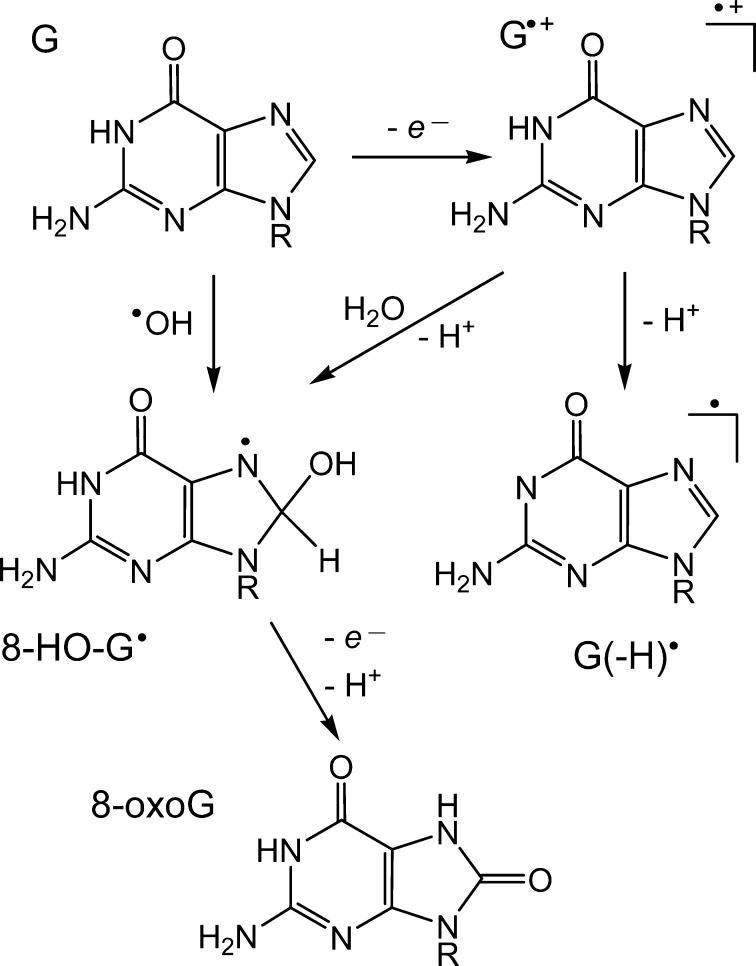
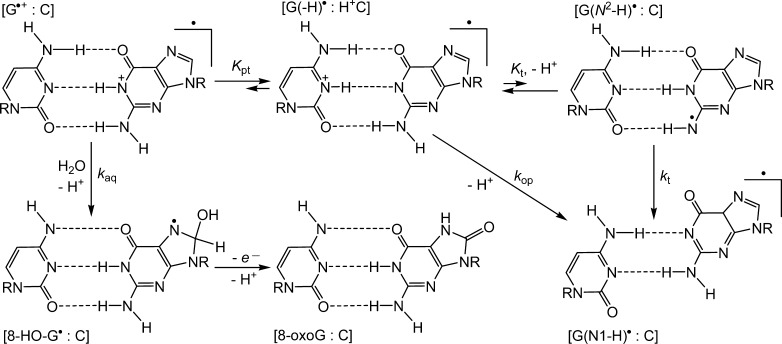
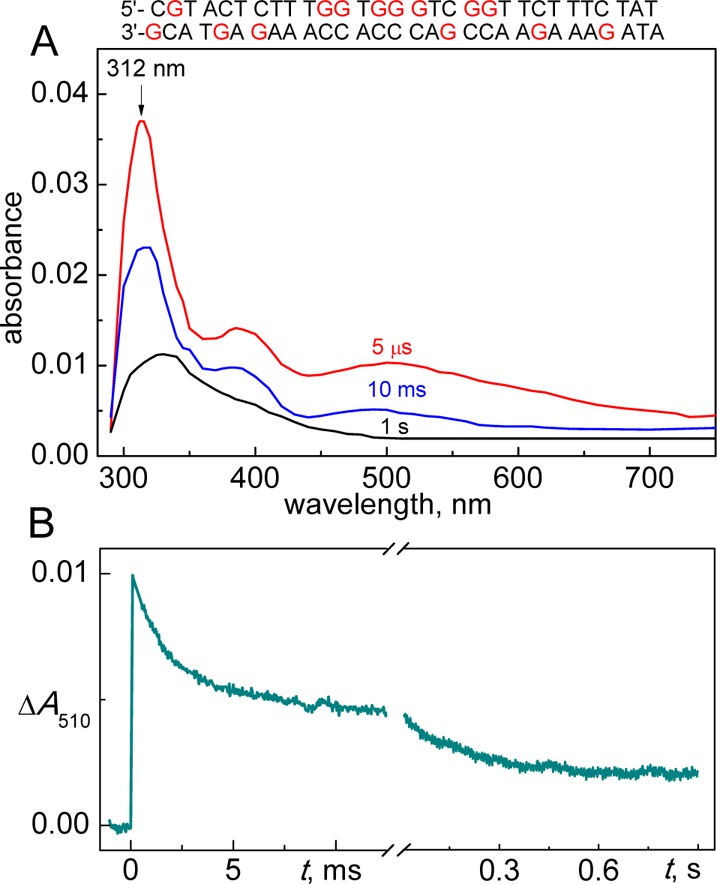
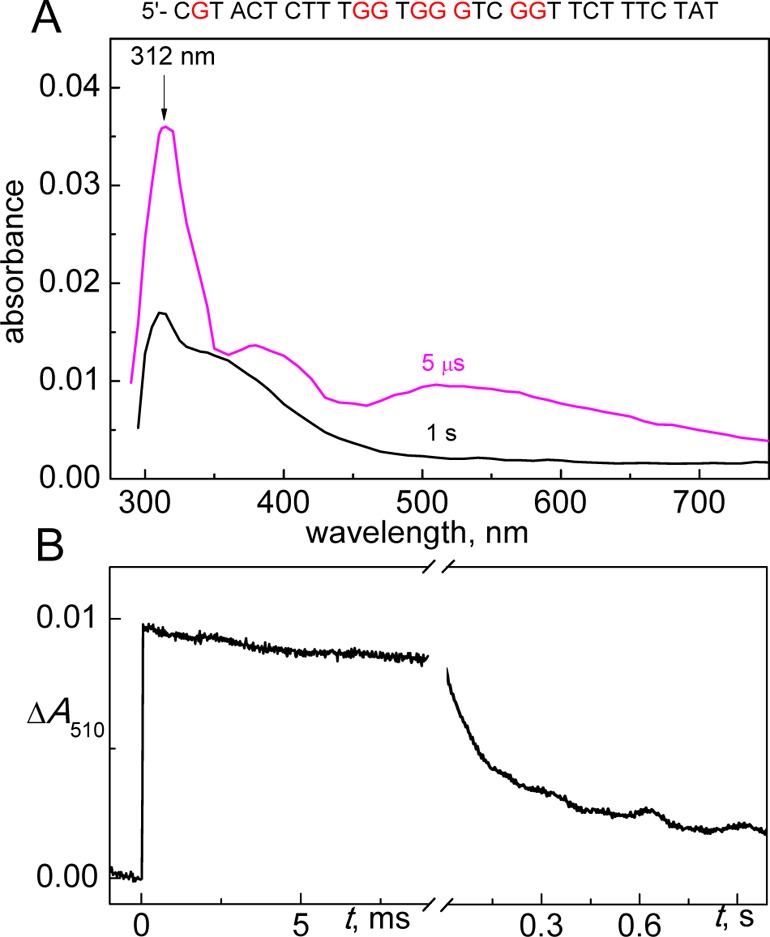
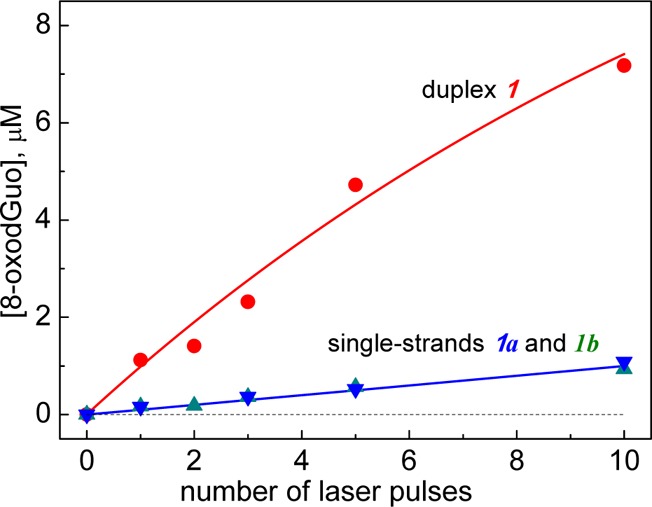
The mechanistic aspects of hydration of guanine radical cations, G(•+) in double- and single-stranded oligonucleotides were investigated by direct time-resolved spectroscopic monitoring methods. The G(•+) radical one-electron oxidation products were generated by SO4(•-) radical anions derived from the photolysis of S2O8(2-) anions by 308 nm laser pulses. In neutral aqueous solutions (pH 7.0), after the complete decay of SO4(•-) radicals (∼5 μs after the actinic laser flash) the transient absorbance of neutral guanine radicals, G(-H)(•) with maximum at 312 nm, is dominant. The kinetics of decay of G(-H)(•) radicals depend strongly on the DNA secondary structure. In double-stranded DNA, the G(-H)(•) decay is biphasic with one component decaying with a lifetime of ∼2.2 ms and the other with a lifetime of ∼0.18 s. By contrast, in single-stranded DNA the G(-H)(•) radicals decay monophasically with a ∼ 0.28 s lifetime. The ms decay component in double-stranded DNA is correlated with the enhancement of 8-oxo-7,8-dihydroguanine (8-oxoG) yields which are ∼7 greater than in single-stranded DNA. In double-stranded DNA, it is proposed that the G(-H)(•) radicals retain radical cation character by sharing the N1-proton with the N3-site of C in the [G(•+):C] base pair. This [G(-H)(•):H(+)C ⇆ G(•+):C] equilibrium allows for the hydration of G(•+) followed by formation of 8-oxoG. By contrast, in single-stranded DNA, deprotonation of G(•+) and the irreversible escape of the proton into the aqueous phase competes more effectively with the hydration mechanism, thus diminishing the yield of 8-oxoG, as observed experimentally.
通过直接的时间分辨光谱监测方法,研究了双链和单链寡核苷酸中鸟嘌呤自由基阳离子G(•+)水合作用的机制。G(•+)自由基单电子氧化产物由308 nm激光脉冲光解S2O8(2-)阴离子产生的SO4(•-)自由基阴离子生成。在中性水溶液(pH 7.0)中,SO4(•-)自由基完全衰减后(光化激光闪光后约5 μs),在312 nm处有最大吸收的中性鸟嘌呤自由基G(-H)(•)的瞬态吸收占主导。G(-H)(•)自由基的衰减动力学强烈依赖于DNA二级结构。在双链DNA中,G(-H)(•)衰减是双相的,一个组分的寿命约为2.2 ms,另一个组分的寿命约为0.18 s。相比之下,在单链DNA中,G(-H)(•)自由基以约0.28 s的寿命单相衰减。双链DNA中ms衰减组分与8-氧代-7,8-二氢鸟嘌呤(8-oxoG)产率的增加相关,其产率比单链DNA中约高7倍。在双链DNA中,有人提出G(-H)(•)自由基通过与[G(•+):C]碱基对中C的N3位点共享N1-质子而保留自由基阳离子特征。这种[G(-H)(•):H(+)C ⇆ G(•+):C]平衡允许G(•+)水合,随后形成8-oxoG。相比之下,在单链DNA中,G(•+)的去质子化以及质子不可逆地逸入水相与水合机制更有效地竞争,从而降低了8-oxoG的产率,如实验观察到的那样。