Shei Amie, Costa Federico, Reis Mitermayer G, Ko Albert I
Analysis Group, Inc,, 111 Huntington Avenue, 10th Floor, Boston, MA 02199, USA.
BMC Int Health Hum Rights. 2014 Apr 1;14:10. doi: 10.1186/1472-698X-14-10.
Conditional cash transfer (CCT) programs provide poor families with cash conditional on investments in health and education. Brazil's Bolsa Família program began in 2003 and is currently the largest CCT program in the world. This community-based study examines the impact of Bolsa Família on child health in a slum community in a large urban center.
In 2010, detailed household surveys were conducted with randomly selected Bolsa Família beneficiaries and non-beneficiaries in a Brazilian slum community of approximately 14,000 inhabitants in a large urban center. 567 families (with 1,266 children) were interviewed. Propensity score methods were used to control for differences between beneficiary and non-beneficiary children to estimate program impacts on health care utilization and health outcomes.
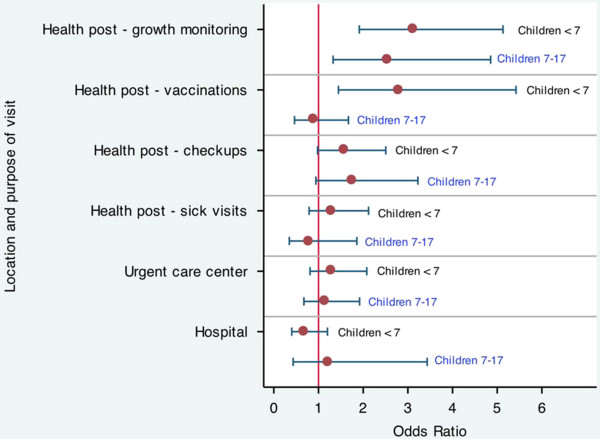
Bolsa Família has increased the odds of children's visits to the health post for preventive services. In children under age seven, Bolsa Família was associated with increased odds for growth monitoring (OR = 3.1; 95% CI 1.9-5.1), vaccinations (OR = 2.8; 95% CI 1.4-5.4), and checkups (OR = 1.6; 95% CI 0.98-2.5), and with the number of growth monitoring visits (β = 0.6; p = 0.049) and checkups (β = 0.2; p = 0.068). There were positive spillover effects on older siblings (ages 7-17) no longer required to meet the health conditionalities. Bolsa Família increased their odds for growth monitoring (OR = 2.5; 95% CI 1.3-4.9) and checkups (OR = 1.7; 95% CI 0.9-3.2) and improved psychosocial health (β = 2.6; p = 0.007).
Bolsa Família has improved health care utilization, especially for services related to the health conditionalites, and there were positive spillover effects on older siblings. The findings of this study are promising, but they also suggest that further improvements in health may depend on the quality of health care services provided, the scope of services linked to the health conditionalities, and coordination with other social safety net programs.
有条件现金转移支付(CCT)项目向贫困家庭提供现金,但条件是这些家庭要在健康和教育方面进行投入。巴西的“家庭补助金”项目始于2003年,目前是世界上最大的CCT项目。这项基于社区的研究考察了“家庭补助金”项目对一个大型城市中心贫民窟社区儿童健康的影响。
2010年,在一个约有14000名居民的巴西大型城市中心贫民窟社区,对随机选取的“家庭补助金”项目受益家庭和非受益家庭进行了详细的家庭调查。共访谈了567个家庭(有1266名儿童)。采用倾向得分法来控制受益儿童和非受益儿童之间的差异,以评估该项目对医疗服务利用和健康结果的影响。
“家庭补助金”项目增加了儿童前往卫生站接受预防服务的几率。在7岁以下儿童中,“家庭补助金”项目与生长监测(比值比[OR]=3.1;95%置信区间[CI]为1.9 - 5.1)、疫苗接种(OR = 2.8;95% CI为1.4 - 5.4)以及体检(OR = 1.6;95% CI为0.98 - 2.5)几率的增加相关,还与生长监测就诊次数(β = 0.6;p = 0.049)和体检次数(β = 0.2;p = 0.068)相关。对不再需要满足健康条件的年长兄弟姐妹(7 - 17岁)有积极的溢出效应。“家庭补助金”项目增加了他们进行生长监测(OR = 2.5;95% CI为1.3 - 4.9)和体检(OR = 1.7;95% CI为0.9 - 3.2)的几率,并改善了心理社会健康(β = 2.6;p = 0.007)。
“家庭补助金”项目改善了医疗服务利用情况,尤其是与健康条件相关的服务,并且对年长兄弟姐妹有积极的溢出效应。本研究的结果很有前景,但也表明健康状况的进一步改善可能取决于所提供医疗服务的质量、与健康条件相关的服务范围以及与其他社会安全网项目的协调。