Instituto de Pesquisa Clínica Evandro Chagas, Fundação Oswaldo Cruz, Rio de Janeiro, Brasil.
Instituto de Pesquisa Clínica Evandro Chagas, Fundação Oswaldo Cruz, Rio de Janeiro, Brasil; Departamento de Matemática e Estatística, Universidade Federal do Estado do Rio de Janeiro, Rio de Janeiro, Brasil.
PLoS One. 2014 Apr 2;9(4):e93039. doi: 10.1371/journal.pone.0093039. eCollection 2014.
There is a continuous debate on how to adequately evaluate long-term CD4+ cell count in response to combination antiretroviral therapy (ART) among human immunodeficiency virus (HIV)-infected individuals. Our study evaluated the long-term CD4+ cell count response (up to ten years) after initiation of ART and described the differences in the CD4+ cell count response stratified by pretreatment CD4+ cell count, and other socio-demographic, behavioral, and clinical factors.
The study population included patients starting ART in the clinical cohorts of Rio de Janeiro, Brazil, and Baltimore, United States. Inverse probability of censoring weighting was used to estimate mean annual CD4+ cell counts while adjusting for choice of initial ART regimen, ART discontinuation and losses-to-follow-up.
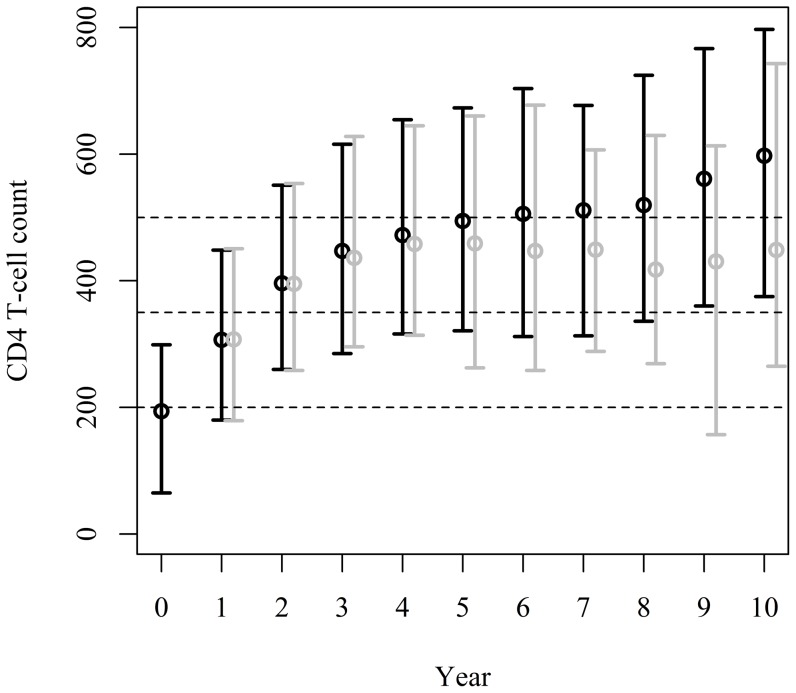
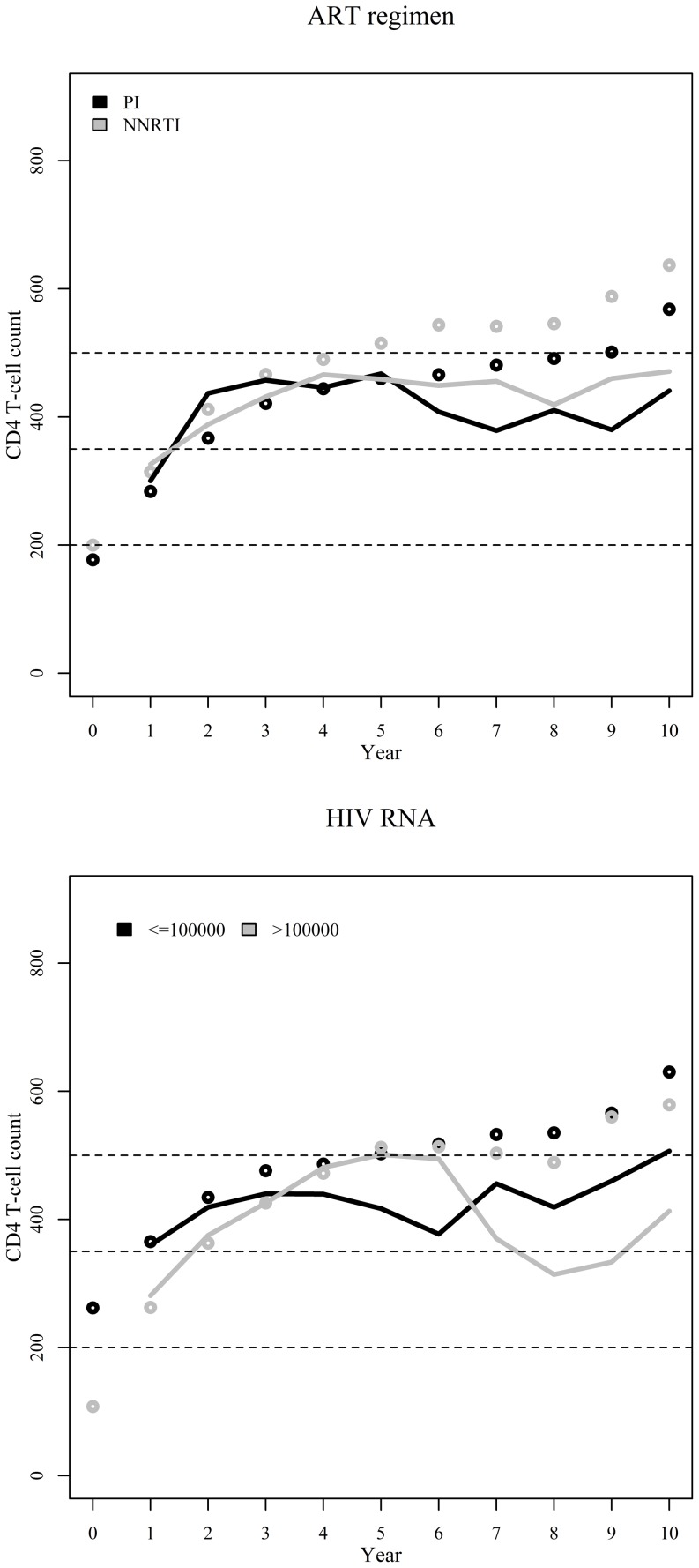
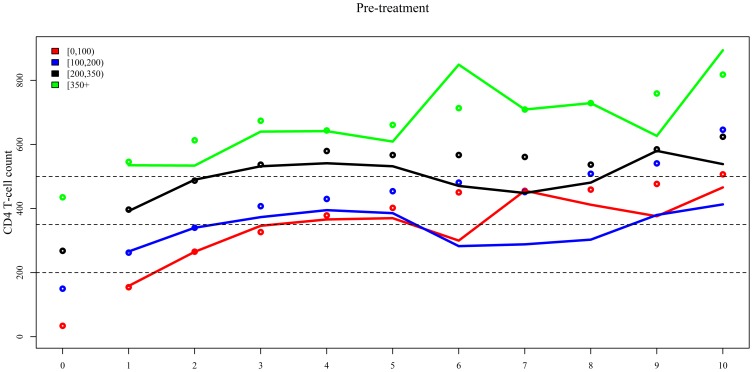
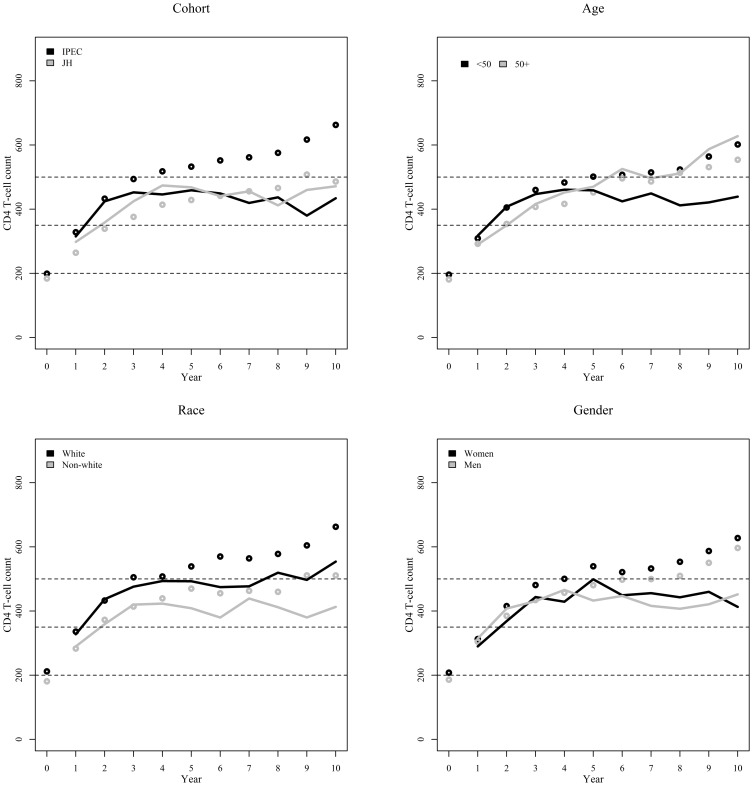
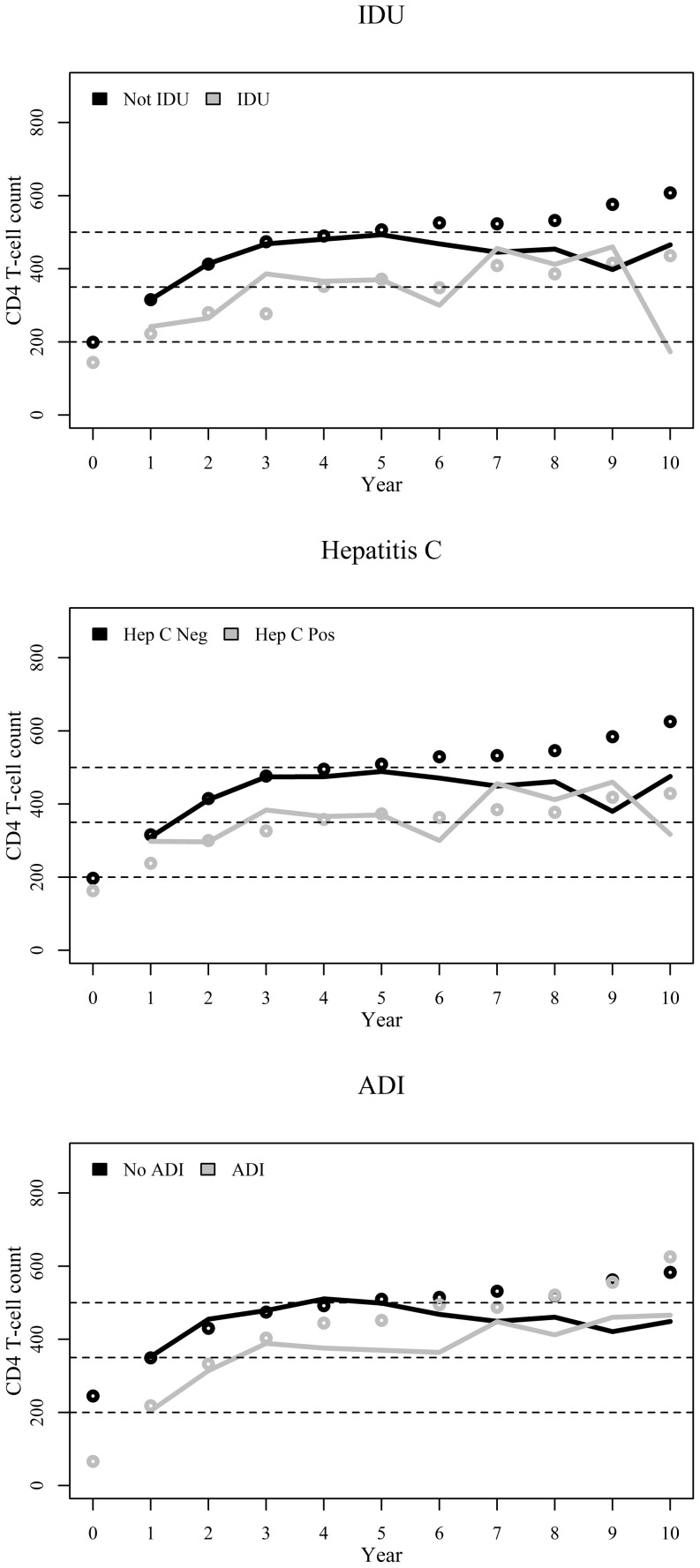
From 1997 to 2011, 3116 individuals started ART; preferred initial regimen was NNRTI-based (63%). The median follow-up time was 5 years, 10% of the individuals had nine or more years of follow-up. Observed CD4+ cell counts increased throughout the ten years of follow-up. Weighted results, in contrast, increased up to year four and plateaued thereafter with 50% of the population reaching CD4+ cell counts of 449/μL or more. Out of all stratification variables considered, only individuals with pre-treatment CD4+ cell counts ≥350/μL showed increasing CD4+ cell counts over time with 76% surpassing the CD4+ cell count >500/μL threshold at year ten.
The present study corroborates the growing body of knowledge advocating early start of ART by showing that only patients who start ART early fully recover to normal CD4+ cell counts.
在接受抗逆转录病毒疗法(ART)的艾滋病毒(HIV)感染者中,如何充分评估长期 CD4+细胞计数存在持续争议。我们的研究评估了开始 ART 后长达十年的长期 CD4+细胞计数反应,并描述了按预处理 CD4+细胞计数和其他社会人口统计学、行为和临床因素分层的 CD4+细胞计数反应差异。
研究人群包括在巴西里约热内卢和美国巴尔的摩的临床队列中开始接受 ART 的患者。使用逆概率 censoring 加权来估计平均每年的 CD4+细胞计数,同时调整初始 ART 方案的选择、ART 停药和随访损失。
1997 年至 2011 年,有 3116 人开始接受 ART;首选初始方案为基于 NNRTI(63%)。中位随访时间为 5 年,10%的患者随访时间超过 9 年。观察到的 CD4+细胞计数在整个十年的随访中逐渐增加。相比之下,加权结果在第四年增加并在此后趋于平稳,50%的人群达到 CD4+细胞计数≥449/μL。在所考虑的所有分层变量中,只有预处理 CD4+细胞计数≥350/μL 的个体显示随着时间的推移 CD4+细胞计数增加,76%的个体在第 10 年超过 CD4+细胞计数>500/μL 的阈值。
本研究通过表明只有早期开始 ART 的患者才能完全恢复正常的 CD4+细胞计数,证实了越来越多的主张早期开始 ART 的知识体系。