Center for Biostatistics in AIDS Research, Department of Biostatistics, Harvard School of Public Health, Boston, Massachusetts 02115, USA.
AIDS. 2010 Jul 31;24(12):1867-76. doi: 10.1097/QAD.0b013e32833adbcf.
To inform guidelines concerning when to initiate combination antiretroviral therapy (ART), we investigated whether CD4(+) T-cell counts (CD4 cell counts) continue to increase over long periods of time on ART. Losses-to-follow-up and some patients discontinuing ART at higher CD4 cell counts hamper such evaluation, but novel statistical methods can help address these issues. We estimated the long-term CD4 cell count trajectory accounting for losses-to-follow-up and treatment discontinuations.
The study population included 898 US patients first initiating ART in a randomized trial (AIDS Clinical Trials Group 384); 575 were subsequently prospectively followed in an observational study (AIDS Clinical Trials Group Longitudinal Linked Randomized Trials).
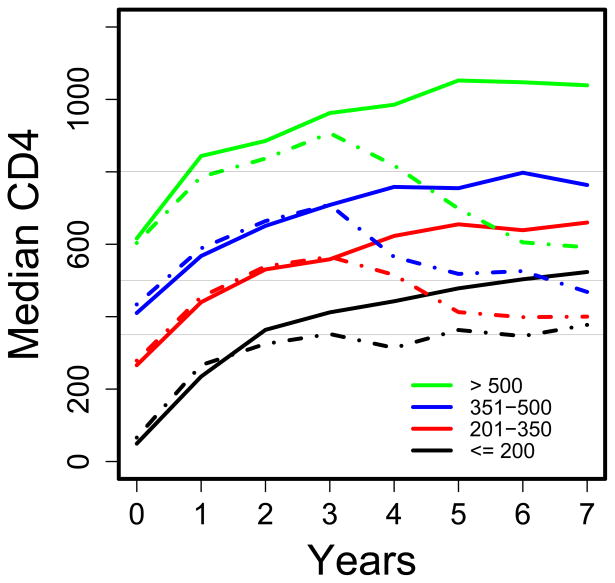
Inverse probability of censoring weighting statistical methods were used to estimate the CD4 cell count trajectory accounting for losses-to-follow-up and ART discontinuations, overall and for pretreatment CD4 cell count categories (<or=200, 201-350, 351-500, and >500 cells/microl).
Median CD4 cell count increased from 270 cells/microl pre-ART to an estimated 556 cells/microl at 3 and 532 cells/microl at 7 years after starting ART in analyses ignoring treatment discontinuations, and to 570 and 640 cells/microl, respectively, had all patients continued ART. However, even had ART been continued, an estimated 25, 9, 3, and 2% of patients with pretreatment CD4 cell counts of 200 or less, 201-350, 351-500, and more than 500 cells/microl would have had CD4 cell counts of 350 cells/microl or less after 7 years.
If patients remain on ART, CD4 cell counts increase in most patients for at least 7 years. However, the substantial percentage of patients starting therapy at low CD4 cell counts who still had low CD4 cell counts after 7 years provides support for ART initiation at higher CD4 cell counts.
为了制定启动联合抗逆转录病毒治疗(ART)的相关指导原则,我们研究了在接受 ART 治疗的过程中 CD4(+)T 细胞计数(CD4 细胞计数)是否会持续长时间增加。失访和部分患者在较高 CD4 细胞计数时停止 ART 治疗会妨碍对此类评估,但新的统计方法可以帮助解决这些问题。我们估计了长期 CD4 细胞计数轨迹,考虑了失访和治疗中断的情况。
研究人群包括 898 名在美国参与随机试验(艾滋病临床试验组 384 号)的首次接受 ART 的患者;其中 575 名患者随后在一项观察性研究(艾滋病临床试验组纵向链接随机试验)中进行了前瞻性随访。
使用逆概率 censoring 加权统计方法来估计 CD4 细胞计数轨迹,考虑了失访和 ART 中断的情况,以及针对治疗前 CD4 细胞计数分类(<=200、201-350、351-500 和 >500 个/μl)的情况。
在分析中忽略治疗中断的情况下,ART 治疗前 CD4 细胞计数中位数从 270 个/μl 增加到开始 ART 后 3 年的 556 个/μl 和 7 年的 532 个/μl,而如果所有患者都继续接受 ART,估计分别为 570 和 640 个/μl。然而,即使继续接受 ART 治疗,估计仍有 25%、9%、3%和 2%的治疗前 CD4 细胞计数为 200 个/μl 或更低、201-350 个/μl、351-500 个/μl 和大于 500 个/μl 的患者在 7 年后的 CD4 细胞计数仍为 350 个/μl 或更低。
如果患者继续接受 ART 治疗,大多数患者的 CD4 细胞计数会在至少 7 年内增加。然而,大量治疗前 CD4 细胞计数较低的患者在 7 年后仍有较低的 CD4 细胞计数,这为在较高 CD4 细胞计数时启动 ART 治疗提供了支持。