Aziz Rukhsanda, Rafiq M T, Yang Jie, Liu Di, Lu Lingli, He Zhenli, Daud M K, Li Tingqiang, Yang Xiaoe
Ministry of Education Key, Laboratory of Environmental Remediation and Ecological Health, College of Environmental and Resource Sciences, Zhejiang University, Hangzhou 310058, China.
Ministry of Education Key, Laboratory of Environmental Remediation and Ecological Health, College of Environmental and Resource Sciences, Zhejiang University, Hangzhou 310058, China ; Department of Environmental Sciences, International Islamic University, Islamabad 44000, Pakistan.
Biomed Res Int. 2014;2014:839538. doi: 10.1155/2014/839538. Epub 2014 Feb 16.
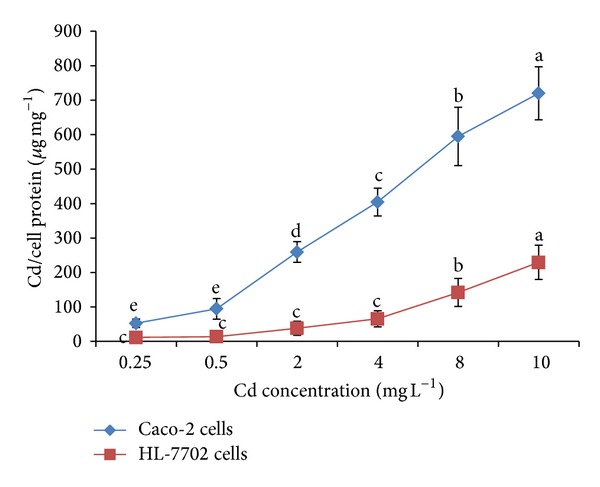
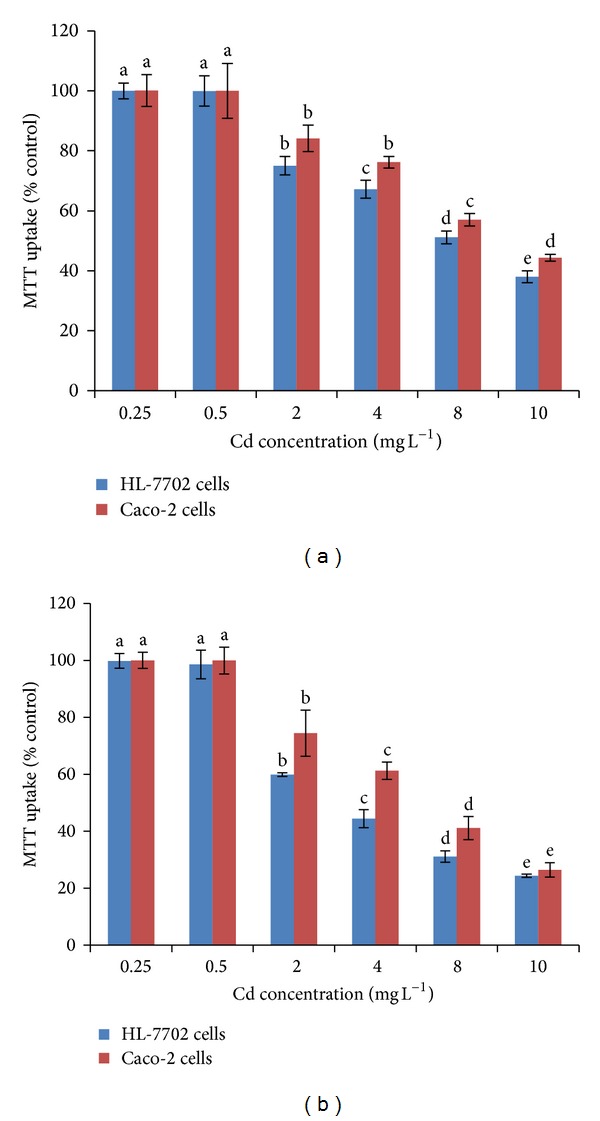
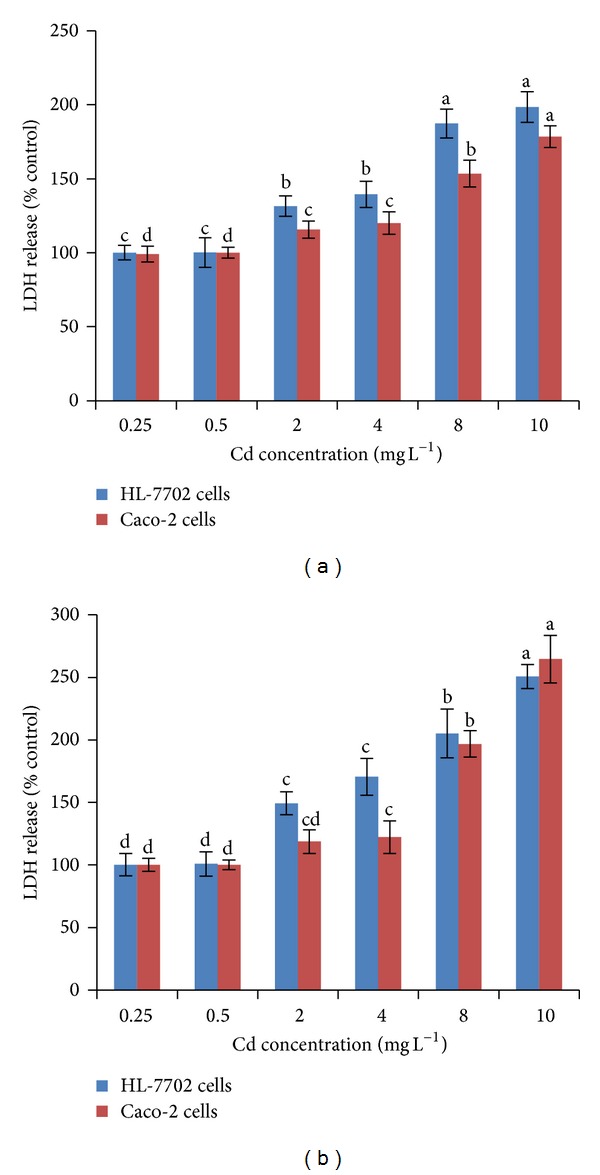
Cadmium (Cd) is a widespread environmental toxic contaminant, which causes serious health-related problems. In this study, human intestinal cell line (Caco-2 cells) and normal human liver cell line (HL-7702 cells) were used to investigate the toxicity and bioavailability of Cd to both cell lines and to validate these cell lines as in vitro models for studying Cd accumulation and toxicity in human intestine and liver. Results showed that Cd uptake by both cell lines increased in a dose-dependent manner and its uptake by Caco-2 cells (720.15 µg mg(-1) cell protein) was significantly higher than HL-7702 cells (229.01 µg mg(-1) cell protein) at 10 mg L(-1). A time- and dose-dependent effect of Cd on cytotoxicity assays (LDH release, MTT assay) was observed in both Cd-treated cell lines. The activities of antioxidant enzymes and differentiation markers (SOD, GPX, and AKP) of the HL-7702 cells were higher than those of Caco-2 cells, although both of them decreased significantly with raising Cd levels. The results from the present study indicate that Cd above a certain level inhibits cellular antioxidant activities and HL-7702 cells are more sensitive to Cd exposure than Caco-2 cells. However, Cd concentrations <0.5 mg L(-1) pose no toxic effects on both cell lines.
镉(Cd)是一种广泛存在的环境有毒污染物,会引发严重的健康相关问题。在本研究中,使用人肠道细胞系(Caco-2细胞)和正常人肝细胞系(HL-7702细胞)来研究镉对这两种细胞系的毒性和生物利用度,并验证这些细胞系作为体外模型用于研究镉在人肠道和肝脏中的积累及毒性。结果表明,两种细胞系对镉的摄取均呈剂量依赖性增加,在10 mg L(-1)时,Caco-2细胞对镉的摄取量(720.15 µg mg(-1)细胞蛋白)显著高于HL-7702细胞(229.01 µg mg(-1)细胞蛋白)。在两种经镉处理的细胞系中均观察到镉对细胞毒性测定(乳酸脱氢酶释放、MTT测定)的时间和剂量依赖性效应。HL-7702细胞的抗氧化酶和分化标志物(超氧化物歧化酶、谷胱甘肽过氧化物酶和碱性磷酸酶)的活性高于Caco-2细胞,尽管随着镉水平的升高两者均显著降低。本研究结果表明,超过一定水平的镉会抑制细胞抗氧化活性,且HL-7702细胞比Caco-2细胞对镉暴露更敏感。然而,镉浓度<0.5 mg L(-1)对两种细胞系均无毒性作用。