Central Virology Laboratory, Ministry of Health, Chaim Sheba Medical Center, Ramat-Gan, Israel; The Mina & Everard Goodman Faculty of Life Sciences, Bar-Ilan University, Ramat-Gan, Israel.
Influenza Other Respir Viruses. 2014 Jul;8(4):422-30. doi: 10.1111/irv.12249. Epub 2014 Apr 4.
A(H1N1)pdm09, a new influenza pandemic virus emerged in 2009. The A(H1N1)pdm09 infection had several unique characteristics which included rapid transmissibility and high morbidity in obese individuals, pregnant women and individuals suffering from chronic diseases.
To study the relationships between A(H1N1)pdm09 influenza infection and infections with other respiratory viruses such as respiratory syncytial virus (RSV), human metapneumo virus (hMPV), adenovirus and seasonal influenza.
Samples (nasopharyngeal swabs or aspirates) collected between 2007 until 2012 from patients of various ages that were hospitalized due to respiratory virus infections were analyzed for the presence of various respiratory viruses, using qRT-PCR.
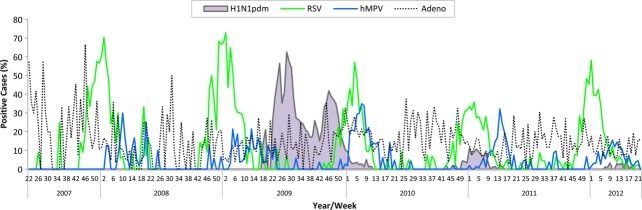
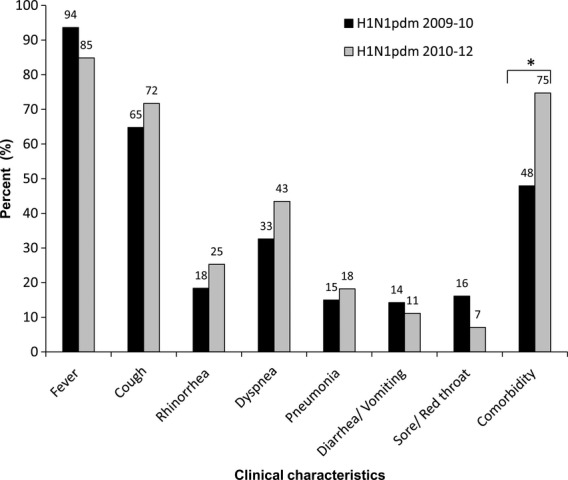
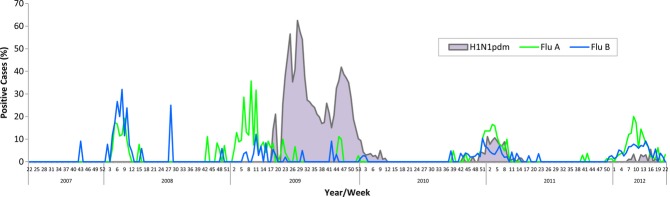
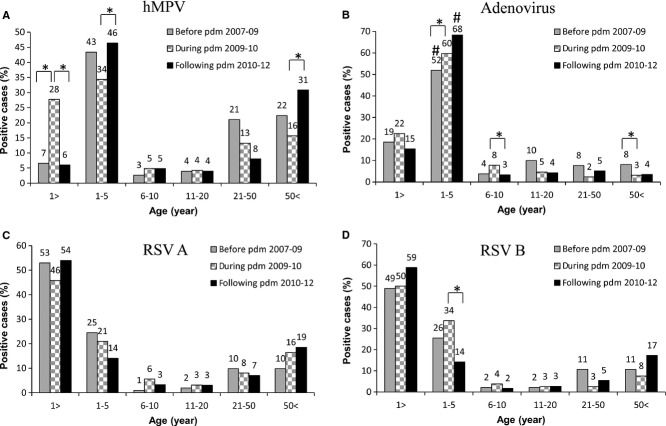
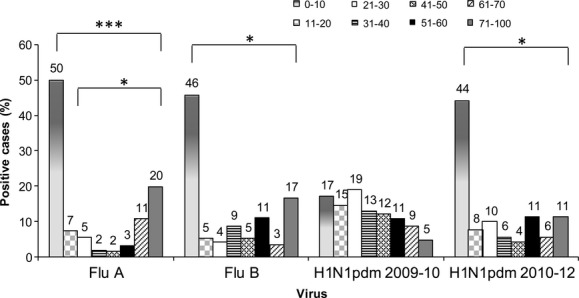
In 2009-2010, when the pandemic influenza A(H1N1)pdm09 first appeared, two major infection peaks were noted and individuals of various ages were infected. Following the decline of the A(H1N1)pdm09 virus infection, the percentages of patients infected with adenovirus and hMPV increased, while infection frequency with RSV B and with seasonal influenza virus decreased. Furthermore, RSV infections were delayed and very few percentages of patients were co-infected with more than one virus. Interestingly, the A(H1N1)pdm09 virus lost its dominancy when it reappeared in the winter of 2010-2011, and at this time, only the incidence of RSV infections was affected by the A(H1N1)pdm09 virus.
The A(H1N1)pdm09 virus had distinct effects on other respiratory viruses when it first appeared versus later, when it evolved from being a pandemic to a seasonal virus.
A(H1N1)pdm09 是一种于 2009 年出现的新型流感大流行病毒。A(H1N1)pdm09 感染具有几个独特的特征,包括在肥胖个体、孕妇和患有慢性病的个体中快速传播和高发病率。
研究 A(H1N1)pdm09 流感感染与其他呼吸道病毒(如呼吸道合胞病毒(RSV)、人偏肺病毒(hMPV)、腺病毒和季节性流感)感染之间的关系。
使用 qRT-PCR 分析了 2007 年至 2012 年间因呼吸道病毒感染住院的各种年龄患者的鼻咽拭子或抽吸物样本,以确定各种呼吸道病毒的存在。
在 2009-2010 年,当大流行的甲型 H1N1pdm09 流感首次出现时,观察到两个主要的感染高峰,各种年龄的个体都受到感染。随着 A(H1N1)pdm09 病毒感染的下降,腺病毒和 hMPV 感染的患者比例增加,而 RSV B 和季节性流感病毒的感染频率下降。此外,RSV 感染被延迟,很少有患者同时感染多种病毒。有趣的是,当 A(H1N1)pdm09 病毒在 2010-2011 年冬季再次出现时,它失去了主导地位,此时只有 RSV 感染的发病率受到 A(H1N1)pdm09 病毒的影响。
A(H1N1)pdm09 病毒在首次出现时对其他呼吸道病毒有明显的影响,而当它从大流行病毒演变为季节性病毒时,影响较小。