Department of Biology, Faculty of Science, Chiang Mai University, Chiang Mai Province, Chiang Mai, Thailand; Program of Applied Biology, Faculty of Science and Technology, Pibulsongkram Rajabhat University, Phitsanulok Province, Phitsanulok, Thailand.
Department of Biology, Faculty of Science, Chiang Mai University, Chiang Mai Province, Chiang Mai, Thailand; Applied Technology in Biodiversity Research Unit, Institute of Science and Technology, Chiang Mai University, Chiang Mai Province, Chiang Mai, Thailand.
PLoS Negl Trop Dis. 2014 Apr 3;8(4):e2778. doi: 10.1371/journal.pntd.0002778. eCollection 2014 Apr.
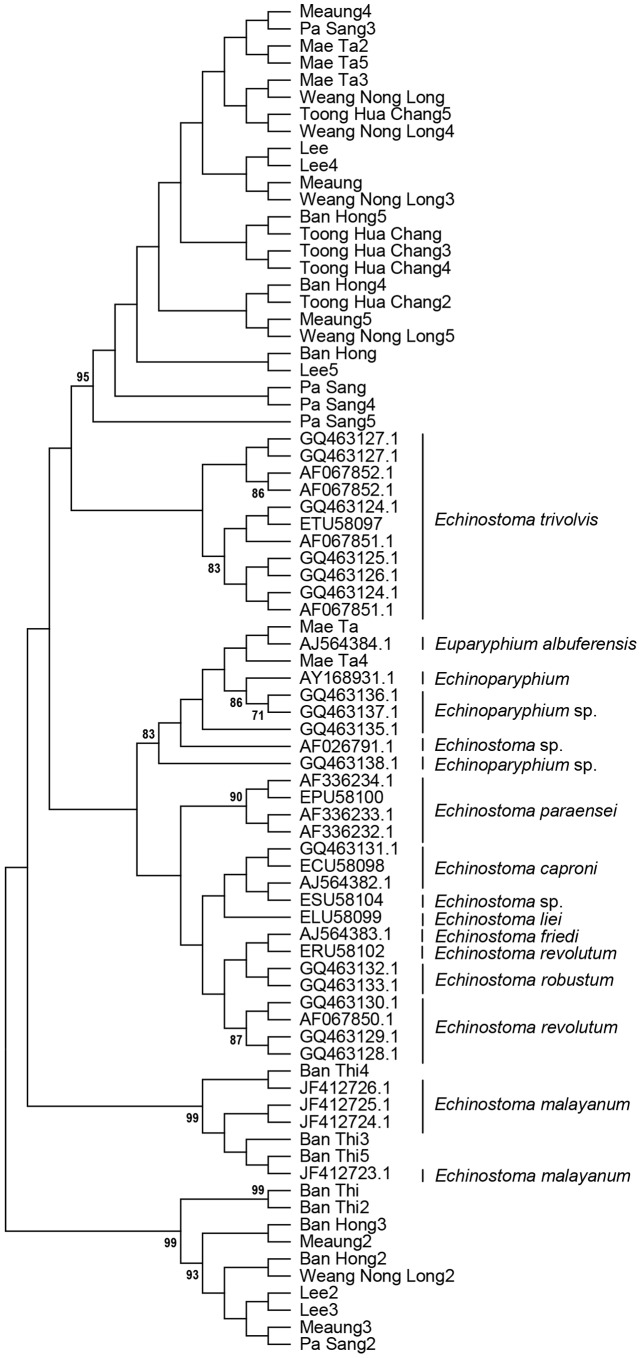
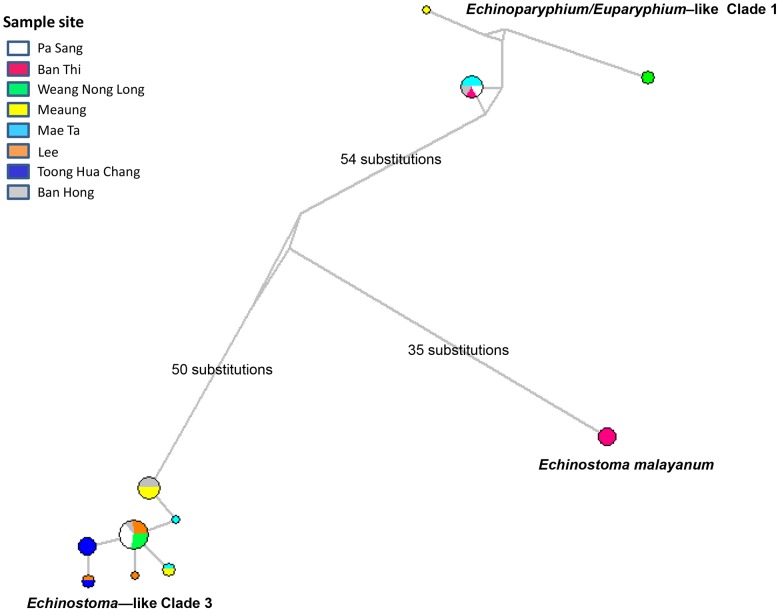
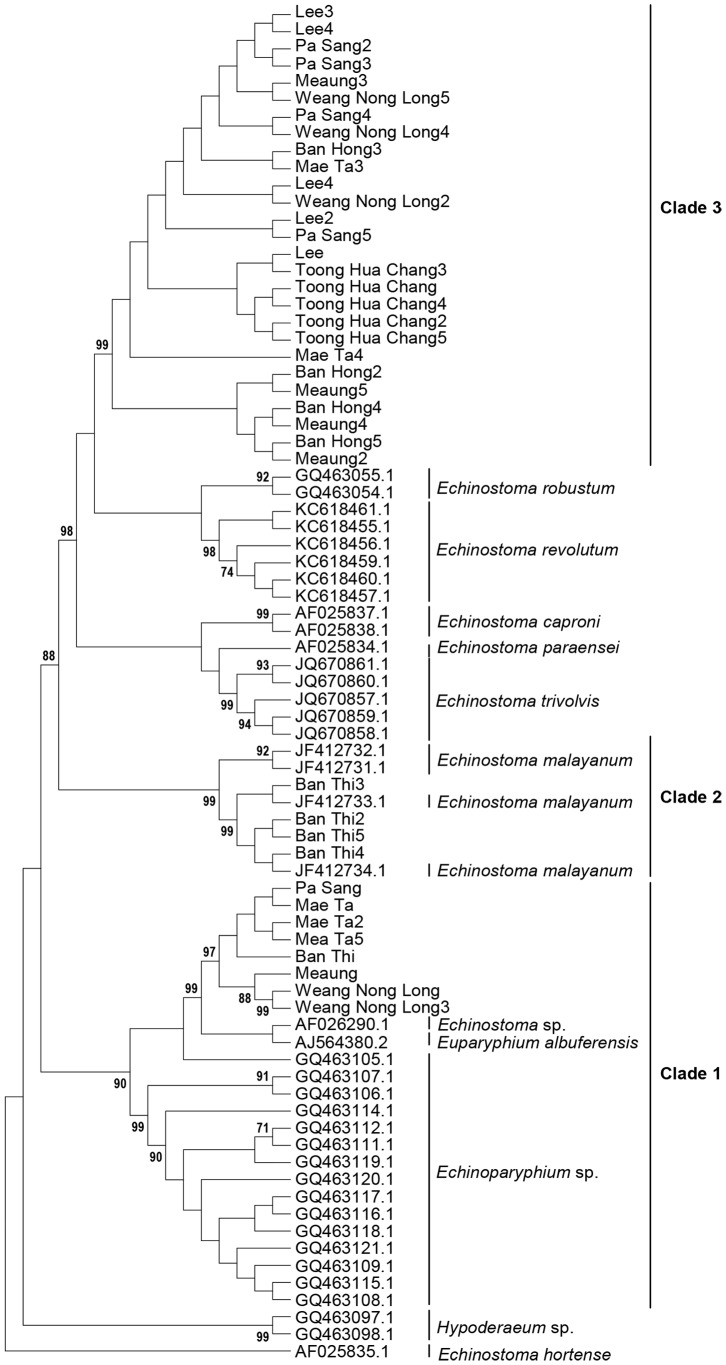
Echinostome metacercariae are the infective stage for humans and animals. The identification of echinostomes has been based until recently on morphology but molecular techniques using sequences of ribosomal RNA and mitochondrial DNA have indicated major clades within the group. In this study we have used the ITS2 region of ribosomal RNA and the ND1 region of mitochondrial DNA to identify metacercariae from snails collected from eight well-separated sites from an area of 4000 km2 in Lamphun Province, Thailand. The derived sequences have been compared to those collected from elsewhere and have been deposited in the nucleotide databases. There were two aims of this study; firstly, to determine the species of echinostome present in an endemic area, and secondly, to assess the intra-specific genetic diversity, as this may be informative with regard to the potential for the development of anthelmintic resistance and with regard to the spread of infection by the definitive hosts. Our results indicate that the most prevalent species are most closely related to E. revolutum, E. trivolvis, E. robustum, E. malayanum and Euparyphium albuferensis. Some sites harbour several species and within a site there could be considerable intra-species genetic diversity. There is no significant geographical structuring within this area. Although the molecular techniques used in this study allowed the assignment of the samples to clades within defined species, however, within these groupings there were significant differences indicating that cryptic speciation may have occurred. The degree of genetic diversity present would suggest the use of targeted regimes designed to minimise the selection of anthelmintic resistance. The apparent lack of geographic structuring is consistent with the transmission of the parasites by the avian hosts.
棘口吸虫囊蚴是人类和动物的感染阶段。直到最近,棘口吸虫的鉴定一直基于形态学,但使用核糖体 RNA 和线粒体 DNA 序列的分子技术表明,该群组内存在主要的进化枝。在这项研究中,我们使用核糖体 RNA 的 ITS2 区域和线粒体 DNA 的 ND1 区域来鉴定从泰国拉廊府一个 4000 平方公里的地区的 8 个相隔较远的地点采集的蜗牛中的囊蚴。衍生的序列已与其他地方收集的序列进行了比较,并已存入核苷酸数据库。本研究有两个目的;首先,确定在流行地区存在的棘口吸虫的种类;其次,评估种内遗传多样性,因为这可能有助于了解驱虫剂抗性的发展潜力,并有助于了解终宿主感染的传播。我们的研究结果表明,最常见的物种与 E. revolutum、E. trivolvis、E. robustum、E. malayanum 和 Euparyphium albuferensis 最为密切相关。有些地点有几种物种,而且在一个地点内可能存在相当大的种内遗传多样性。该地区没有明显的地理结构。尽管本研究中使用的分子技术允许将样本分配到定义物种内的进化枝中,但在这些分组中存在显着差异,表明可能发生了隐生种形成。目前存在的遗传多样性表明,应采用有针对性的方案来最小化驱虫剂抗性的选择。缺乏明显的地理结构与寄生虫通过鸟类宿主传播的情况一致。